Towel Warmer Guide: Types, Sizing, Energy Use, and Cost
Warm, dry towels for pennies a day, chosen and sized right.

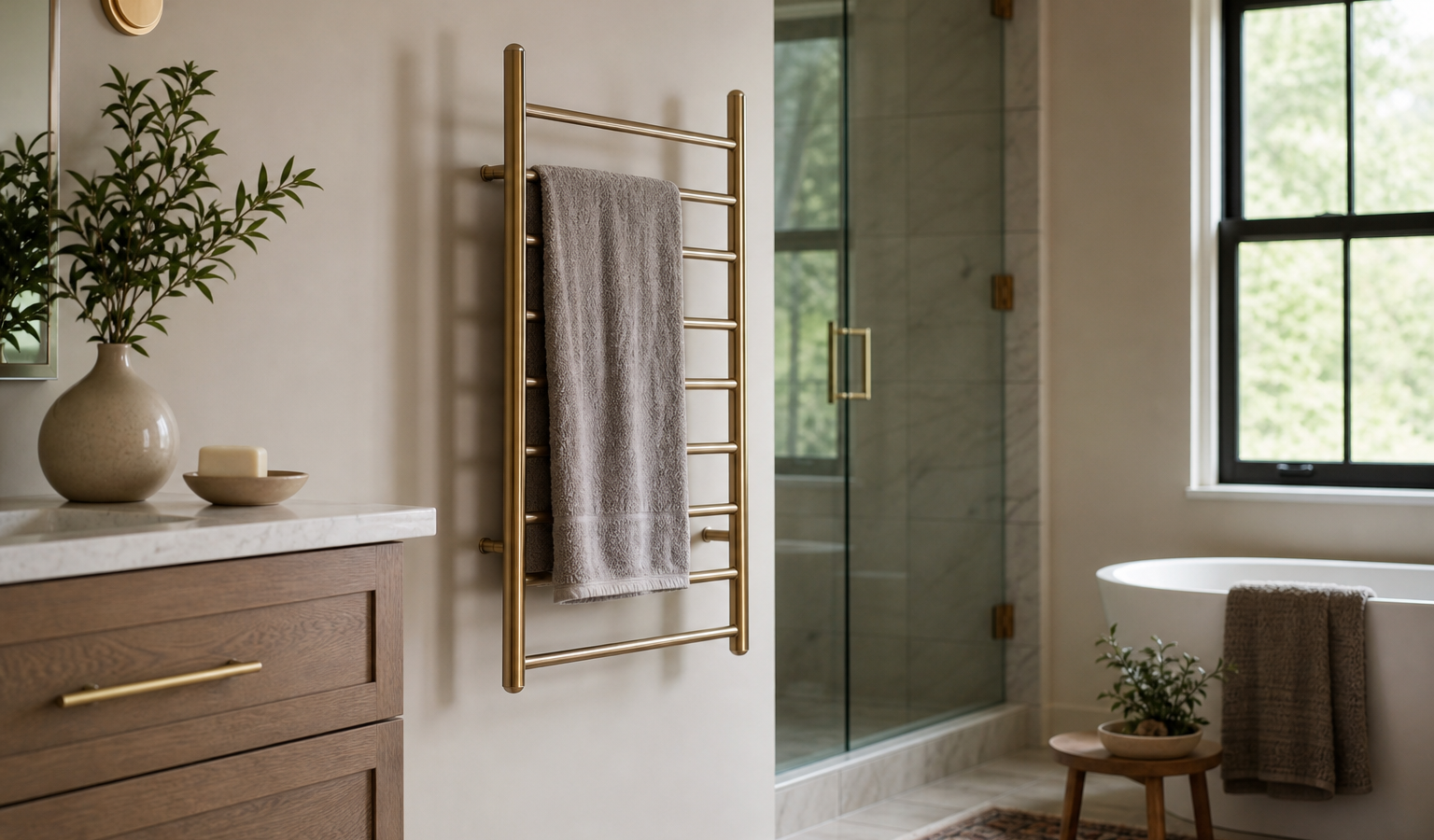
A towel warmer is the rare bathroom upgrade that feels like pure luxury yet costs just pennies a day to run. Also called a heated towel rack or towel rail, it warms and dries your towels, cuts down on the musty smell of damp cotton, and adds a little supplemental heat to the room. This guide covers the two main types, how to size and mount one, what finishes to choose, the real 2026 prices, and the small energy cost of keeping warm towels on demand.
Key takeaways
- Electric models suit almost every home; hydronic models tie into your heating system and make sense mainly during a full renovation.
- Plug-in units need only a GFCI outlet; hardwired and hydronic units need a pro and a cleaner look with no visible cord.
- Running cost is tiny: about $0.03 to $0.05 per day on a timer, or under $1.50 a month.
- Size by bar count: 4 to 6 bars for a guest bath, 7 to 10 for a primary bath, 11-plus for a family bathroom.
- Expect $100 to $500 for the unit plus $0 to $300 for installation depending on type.
What a towel warmer does and why people love them
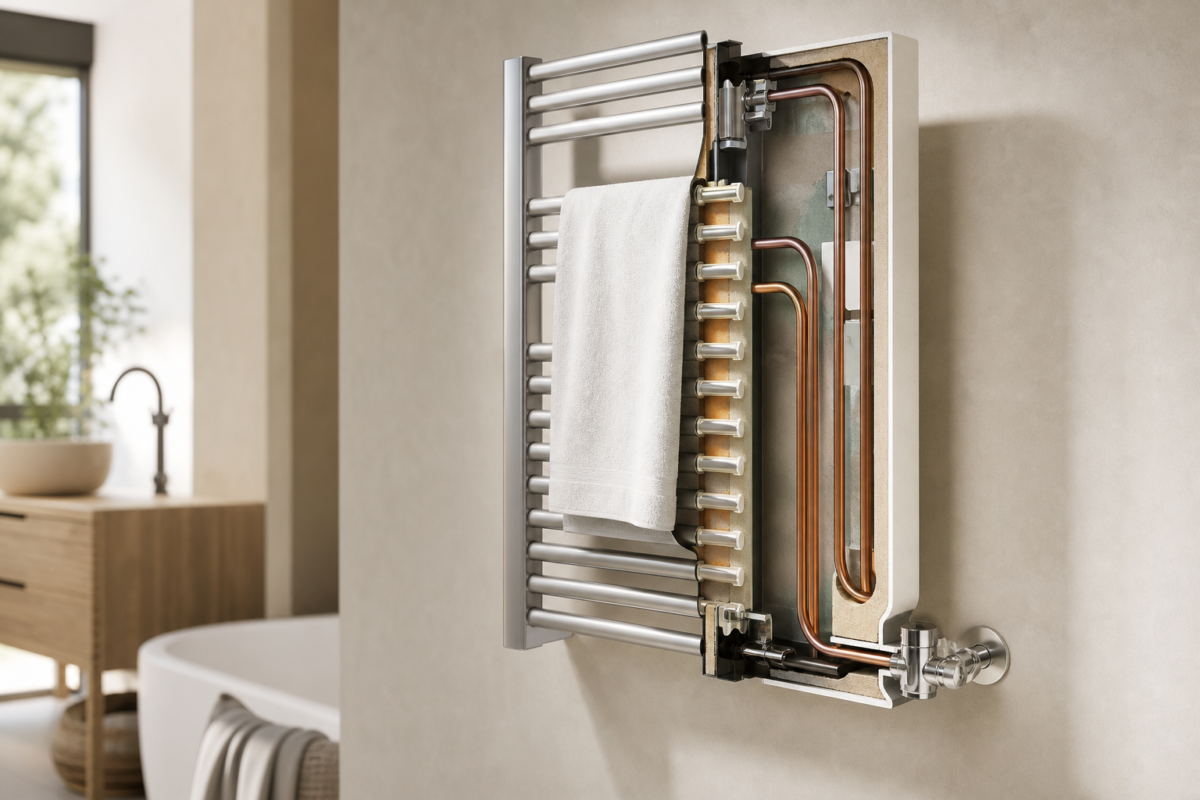
A towel warmer is a heated rack that gently raises the temperature of towels and robes, drying them between uses and delivering a warm towel when you step out of the shower. Beyond the obvious comfort, the drying action matters: a towel that dries fully between showers grows less mildew and smells fresher, and the rack adds a small amount of ambient warmth to a cold bathroom.
Owners consistently rank it among the highest-satisfaction, lowest-regret bathroom additions, which is why it appears on so many lists of worthwhile luxury bathroom upgrades. It also helps control moisture, working alongside a good bathroom exhaust fan to keep damp textiles from feeding mold. For a feature that often costs less than a mid-range faucet, the daily payoff is outsized. There is a genuine hygiene angle too: cotton that stays damp for hours in a humid bathroom is where odor-causing bacteria thrive, and a rack that keeps towels dry between uses sidesteps that cycle entirely. In colder climates, the morning warmth of a heated towel also makes the transition out of a hot shower noticeably less jarring, which is a small comfort people miss immediately when it breaks.
Electric vs hydronic towel warmers
Electric towel warmers heat with an internal element and fit nearly any home, while hydronic models circulate hot water from your boiler or water heater and make sense mainly when you are already opening walls. For most remodels, electric is the simpler, cheaper, and more flexible choice.
| Factor | Electric | Hydronic |
|---|---|---|
| How it heats | Internal electric element | Hot water from heating system |
| Installation | Plug-in or hardwired | Plumber ties into boiler loop |
| Heat-up time | Fast (15 to 20 min) | Slower; depends on boiler |
| Running cost | Very low (pennies/day) | Very efficient if system runs anyway |
| Best for | Renters, retrofits, multiple baths | Full renovations, new construction |
| Repairability | Element not usually replaceable | Element often replaceable |
Hydronic units run with no visible wiring and can be very economical in a home whose heating system is already on, but they are immobile once installed and demand professional plumbing. Electric units heat fast, go almost anywhere, and come in portable forms, at the cost of a cord or a wired connection. If you are not mid-renovation, electric is almost always the right answer.
Hardwired vs plug-in
Plug-in towel warmers need only a nearby GFCI outlet and install in minutes, while hardwired models connect directly into the wall circuit for a clean, cordless look. The choice is mostly about aesthetics and whether you are willing to hire an electrician.
When plug-in makes sense
Plug-in is ideal for renters, quick upgrades, and anyone who wants to avoid electrical work. You mount the rack, plug it into a GFCI outlet, and you are done, often in 15 to 30 minutes. The trade-off is a visible cord running to the outlet, which some people tuck behind the unit or route to a hidden receptacle.
When hardwired is worth it
Hardwiring hides the cord entirely and looks built-in, which is the better choice during a remodel when a wall is already open. It requires a licensed electrician and a GFCI-protected circuit, adding one to two hours of labor. Many premium units ship dual-connection, letting you start plug-in and convert to hardwired later.
Sizing: bar count and heat output
Match the bar count to how many towels the bathroom serves: 4 to 6 bars for a single person or guest bath, 7 to 10 for a primary bath used by a couple, and 11 or more for a busy family bathroom. Heat output, measured in BTU per hour, follows roughly the same scale.
A typical residential warmer delivers 300 to 600 BTU per hour, enough to dry towels and take the chill off a small room, though it is a supplement and not a primary heat source. Measure your wall space and leave clearance for towels to hang without touching the toilet or vanity. If warming the floor matters more to you than the towels, compare the comfort-per-dollar against heated bathroom floors, which warm the whole room underfoot.
Mounting styles and placement
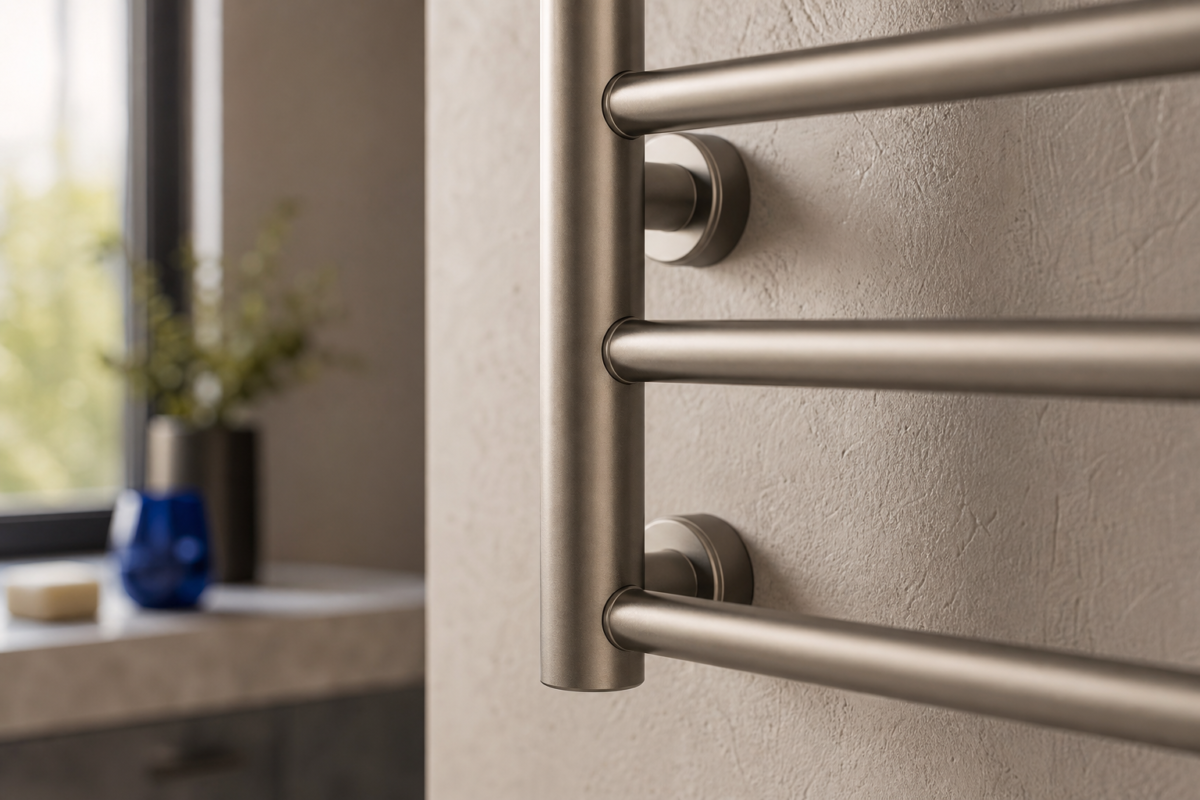
Towel warmers come in wall-mounted, freestanding, and ladder (rail) styles, and the right one depends on your wall space and whether you want it permanent. Wall-mounted ladder racks are the most common because they use vertical space efficiently and read as a sleek design element.
Mount a wall unit so its lowest bar sits about 48 inches off the floor, within easy reach of the shower or tub but clear of splash. Freestanding models need no installation and can move between rooms, which suits renters, while hardwired radiator-style panels throw the most heat and double as functional bathroom storage for folded towels. Avoid mounting a warmer directly above a heat-sensitive surface or inside a shower enclosure, and keep at least a few inches of air gap around it so towels heat evenly. In a small bathroom, a slim ladder rack on an otherwise unused stretch of wall adds function without eating into the floor plan, while a larger room can carry a full panel that anchors a corner.
Materials and finishes
Choose a 304-grade stainless steel unit for corrosion resistance in a wet room, then pick a finish that matches your other fixtures. Quality towel warmers last 25 years or more, so the finish decision outlives most other hardware in the bathroom.
Finishes typically include polished and brushed stainless, matte black, and PVD brushed gold, which conveniently mirror the common faucet finishes. Coordinating the warmer with your faucet and towel bars follows the same logic laid out in our guide to bathroom hardware finishes, so the heated rack reads as part of the design rather than an appliance bolted to the wall. A PVD finish resists the mineral spotting that plagues electroplated metal in hard-water homes.
Energy use and running cost
A towel warmer uses very little electricity, drawing 60 to 240 watts, less than many light bulbs, for about $0.03 to $0.05 per day on a two-hour timer. Even run continuously, most units cost only $0.31 to $0.59 a day, so the comfort comes cheap.
The smartest way to keep costs and energy use down is a programmable timer or a WiFi-connected model that heats only before your morning and evening routines. Pairing a timer with the unit keeps monthly operating cost under about $1.50 while still delivering warm towels on demand, the kind of small efficiency habit the ENERGY STAR program encourages across home systems. Continuous operation is rarely necessary and wastes the most power.
Installation, safety, and codes
Every towel warmer in a bathroom must be on a GFCI-protected circuit, and quality units carry safety certifications and overheat protection. These are not optional details, because the device combines electricity, water, and skin contact.
Look for cULus or cETLus certification, an IP44 or better moisture rating, and built-in overheat protection that caps the surface temperature around 150 to 167 degrees Fahrenheit so a resting hand or towel never scorches. Plug-in units take 15 to 30 minutes to mount, while hardwired and hydronic installs run one to two hours with a licensed pro. Factor the install into your overall bathroom remodel cost, since adding a GFCI circuit mid-project is far cheaper than retrofitting one later.
What towel warmers cost in 2026
Most towel warmers cost $100 to $500 for the unit, with installation adding nothing for a plug-in freestanding model up to $300 for a hardwired or hydronic one. Designer and large family-size units push higher, and custom hardwired radiators can reach well over $1,000 installed.
| Type | Unit price | Installation | Total |
|---|---|---|---|
| Freestanding plug-in | $100 – $250 | $0 | $100 – $250 |
| Wall-mounted plug-in | $150 – $400 | $0 – $100 | $150 – $500 |
| Hardwired electric | $200 – $500 | $150 – $300 | $350 – $800 |
| Hydronic | $250 – $700 | $300 – $700 | $550 – $1,400+ |
For the comfort it delivers, a towel warmer is one of the better returns per dollar in a bathroom, and it rarely hurts resale, a theme we explore more broadly in our look at bathroom remodel ROI.
Contractor’s take
When I frame a bathroom, I ask the homeowner whether they even might want a towel warmer someday, and if the answer is anything but a hard no, I have the electrician drop a GFCI-protected box behind the towel wall before the drywall goes up. It costs almost nothing at that stage. The folks who skip it end up with a plug-in unit and a cord snaking across the tile, which looks like an afterthought. Spend the extra hour on rough-in and you get the clean, hardwired look for the price of a plug-in later.
Towel warmer buying checklist
Run through these points before you buy so the unit fits your space, your wiring, and your design.
- Pick electric unless you are mid-renovation and want to tie into your heating system.
- Decide plug-in versus hardwired based on whether you can hide or tolerate a cord.
- Size the bar count to the number of towels the bathroom serves.
- Confirm a GFCI-protected outlet or circuit is available or can be added.
- Choose 304 stainless and a finish that matches your faucet and towel bars.
- Add a programmable timer or WiFi control to minimize energy use.
- Verify cULus or cETLus certification and built-in overheat protection.
Frequently asked questions
Your next move
You know the number. What are you deciding next?
Walk-in tub cost in 2026: $5,000 to $20,000 installed. Compare tub types, features, and the real Medicare coverage…
Continue →Bathroom remodel financing explained: compare home equity loans, HELOCs, cash-out refi, personal loans, and 0% cards with 2026…
Continue →Steam shower cost runs $3,000 to $10,000 installed in 2026. See prices by generator size, enclosure, and prefab…
Continue →Frequently asked
Are towel warmers expensive to run?
No. A typical electric towel warmer draws 60 to 240 watts and costs about $0.03 to $0.05 per day on a two-hour timer, or under $1.50 a month. Even continuous use rarely exceeds $0.60 a day.
Do towel warmers dry towels or just warm them?
They do both. The gentle heat warms a towel in 15 to 20 minutes and fully dries it between uses, which reduces the mildew smell that damp towels develop. Drying performance is one of the main reasons owners install them.
Do I need an electrician for a towel warmer?
Not for a plug-in model, which simply needs a GFCI outlet and mounts in minutes. Hardwired and hydronic units do require a licensed pro to wire or plumb them in, typically adding one to two hours of labor.
What size towel warmer do I need?
Choose 4 to 6 bars for a guest or single-person bath, 7 to 10 bars for a primary bath shared by a couple, and 11 or more for a family bathroom. Also measure your wall so towels can hang without touching other fixtures.
Can a towel warmer heat the whole bathroom?
Only partially. Most units put out 300 to 600 BTU per hour, enough to take the chill off a small room but not to serve as a primary heat source. For whole-room warmth, a heated floor or a dedicated heater is the better tool.
