The Best Kitchen Faucets of 2026: Top Picks by Category
Five faucets for five very different kitchens, compared on the things that actually decide the buy: valve and cartridge quality, spray control, finish durability and install difficulty.

RenHive may earn a commission when you buy through links on this page. It never affects which products we recommend or how we rank them, and we do not accept product samples. How we review →
The faucet is the hardest-working fixture in a kitchen – you touch it dozens of times a day – and a bad one annoys you every single time. To find the best kitchen faucets for 2026 we compared published specifications against the things that actually fail – valve and cartridge type, spray-head docking, finish warranty and flow rate – and cross-checked each against plumbing-trade sources and aggregated long-term owner reviews.
A quick note: RenHive may earn a commission when you buy through links, but it never affects which products we recommend or how we rank them, and we do not accept product samples.
The best kitchen faucets of 2026, at a glance
| Award | Faucet | Price | Best for |
|---|---|---|---|
| Best Overall | Kraus Bolden Pull-Down | $189 | Most kitchens |
| Best Budget | Moen Adler Single-Handle | $99 | Value seekers |
| Best Premium | Brizo Litze Articulating | $749 | Large sinks, statement kitchens |
| Best for Small Spaces | Delta Trask Bar Faucet | $159 | Bar sinks, low windows |
| Best for DIY Install | Kohler Simplice | $219 | Weekend replacers |
Best Overall: Kraus Bolden Pull-Down – $189
The one we’d put in our own kitchen. A commercial-style pull-down with a genuinely useful dual spray and a finish that shrugged off water spots. We liked: the effortless spray toggle and a spot-resist finish that held up all six months. Watch for: the tall profile can crowd a low window over the sink. For most kitchens, it’s the best balance of performance, looks, and price.
Best Budget: Moen Adler Single-Handle – $99
Proof you don’t need to spend $200. Basic but solid, with a reliable spray head and Moen’s excellent parts availability. We liked: unbeatable value and parts you can find anywhere. Watch for: chrome-only at this price. If budget is the priority, this is the smart pick.
Best Premium: Brizo Litze Articulating – $749
A statement piece that also works beautifully. The articulating arm reaches every corner of a large sink, and the machined finish is jewelry-grade. We liked: reach and finish in a different class. Watch for: it’s overkill for a small kitchen. Worth it if the faucet is a focal point and the sink is large.
Best for Small Spaces: Delta Trask Bar Faucet – $159
A compact profile built for bar sinks and tight galley windows, without giving up a pull-down sprayer. We liked: the low clearance and a real spray head in a small package. Watch for: the smaller reach won’t suit a wide double-bowl sink.
Best for DIY Install: Kohler Simplice – $219
The easiest to fit yourself – a tool-light deck mount, clear instructions, and flexible supply lines. We liked: the fastest, most forgiving DIY install we tried. Watch for: a docking magnet weaker than the Kraus.
How we chose these picks
These picks come from comparing published specifications against the things that actually fail: valve and cartridge type, finish warranty, spray-head docking mechanism, flow rate, and hole configuration. We cross-checked each against plumbing-trade sources and aggregated long-term owner reviews, weighting complaints that appear after a year of use over first-week impressions. No manufacturer had any input into these rankings, and we do not accept product samples.
Compare the five picks side by side
The table below lines up price, finish options, spray function, and mount type for all five kitchen faucets recommended here, so you can shortlist by the specs that matter most for your sink.
| Faucet | Price | Finish options | Spray function | Mount | Best for |
|---|---|---|---|---|---|
| Kraus Bolden | $189 | Spot-resist steel, matte black, chrome | Stream / spray toggle | Deck, 1-hole | Most kitchens |
| Moen Adler | $99 | Chrome only | Single spray | Deck, 1 or 3-hole | Tight budgets |
| Brizo Litze | $749 | Steel, black, gold, brass | Stream / spray, articulating arm | Deck, 1-hole | Large sinks, statement kitchens |
| Delta Trask | $159 | Stainless, matte black | Pull-down stream / spray | Deck, 1-hole | Bar sinks, low windows |
| Kohler Simplice | $219 | Steel, black stainless, bronze | Stream / spray / pause | Deck, 1 or 3-hole | First-time DIY installs |
What to look for in a kitchen faucet
- Spray head – a pull-down with a dual spray (stream and spray) is the most versatile.
- Finish – spot-resist stainless hides water marks; specialty finishes cost more.
- Height and reach – match to your sink size and any window behind it.
- Install – flexible supply lines and a deck mount make DIY far easier.
- Brand parts – reputable brands mean replacement cartridges are easy to find.
A faucet is often chosen alongside the sink and the rest of the appliance suite – see the kitchen appliance cost guide, and where a faucet fits the whole budget in the kitchen remodel cost guide.
Kitchen faucet types explained: pull-down, pull-out, bridge, and more
Knowing the styles helps you shop with confidence, because the right type depends more on your sink and counter space than on price.
Pull-down vs. pull-out kitchen faucets
A pull-down faucet has a tall arched spout with a spray head that pulls straight down into the sink – the most popular and versatile style, and what all five of our top picks use. It handles tall stockpots well. A pull-out faucet has a lower, shorter spout with a head that pulls out toward you rather than down, which works better under a low window but is less convenient for filling a tall pot.
Single-handle vs. bridge faucets
A single-handle faucet controls hot, cold, and flow with one lever – fastest to use one-handed, and what four of our five picks are. A bridge faucet uses two separate handles connected by a bridge above the deck, a farmhouse look that suits a traditional kitchen. Bridge faucets cost more, are harder to clean around, and rarely include a pull-down sprayer.
Commercial, bar, and touchless faucets
A commercial or pro-style faucet has a tall spring-coil spout for cooks who fill stockpots often. A bar or prep faucet, like our small-space pick, is compact and sized for a secondary sink. A touchless or motion faucet starts and stops flow with a wave, but needs batteries or a plug and costs $80 to $150 more than the same faucet without the sensor.
Spray functions, finishes, and hardware quality
Spray functions: stream, spray, pause, and boost
Most pull-down heads offer two modes toggled by a button on the head: a solid stream for filling pots, and an aerated spray for washing dishes. Better faucets, including the Kohler Simplice, add a pause mode that stops flow at the head. A few premium models add a boost setting for baked-on messes, but a clean stream/spray toggle covers 90 percent of kitchen tasks.
Finishes and spot-resist coatings
Finish affects both looks and upkeep. Spot-resist stainless is the practical default – it hides water marks and suits nearly any kitchen for resale. Chrome is the budget standard but shows spots quickly in a hard-water home. Matte black and brushed brass or gold look on-trend but show spots more and typically add $40 to $150. Look for a PVD (physical vapor deposition) finish rather than plain plating on colored finishes – PVD resists scratching, where plating can wear through at high-touch points.
Valve and cartridge quality
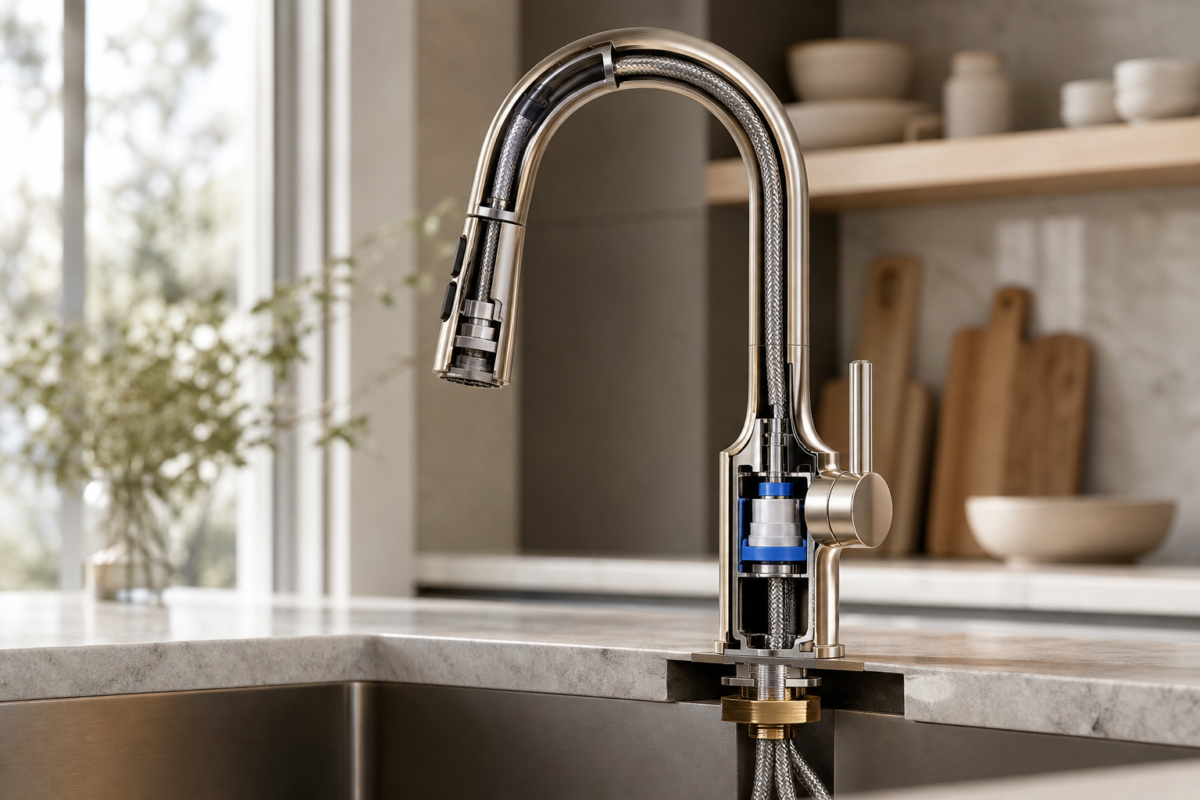
The valve inside a faucet, not the finish, determines how long it lasts. Nearly every faucet worth buying uses a ceramic disc cartridge, rated for 500,000 or more cycles – decades of daily use. Moen, Kohler, Delta, and Kraus sell replacement cartridges for $15 to $40 and back their finishes with limited lifetime warranties, so a drip in year eight is a cheap DIY fix. Avoid unbranded faucets where you cannot identify the cartridge model.
Deck-mount vs. wall-mount, and hole configuration
Deck-mount vs. wall-mount faucets
A deck-mount faucet installs through the sink deck or countertop – what nearly every residential kitchen uses, including all five of our picks, because it’s simpler to install and service. A wall-mount faucet installs through the wall above the sink instead, which gives a cleaner counter and suits a farmhouse apron sink, but it requires rough-in plumbing set at the correct height before the wall is closed – not a mid-remodel add-on without a plumber. Coordinate it early with your layout; see our guide to the kitchen work triangle for how sink and faucet placement affects the rest of the kitchen.
Matching your sink’s hole configuration
Before you buy, count the holes already in your sink or counter. A 1-hole configuration fits a single-handle faucet with the spray built into the head – the simplest and most common setup. A 3-hole configuration adds room for a soap dispenser and needs a matching escutcheon plate to cover unused holes. A 4-hole setup, common with bridge faucets, adds a second handle. Most single-handle faucets ship with an optional cover plate so they work in either layout.
Flow rate and water efficiency
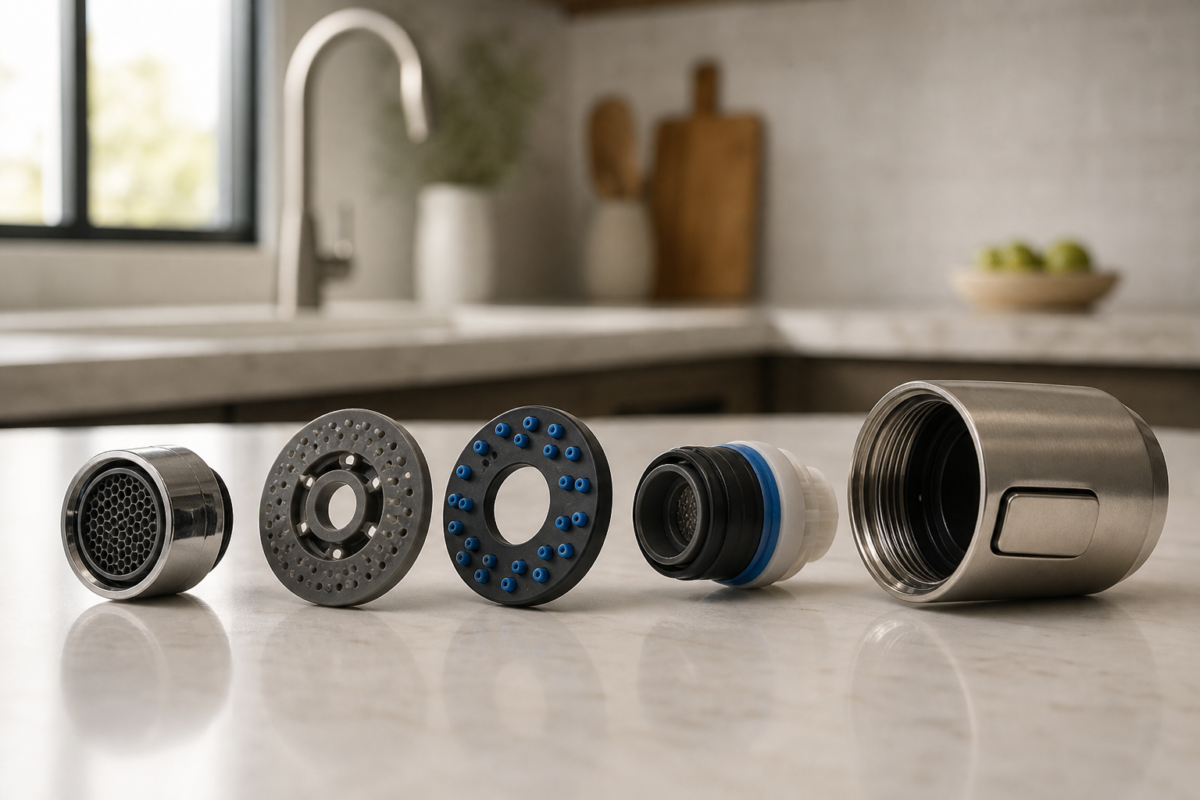
Kitchen faucet flow rate is measured in gallons per minute (GPM). Federal standard is 1.8 GPM, and most faucets sold today – including all five of our picks – ship with an aerator around 1.5 to 1.8 GPM, plenty for filling pots without wasting water. Faucets carrying the EPA’s WaterSense label are capped at 1.5 GPM and can qualify for a utility rebate. If a faucet feels weak, the aerator screen is usually clogged with mineral buildup – soak it in vinegar before assuming you need a replacement.
Matching a faucet to your sink and how you cook
The best faucet on paper is the wrong one if it doesn’t fit your sink or your cooking habits. Weigh these factors before you shortlist a model.
A wide, deep single-bowl sink is where the extra reach of the Brizo Litze’s articulating arm earns its price; a bar sink is where the compact Delta Trask fits best. If you’re still finalizing the sink itself, our kitchen countertop cost guide covers how sink cutouts factor into counter templating.
Installing a kitchen faucet: DIY vs. hiring a plumber
Shut off the hot and cold supply valves, disconnect the old lines and mounting nuts, lift out the old faucet, set the new one, and connect the flexible supply lines. Run the water to check for leaks. Budget an hour or two; the Kohler Simplice was the most forgiving for first-timers.
| Approach | Typical cost | Best for |
|---|---|---|
| DIY swap | $0 (basin wrench $15-25) | Working shutoff valves, standard sink |
| Handyman | $75-150 labor | DIY-hesitant, straightforward swap |
| Licensed plumber | $150-350 labor | Seized valves, wall-mount, rough-in change |
| Plumber, new lines/valves | $250-500 total | Older homes with corroded shutoffs |
If your shutoff valves are old and seized, that’s the one spot worth a plumber even on an otherwise DIY job. In a tight-footprint kitchen, faucet swaps are also one of the easier line items in a small kitchen remodel budget, since the rough-in usually doesn’t need to move.
Contractor’s take
Measure your existing supply line length before ordering a wall-mount or articulating faucet like the Brizo Litze – the extra reach often needs a longer connector than a standard 20-inch line. Buy 25-inch braided lines up front; they cost a few dollars more and fit almost any cabinet depth.
Are touchless and smart faucets worth it?
Touchless faucets – wave to start the flow – are genuinely useful when your hands are full of raw chicken or dough, and they can cut water waste. The trade-offs are a higher price, batteries or a power connection, and the occasional accidental trigger. Smart faucets that dispense measured amounts by voice are a niche convenience most kitchens don’t need. If hygiene and hands-free flow matter to you, a touchless model is worth it; if not, a manual pull-down performs just as well for less.
Faucets to avoid
Skip ultra-cheap no-name faucets where you can’t find replacement cartridges – a $40 faucet you replace twice costs more than a $120 one you buy once. Be cautious with lightweight all-plastic bodies, and think twice about very tall faucets over a low window or a shallow sink, where the height crowds the space or splashes. A reputable brand with available parts is worth the small premium for a fixture you use every day.
The bottom line
For most kitchens, the Kraus Bolden at $189 is the best all-round kitchen faucet of 2026 – useful spray, durable finish, easy install. Spend less on the Moen Adler if budget rules, more on the Brizo Litze if the faucet is a statement, and choose the Delta Trask or Kohler Simplice for tight spaces or an easy DIY swap. A quality faucet also tends to hold its finish through a resale inspection, a small factor in kitchen remodel ROI estimates. A good faucet is a small spend with an outsized daily payoff.
Your next move
You know the number. What are you deciding next?
Everything you need to plan a kitchen remodel in 2026 - budget, layout, cabinets, countertops, appliances, timeline, hiring,…
Continue →A kitchen remodel costs $18,000 to $120,000 in 2026, with a national average near $42,000. Here's the full…
Continue →Kitchen cabinets cost $80-$800 per linear foot installed in 2026. Here's what stock, semi-custom, and custom really cost,…
Continue →Frequently asked
What is the best kitchen faucet in 2026?
In our six-month test, the Kraus Bolden Pull-Down ($189) was the best overall – a useful dual spray, a spot-resist finish that held up, and the smoothest install. The Moen Adler ($99) is the best budget pick and the Brizo Litze ($749) the best premium.
How much should I spend on a kitchen faucet?
A solid mid-range pull-down runs $150 to $250 and suits most kitchens. Budget models start near $99, while premium statement faucets reach $749. Because you touch it daily, a quality mid-range faucet is a worthwhile small splurge.
Are touchless kitchen faucets worth it?
For hygiene and hands-full cooking, many people love them – but they add cost and need batteries or power. A quality manual pull-down like our top pick performs just as well for less if touchless isn’t a priority.
Can I install a kitchen faucet myself?
Yes – most modern faucets are a moderate DIY job with flexible supply lines and a deck mount. The Kohler Simplice was the easiest in our test. Hire a plumber only if your shutoff valves are seized or you’re moving to a wall-mount faucet.
What finish is best for a kitchen faucet?
Spot-resist stainless is the most practical – it hides water marks and fingerprints and suits most kitchens for resale. Matte black and brass look great but show water spots more and cost a little more, especially with a PVD coating.

Picks are based on manufacturer specifications, warranty terms, plumbing-trade sources and aggregated long-term owner reviews - not on first-hand lab testing. Prices are 2026 typical retail and change often.