Kitchen Cabinet Cost in 2026: Stock vs. Semi-Custom vs. Custom
Cabinets are the single biggest line in almost every kitchen remodel. Here's what stock, semi-custom, and custom really cost in 2026 - priced per linear foot, so you can plan before you shop.

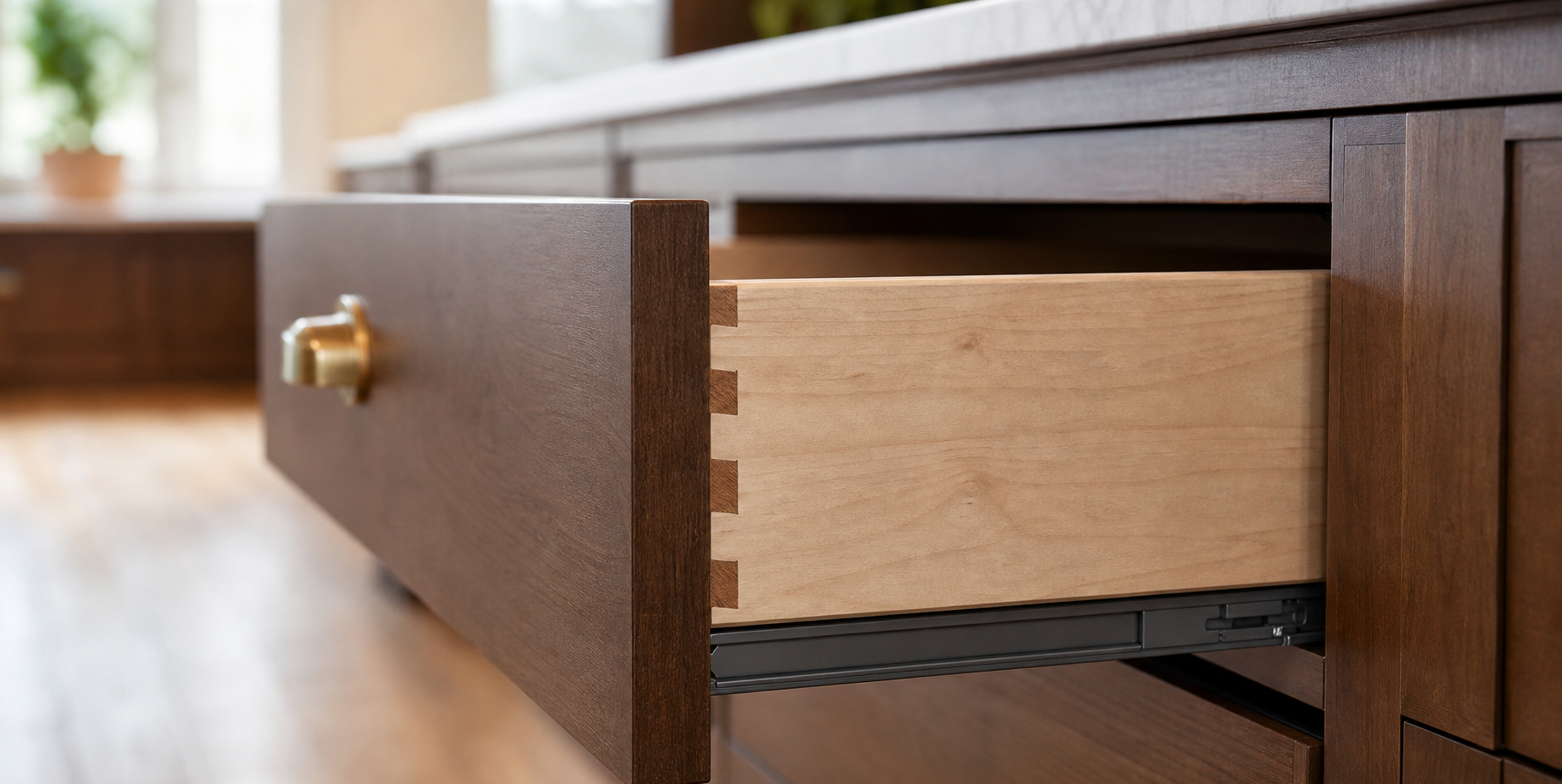
Ask three homeowners what they paid for kitchen cabinets and you’ll get three wildly different numbers – because “cabinets” covers everything from flat-pack stock boxes to shop-built custom cabinetry. In 2026 the honest way to budget the kitchen cabinet cost is per linear foot of cabinetry, then adjust for your kitchen’s size and finish. Because cabinets are the single largest line in a kitchen remodel – 25 to 35% of the total – getting this number right is the foundation of your whole budget, shaping what’s left for countertops, appliances, and flooring. This guide breaks down all three tiers, what actually drives the price inside the box, and how to spend less without buying worse.
Cabinet cost per linear foot in 2026
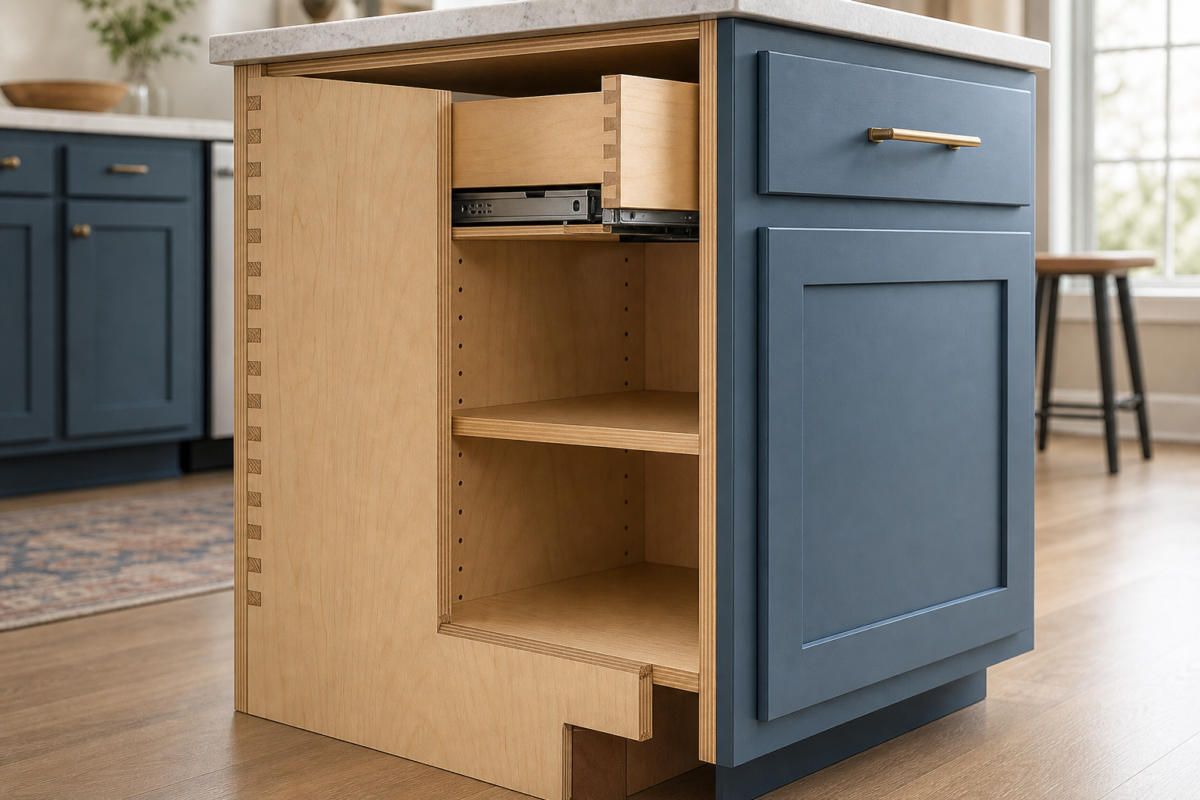
A “linear foot” is one foot of cabinet run measured along the wall – most kitchens have 25 to 40 linear feet of upper and lower cabinets combined. Here’s what each tier runs installed:
| Cabinet tier | Per linear foot | Typical 40-ft kitchen | Best for |
|---|---|---|---|
| Stock | $80-$120 | $3,200-$4,800 | Rentals, flips, tight budgets |
| Refacing | $120-$250 | $4,800-$10,000 | Sound boxes, a new look |
| Semi-custom | $150-$300 | $6,000-$12,000 | Most mid-market remodels |
| Custom | $500-$800 | $20,000-$32,000 | Odd layouts, high-end kitchens |
For most American kitchens, semi-custom is the sweet spot – real choice in sizes, finishes, and storage without custom-shop rates. Stock cabinets save the most but limit you to standard sizes in 3-inch increments; custom is worth it when your kitchen has awkward dimensions or you want a specific species and door profile. See how cabinets fit the whole budget in the kitchen remodel cost guide.
Contractor’s take
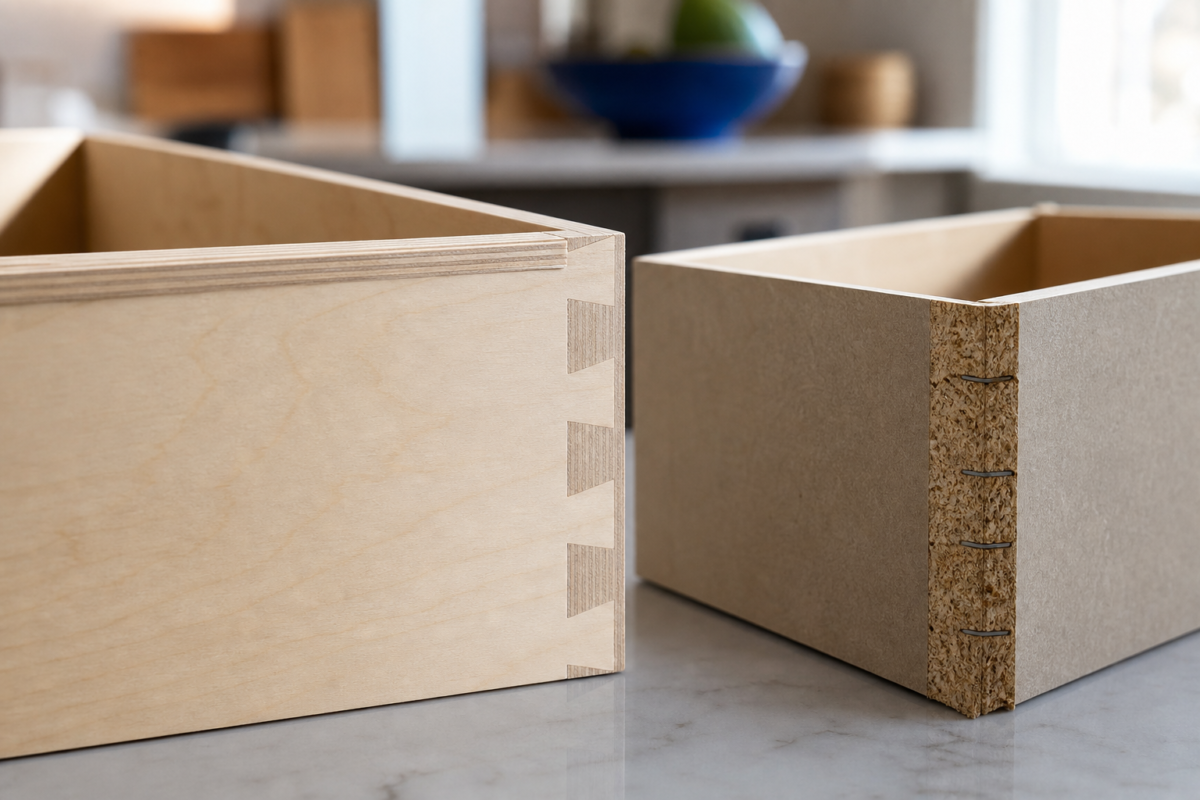
“The mistake I see is people pricing cabinets on the door style alone. The box construction – plywood vs. particleboard, dovetail vs. stapled drawers, soft-close hardware – is what you’re actually paying for, and it’s what lasts twenty years instead of five.” – Marcus Hale, licensed GC
Stock, semi-custom, and custom cabinets explained
Stock cabinets – $80-$120 / linear foot
Pre-made in standard sizes and finishes and ready to take home or ship quickly. Stock is the budget champion and perfectly good in quality at the better end, but you’re limited to fixed sizes in 3-inch increments, so fillers cover the gaps. Ideal for rentals, flips, laundry rooms, and tight-budget kitchens with a straightforward layout.
Semi-custom cabinets – $150-$300 / linear foot
The most popular choice for a reason. Semi-custom starts from standard sizes but adds real options – door styles, finishes, interior organizers, and modifications to depth or width. It’s the tier that gets you a personalized kitchen at a sensible price, and where most mid-market remodels land.
Custom cabinets – $500-$800 / linear foot
Built to order for your exact kitchen, in any size, species, and finish. Custom is worth it for unusual layouts, ceiling-height runs, furniture-grade detail, or a specific look you can’t get off the shelf – but it carries the longest lead time (often 8 to 16 weeks versus 1 to 4 for stock) and the highest price.
Which tier is right for your kitchen
| Your situation | Recommended tier | Why |
|---|---|---|
| Rental, flip, or resale-focused starter kitchen | Stock | Lowest cost per foot; buyers rarely pay more for cabinet pedigree |
| Standard layout, want real style options | Semi-custom | Best balance of choice, lead time, and price |
| Awkward angles, tall ceilings, or a signature look | Custom | Only tier that builds to exact dimensions and detail |
| Boxes are sound, just tired-looking | Reface | New face for roughly half of replacement cost |
Where the cabinet money goes
Within the cabinet budget, these factors move the total the most:
Installation labor is folded into most per-foot quotes, but on a supply-only order expect to add carpenter time for hanging and leveling – a meaningful share of the total on stock and semi-custom jobs.
Framed vs. frameless (full-access) cabinets
Beyond tier, the cabinet’s basic construction style affects both price and storage. Framed cabinets – the traditional American style – have a solid wood face frame attached to the front of the box. That frame adds rigidity, hides minor gaps during installation, and is what most stock and semi-custom lines default to. The tradeoff is a slightly smaller opening, since the frame overlaps roughly 1 to 1.5 inches of usable space on each cabinet.
Frameless (full-access) construction
Frameless cabinets – also called full-access or European-style – skip the face frame entirely, so the door mounts directly to the box edge. That means a wider opening and roughly 10 to 15% more usable storage in the same footprint. IKEA’s SEKTION line and most modern-style shops build this way. Because the box must be perfectly square and usually needs thicker 3/4-inch sides, frameless construction often runs slightly higher than an equivalent framed line, though the gap has narrowed as it’s become more common.
Neither style is objectively “better” – framed reads more traditional and is more forgiving of an out-of-level wall; frameless reads cleaner and modern. Choose based on your kitchen’s overall design rather than price alone, since the cost difference between the two is usually smaller than the difference between tiers.
Cabinet box materials: particleboard vs. plywood vs. solid wood
What you can’t see matters as much as the door. Plywood boxes are stronger and more moisture-resistant than particleboard or MDF, and they hold screws and hardware better over decades. Solid-wood or plywood drawer boxes with dovetail joints outlast stapled particleboard drawers. And soft-close hinges and undermount glides have gone from luxury to expected. Splurge on the box and the hardware; you can save on the door material and finish, where a quality veneer reads like solid wood to most people.
| Box material | Durability | Moisture resistance | Typical use |
|---|---|---|---|
| Particleboard | Lowest – can swell and sag under load | Poor unless sealed | Entry-level stock lines |
| MDF (medium-density fiberboard) | Moderate – dense and stable, heavier | Fair | Painted stock and semi-custom doors |
| Plywood (cabinet-grade) | High – resists warping and racking | Good | Semi-custom and custom boxes |
| Solid wood | Highest for frames/doors, can move seasonally | Good if sealed | Custom face frames and premium doors |
A practical rule: check the sink base and under-dishwasher cabinet first, since those take the most moisture exposure. If a line offers a plywood upgrade only in those locations, it’s worth the extra cost even if the rest of the run stays particleboard or MDF.
Cabinet door styles and finishes that move the price
Door style and profile
The door sets the style and can shift the price. Shaker – a simple recessed panel – is the timeless, do-anything choice and the safest for resale. Flat/slab doors read modern and are the easiest to clean. Raised-panel and detailed profiles feel traditional and cost more to make because of the extra shaping and sanding. For a kitchen you’ll keep a decade, a classic shaker in a neutral finish rarely goes wrong.
Painted, stained, thermofoil, and two-tone finishes
Finish is often a bigger swing than the door profile itself:
| Finish | Relative cost | Notes |
|---|---|---|
| Thermofoil / laminate | Lowest | Vinyl-wrapped MDF; consistent color, but can peel near heat sources over time |
| Stained wood | Baseline | Shows natural grain; cost varies more by species than by the stain itself |
| Factory-painted | +10-20% vs. stained | Extra primer and sanding steps for a smooth, durable finish |
| Two-tone (island vs. perimeter) | +5-15% | Popular design trend; extra changeover in the shop |
| Glazed or distressed | +15-25% | Hand-applied detailing adds labor time |
Wood species matters too: paint-grade woods like poplar and maple are the cheapest base for a painted door, oak and standard maple sit in the middle for stained finishes, and cherry, walnut, hickory, or quarter-sawn/rift-cut cuts carry a premium. If you’re leaning toward paint anyway, don’t pay for a premium species underneath it. Homeowners planning to paint kitchen cabinets themselves later can often buy an unfinished or lower-cost stained line and finish it on their own timeline instead of paying the factory-paint premium up front.
Popular kitchen cabinet brands by budget tier
Brand names are a useful shorthand for positioning, though the underlying box construction still varies by product line within each brand:
| Tier | Common brands | Typical price positioning |
|---|---|---|
| Budget / stock | IKEA SEKTION, Hampton Bay (Home Depot), Value/Continental lines (Lowe’s), big-box house brands | $80-$150 / linear foot |
| Semi-custom | KraftMaid, Thomasville, American Woodmark, Waypoint Living Spaces, Kemper, Schrock, Homecrest, Shenandoah | $150-$350 / linear foot |
| High-end semi-custom / custom | Wellborn, Medallion, Dura Supreme, Plain & Fancy, Wood-Mode, Rutt Cabinetry, local custom shops | $400-$800+ / linear foot |
A brand name doesn’t guarantee quality on its own – entry and premium lines from the same brand can differ enormously in box material and hardware. The more reliable signal is the warranty: a lifetime warranty on the box and hinges usually means plywood construction and better hardware, while a 1- to 5-year warranty often points to a particleboard-and-staple build.
Hidden costs that inflate the cabinet budget
The per-linear-foot number is only the starting point. These extras commonly add 10 to 20% on top of the sticker price, and skipping them in your budget is the most common reason cabinet costs come in over estimate:
- Removal and disposal of old cabinets: $300-$1,000 depending on how they’re attached and whether tile or backsplash has to come off first.
- Electrical or plumbing modifications: $200-$800 per line moved when a new layout shifts the sink, dishwasher, or under-cabinet lighting.
- Crown molding, light rail, and trim kits: $8-$25 per linear foot for a finished, built-in look at the ceiling and under uppers.
- Soft-close hinge and glide upgrades: $10-$25 per door or drawer if not already standard on your chosen line.
- Filler strips, end panels, and toe kicks: $50-$300 total to close gaps and give a custom-built appearance.
- Hardware: knobs and pulls run $3-$25 each, and a typical kitchen needs 30 to 50 pieces.
- Freight or delivery: $150-$500, especially for semi-custom and custom orders shipped from a regional plant.
- Installation labor on supply-only orders: $1,500-$4,000 for a full kitchen if cabinets aren’t sold pre-installed.
Ask any quote to itemize these separately rather than bundling them into a vague “cabinet allowance” line – it’s the only way to compare bids apples to apples, and it also helps you schedule the rest of the job, since custom-order lead times and any electrical work both affect how long the project runs before countertops can be templated and installed on top.
Refacing vs. replacing
If your cabinet boxes are structurally sound, refacing – new doors, drawer fronts, and a matching veneer on the boxes – delivers a brand-new look for $120 to $250 per linear foot, roughly half the cost of custom replacement, while keeping your existing layout. Replace when the boxes are damaged, the layout needs to change, or you want different sizes; reface when the bones are good and you just want a fresh face. It’s one of the highest-return moves in a budget kitchen remodel.
How to cut cabinet costs without buying worse
The goal isn’t the cheapest cabinets – it’s the cheapest cabinets that still hold up. These moves cut cost without cutting the parts that actually fail first:
- Reface if the boxes are solid – a new look for a fraction of replacement.
- Mix tiers: semi-custom perimeter with one custom feature, not custom everywhere.
- Keep standard sizes and heights – every custom-size cabinet carries a premium.
- Choose a stock or semi-custom line with the plywood-box upgrade rather than jumping to custom.
- Buy soft-close hardware and pulls separately if your supplier marks them up.
- Skip glass-front and specialty organizer inserts on cabinets you’ll rarely open.
- Order paint-grade doors in poplar or maple instead of a premium species if you’re painting anyway.
- Get at least three itemized bids, since labor and hidden-cost items vary more between contractors than the cabinets themselves.
The one place not to save is the box and the hinges – both are invisible once installed and both are the most expensive to fix later, since a sagging particleboard box means pulling the whole run back off the wall.
Do new cabinets add resale value?
Cabinets anchor a buyer’s impression of the whole kitchen, so fresh, quality cabinetry helps a home show and sell – and refacing in particular returns a high share of its cost because it’s inexpensive relative to the visual change. For resale, semi-custom cabinets in a neutral, timeless style return more reliably than ultra-custom cabinetry, which rarely recoups its full premium. See the full kitchen remodel ROI data.
The bottom line
Budget $80-$120 per linear foot for stock, $150-$300 for semi-custom, and $500-$800 for custom in 2026. For a typical mid-market kitchen, semi-custom cabinets land most homeowners around $9,000-$12,000 installed – the biggest single decision in your remodel, and the one most worth getting right. Buy quality boxes and hardware, save on the door finish, budget for the hidden extras up front, and reface rather than replace when the bones are good.
Your next move
You know the number. What are you deciding next?
Quartz vs. granite: the two most-chosen kitchen countertops compared on 2026 cost, durability, maintenance, heat, and looks -…
Continue →Luxury vinyl, tile, or hardwood? The three most-chosen kitchen floors compared on 2026 cost, water resistance, comfort, and…
Continue →Everything you need to plan a kitchen remodel in 2026 - budget, layout, cabinets, countertops, appliances, timeline, hiring,…
Continue →Frequently asked
How much do kitchen cabinets cost in 2026?
Installed, expect $80-$120 per linear foot for stock, $150-$300 for semi-custom, and $500-$800 for custom. A typical 40-linear-foot kitchen runs about $3,200-$4,800 in stock and $6,000-$12,000 in semi-custom, before hidden extras like removal, trim, and hardware.
Are semi-custom cabinets worth it?
For most kitchens, yes. Semi-custom gives you real choice in sizes, finishes, and storage at roughly a third to half of custom pricing – the best value for a mid-market remodel and the tier most designers default to.
Is refacing cheaper than replacing cabinets?
Yes. Refacing runs $120-$250 per linear foot versus $500-$800 for custom replacement, and it keeps your existing layout – ideal when the boxes are still sound but the doors and finish look dated.
What percentage of a kitchen remodel is cabinets?
Cabinets are usually 25 to 35% of the total kitchen budget – the single largest line item, ahead of labor, countertops, and appliances.
What is the most durable kitchen cabinet material?
Plywood boxes with solid-wood or plywood dovetailed drawers are the most durable and moisture-resistant. Particleboard and MDF cost less but hold up less well over decades, especially near the sink and dishwasher.
What is the difference between framed and frameless cabinets?
Framed cabinets have a face frame across the front of the box, which is the traditional American style and slightly more forgiving to install. Frameless (full-access) cabinets skip the frame for a wider opening and roughly 10 to 15% more usable storage, at a similar or slightly higher price.
Does the cabinet brand matter more than the tier?
Not really – tier and box construction matter more than the name on the catalog. Within any brand, check whether the warranty covers a lifetime on the box and hinges (a sign of plywood and quality hardware) or just 1 to 5 years (often a particleboard build), and compare that across brands at the same price point.

Per-linear-foot and total figures are 2026 national installed ranges; your metro, kitchen size, and door style will move the number.