Quartz vs. Granite Countertops: Which Wins in 2026?
Two of the most-chosen kitchen surfaces in America, head to head - on cost, durability, upkeep, and how they actually live over ten years.

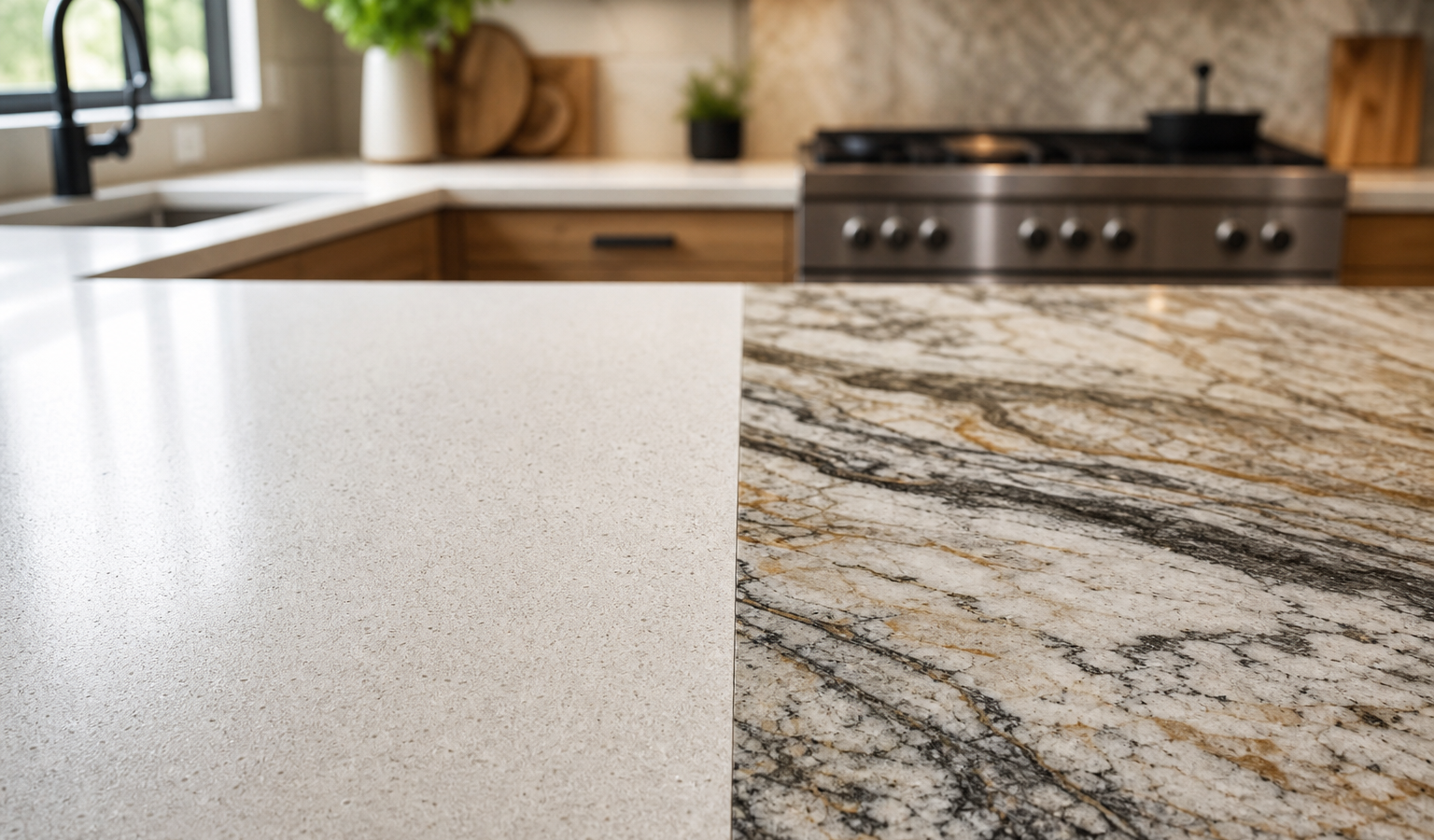
When it’s time to choose a kitchen countertop, most homeowners come down to two materials: quartz vs granite. Both are premium, both are durable, and both land in a similar price range – which is exactly why the choice trips people up. The honest answer is that neither is universally better; there is a winner for your kitchen depending on how you cook, how much maintenance you will tolerate, and the look you want. This guide compares quartz and granite head to head on appearance, durability, heat resistance, scratch and stain resistance, maintenance and sealing, installed cost, food safety, and resale value, then hands you a decision matrix so you can pick with confidence. If you are budgeting the whole project, pair this with the kitchen remodel cost guide.
Quick verdict
Choose quartz if you want a hands-off surface, a predictable pattern, and never want to think about sealing – the low-worry default for busy family kitchens. Choose granite if you want a one-of-a-kind natural stone, you cook with real heat, and a few minutes of sealing once a year is a fair trade for a surface that outlasts everything around it.
Quartz vs granite: the comparison at a glance
| Dimension | Quartz | Granite | Edge |
|---|---|---|---|
| Cost (installed) | $50-$155 / sq ft | $40-$250 / sq ft | Even |
| Material type | Engineered (90% stone + resin) | 100% natural quarried stone | Depends |
| Hardness (Mohs) | About 7 | 6 to 7 | Even |
| Durability | Very high, non-porous | Very high, scratch-proof | Even |
| Heat resistance | Can scorch above 300 F | Excellent – set hot pans | Granite |
| Scratch resistance | Excellent, resin can dull | Excellent, true stone | Granite (slight) |
| Stain resistance | Excellent, non-porous | Good if sealed yearly | Quartz |
| Maintenance | Wipe clean, no sealing | Seal about 1x/year | Quartz |
| Food safety | Non-porous, no bacteria harborage | Safe when sealed | Quartz |
| Appearance | Consistent, engineered | Unique natural veining | Taste |
| Lifespan | 25+ years | 30+ years | Granite |
| Resale appeal | High, neutral colors sell | High, but slab varies | Even |
| Best use | Busy family kitchens | Statement islands, bakers, grillers | Depends |
Appearance and variety: engineered consistency vs natural veining
This is where taste decides. Quartz is engineered from roughly 90 percent ground natural quartz bound in resin and pigment, so manufacturers can produce a slab in nearly any color or pattern, including convincing marble-look veining, and repeat that exact look across every slab in the batch. That makes quartz ideal if you want to match cabinets precisely, need several slabs to look identical across a large kitchen, or simply dislike surprises. Granite, by contrast, is quarried natural stone: every slab is genuinely one of a kind, with mineral movement, crystal flecks, and veining that no factory can replicate. Granite ranges from quiet, uniform speckled fields to dramatic, colorful movement in exotic varieties. Because granite varies slab to slab, most fabricators recommend seeing and approving the actual slab (not just a sample chip) before it is cut for your kitchen – a step quartz buyers can usually skip. If you are also weighing wall color and backsplash tile against your countertop choice, see the kitchen backsplash cost guide for pairing ideas.
Durability, hardness, and heat resistance
Durability and hardness
Both materials sit near the top of the countertop hardness scale, which is why both carry 25-to-30-year lifespans when properly installed. On the Mohs scale, granite typically measures 6 to 7 and quartz measures around 7, putting them in the same league as many gemstones – both shrug off the daily abuse of a working kitchen far better than laminate, tile, or butcher block. The practical difference shows up in how each material fails over time rather than in day-to-day toughness. Granite, being a single natural mineral structure, can develop hairline fissures at weak points in the stone or chip at an unsupported edge under a hard impact. Quartz, because it is resin-bound, is more uniform and slightly more impact-resistant at edges and corners, but the resin component means it is not purely mineral and can behave differently than granite under extreme heat or UV exposure, discussed below.
Heat resistance: the biggest practical difference
Heat is the single clearest technical edge for granite. Granite formed under intense geological heat and pressure, so it comfortably tolerates a hot pan, a cookie sheet straight from the oven, or a slow cooker left running for hours – most fabricators will tell you it is essentially heatproof for normal kitchen use. Quartz cannot make the same claim. Because it is roughly 90 percent stone but 10 percent polymer resin, sustained heat above about 300 to 400 degrees Fahrenheit can scorch, discolor, or even crack the surface, and thermal shock from a sudden temperature swing (an ice-cold pan set down right after something hot) is also a risk. In practice this means quartz owners should keep trivets and hot pads within reach near the range and around the kitchen island, while granite owners can set pans down with far less worry. If your kitchen centers on a range, griddle, or heavy roasting and you are also upgrading appliances, budget both together using the kitchen appliance cost guide.
Scratch and stain resistance
Scratch resistance
Both materials resist knife marks and everyday scuffing extremely well, and neither should be used as a literal cutting board even though both could technically survive it – a cutting board protects your knife edges as much as the counter. Granite’s crystalline mineral structure is marginally harder against a scratch test, while quartz’s resin binder is slightly more prone to dulling under an abrasive scouring pad over many years, though this is a minor difference that rarely matters in a real kitchen.
Stain resistance
Here the materials genuinely diverge. Quartz is non-porous straight out of the factory, so wine, olive oil, coffee, and citrus juice sit on the surface and wipe away rather than soaking in – it simply cannot stain under normal conditions. Granite is naturally porous at a microscopic level, so an unsealed or under-sealed slab can absorb oil or dark liquids and leave a shadow, especially on lighter-colored stone. A properly sealed granite countertop resists stains almost as well as quartz, which is why sealing schedule matters so much for granite owners.
Maintenance, sealing, and food safety
Maintenance and sealing: the ongoing chore that separates them
For quartz: wipe with mild soap and water, avoid abrasive pads and harsh chemicals like bleach or oven cleaner, and use a trivet under hot pans and a board for cutting. That is the entire routine – quartz never needs sealing, ever, because the resin already fills every pore during manufacturing. For granite: seal it about once a year with a simple wipe-on penetrating sealer (a 20-to-30-minute job most homeowners do themselves), clean with a stone-safe, pH-neutral cleaner rather than anything acidic or ammonia-based, and wipe spills reasonably promptly, especially oil and wine. A quick way to check if a granite counter needs resealing is the water-drop test: splash a few drops on the surface, and if they soak in and darken the stone within a few minutes rather than beading up, it is time to reseal. Neither material is genuinely high-maintenance day to day, but granite is the one that asks for a once-a-year task and quartz asks for nothing.
Cost comparison: installed price per square foot
On paper the two overlap heavily. Quartz runs about $50 to $155 per square foot installed in 2026, and granite runs $40 to $250 per square foot installed. Quartz pricing is steadier because it is manufactured to consistent specifications; granite pricing swings wider because rare colors, unusual veining, and extra-thick slabs command a real premium while common, widely quarried colors can undercut entry-level quartz. Fabrication and installation labor – templating, cutting, edge profiles, sink cutouts, and setting – typically adds $10 to $40 per square foot on top of the raw slab price for either material, and both require a professional install since a single slab can weigh several hundred pounds. For most mid-market kitchens the installed difference between a mid-tier quartz and a mid-tier granite is small enough that cost alone rarely decides the choice. See full pricing for both, plus quartzite, marble, and laminate, in the kitchen countertop cost guide, and remember countertops are usually chosen alongside cabinetry – the kitchen cabinet cost guide covers that half of the budget.
Fabricator insight
“People ask me which is ‘better’ and I turn it around: how do you cook? If you set hot pans straight off the burner, granite. If you want to wipe it and walk away and never seal it, quartz. The stone should match your habits, not a trend.” – RenHive fabricator source
Eco-friendliness and food safety
Food safety favors quartz slightly: its non-porous surface gives bacteria, mold, and mildew nowhere to take hold, and most quartz lines are NSF-certified for direct food contact without any ongoing care. Granite is also considered food-safe once properly sealed, since a good seal closes the microscopic pores that would otherwise harbor bacteria – the risk only rises if a granite counter goes years without resealing. On the environmental side, granite is a quarried, natural material with real transportation impact from quarry to fabricator, but it involves no manufactured resin and can in principle be recycled as crushed stone. Quartz requires resin and energy-intensive manufacturing, though many brands now use a meaningful share of recycled quartz content and offer low-VOC formulations. Neither material off-gasses meaningfully once cured and installed, so day-to-day indoor air quality is a non-issue for either choice.
Best uses and resale value
Best uses: matching the material to how you actually cook
Use the scorecard above as a gut check: the higher the bar, the more that scenario tends to favor granite’s heat tolerance and natural character over quartz’s convenience, and vice versa. A busy family kitchen or a rental unit leans quartz because nobody has to remember to reseal it or babysit a hot pan. A dedicated baker who pulls trays straight from a 425-degree oven, or a kitchen built around a big kitchen island meant to be a visual centerpiece, leans granite. Outdoor kitchens deserve a special note: granite handles sun and temperature swings better long-term than most standard indoor quartz, which can fade or degrade with prolonged UV exposure unless you choose an outdoor-rated line.
Resale value
For resale, both quartz and granite read as premium and help a kitchen sell – they are near the top of buyers’ countertop wish lists nationally, well ahead of laminate or tile. Neutral colors in either material are the safe bet; bold or unusual slabs can narrow the buyer pool even if they cost more. If you are remodeling partly for resale, a mid-range quartz or granite in a neutral white, gray, or beige tone typically returns better than an ultra-premium exotic slab that most buyers will not pay a premium for. For a full breakdown of what recoups value and what does not, see the kitchen remodel ROI guide.
Decision matrix: which should you choose
Choose quartz if…
- You want a surface you never have to think about or reseal
- You need a predictable color to match cabinets exactly, or match multiple slabs
- Your household is busy and low maintenance beats natural character
- Food safety and stain-proofing are top priorities
Choose granite if…
- You want a one-of-a-kind natural slab with real mineral movement
- You cook with real heat and want to set pans down without a trivet
- A few minutes of sealing once a year is a fair trade for you
- You are building a statement island or outdoor kitchen
If neither material feels exactly right, the kitchen countertop cost guide also covers marble, quartzite, butcher block, and laminate with 2026 pricing for each. And whichever way you lean, weigh the decision against the rest of the room’s budget with the splurge vs save guide, since countertops are one of the categories most worth splurging on.
The bottom line
Quartz and granite are both excellent, similarly priced, and built to last decades – so the winner is the one that fits how you live, not a generic ranking. Pick quartz for hands-off, low-maintenance consistency and non-porous stain and food safety. Pick granite for natural character, true heat resistance, and a slightly longer typical lifespan. Match the stone to your habits and either one will serve a kitchen beautifully for 25 years or more.
Your next move
You know the number. What are you deciding next?
Most kitchen remodels take 6-12 weeks of construction - plus the planning nobody counts. Here's the honest week-by-week…
Continue →Kitchen countertops run $2,000 to $10,000+ installed. Here's the 2026 cost of every material per square foot -…
Continue →Quartzite vs quartz compared for 2026: real installed prices, hardness, heat, sealing, looks, and how to avoid mislabeled…
Continue →Frequently asked
Is quartz or granite better?
Neither is universally better. Quartz is lower-maintenance (no sealing, non-porous) and great for busy kitchens; granite is more heat-resistant, slightly harder against impact, and offers unique natural veining. Choose based on how you cook and how much upkeep you will tolerate.
Is quartz or granite more expensive?
They overlap: quartz runs $50-$155 per square foot installed and granite $40-$250. Standard granite can be cheaper than premium quartz, but exotic granite is the pricier of the two. Cost usually is not the deciding factor between them.
Does quartz stain or scorch?
Quartz is non-porous and will not stain, but it can scorch or discolor above about 300 to 400 degrees Fahrenheit, so use a trivet for hot pans. Granite handles heat better but needs yearly sealing to resist stains from oil and wine.
Which lasts longer, quartz or granite?
Both last decades – quartz 25-plus years and granite 30-plus years with a proper sealing routine. Granite has a slight edge in longevity and heat resistance; quartz wins on maintenance, food safety, and pattern consistency.
Do quartz and granite need sealing?
Quartz never needs sealing because it is non-porous straight from the factory. Granite is porous and should be sealed about once a year to stay stain- and bacteria-resistant – a quick, easy task most owners barely notice.
Is granite or quartz safer for food prep?
Both are considered food-safe. Quartz is inherently non-porous so it never needs sealing to stay sanitary. Granite is equally safe once properly sealed, since the seal closes the microscopic pores where bacteria could otherwise collect.

Installed pricing reflects 2026 national figures; durability and maintenance guidance follows fabricator and manufacturer sources.