Wall-Hung vs Floor Vanity: Cost, Pros, and Cons
Floating or floor-mounted? A side-by-side on cost, storage, wall support, and which fits small and accessible baths.

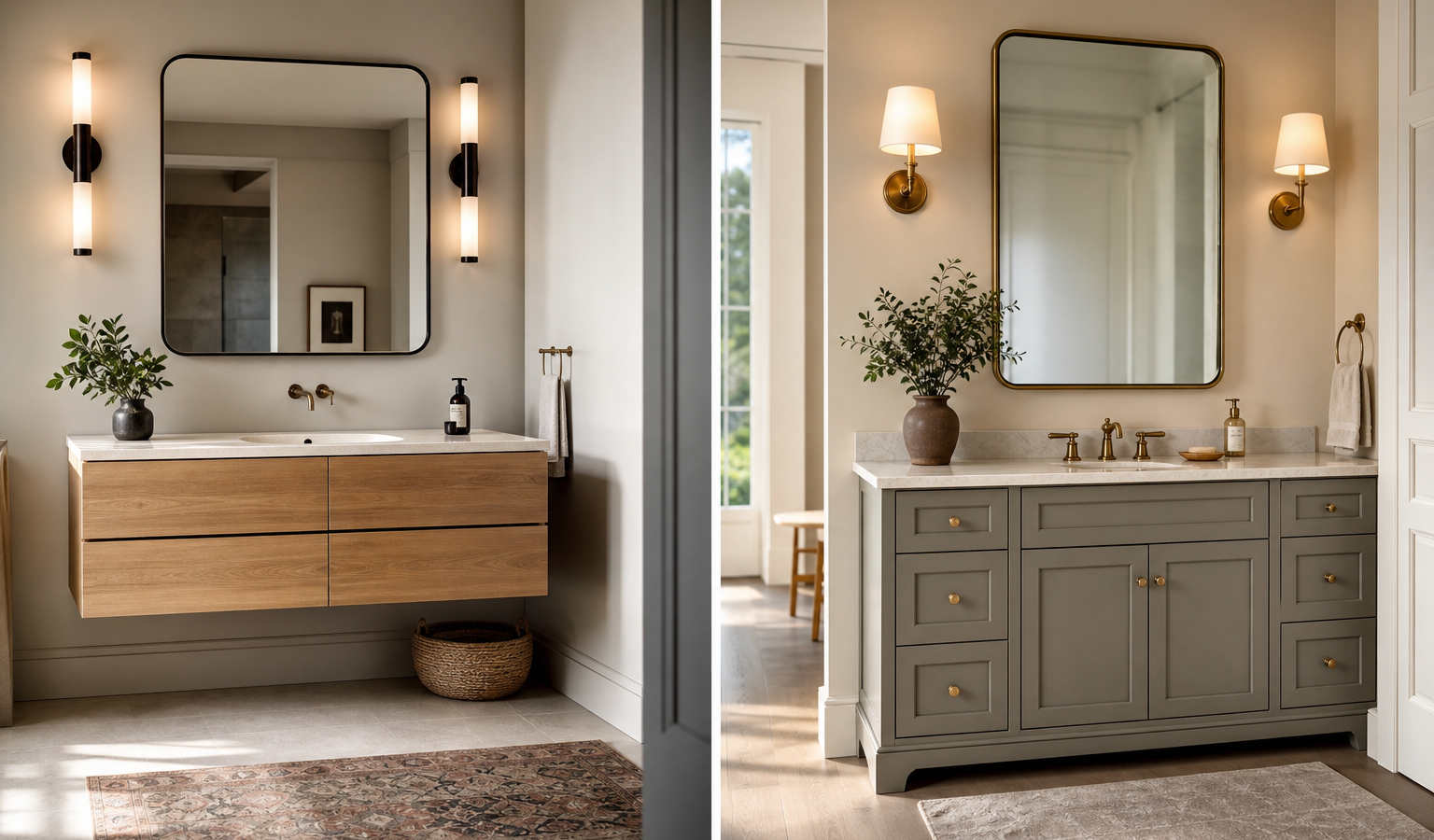
The choice of wall-hung vs floor vanity comes down to three things: the look you want, how much storage you need, and whether your wall can carry the load. A wall-hung (floating) vanity makes a bathroom feel larger and the floor easier to clean, but it needs reinforced framing and gives up some storage. A floor-mounted vanity is sturdier, holds more, and installs for less, which is why it remains the default in most US homes. Expect a 60-inch unit to cost roughly $1,200 installed on the floor and $1,300 to $1,500 floating, with the difference coming from the extra labor to support the wall.
Below you will find a side-by-side comparison of cost, storage, durability, accessibility, and installation, plus clear guidance on which style fits small baths, family baths, and accessible designs. Use it to pick the right base before you spend money on the cabinet and top.
Key takeaways
- Wall-hung vanities need in-wall blocking or a steel carrier to bear weight; floor-mounted units just need a level floor.
- Floating vanities make small bathrooms feel larger and let you set any height, including accessible heights.
- Floor-mounted vanities offer more storage and hide uneven floors, at a lower installed cost.
- A 60-inch vanity runs about $1,200 installed floor-mounted and $1,300 to $1,500 wall-hung.
- Choose floating for a modern look and easy cleaning; choose floor-mounted for maximum storage and durability.
Wall-hung vs floor vanity: cost compared in 2026
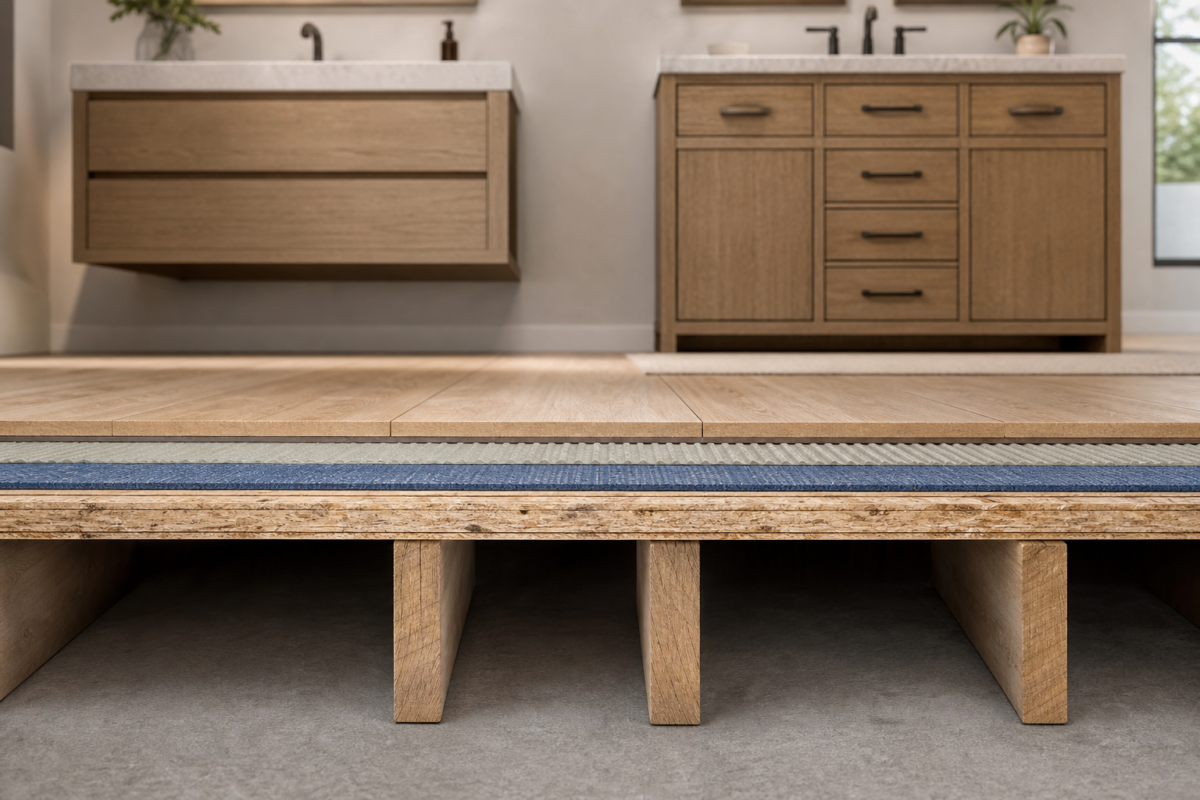
A floor-mounted vanity costs less to install than a wall-hung one, typically $1,200 versus $1,300 to $1,500 for a comparable 60-inch cabinet, because floating units require wall reinforcement. The cabinets themselves cost about the same; the gap is almost entirely labor.
A floor-mounted vanity sets on the floor and is secured with a few screws, adhesive, and caulk, which a pro can do in about an hour. A wall-hung vanity needs blocking added between the studs or a steel carrier frame, plus careful leveling to bear weight, which adds two to four hours of labor. If the wall is already finished and tiled, expect the higher end of that range, since the installer has to open and repair the surface to add support. Relocating the plumbing stub-outs higher on the wall for a floating unit can add a few hundred dollars more. For how a vanity fits the overall budget, see our bathroom remodel cost guide and the complete bathroom vanity guide.
| Factor | Wall-hung (floating) | Floor-mounted |
|---|---|---|
| Cabinet price (60 in) | $400 – $3,000 | $300 – $3,500 |
| Installation labor | $200 – $600 | $100 – $300 |
| Storage | Less (shorter cabinet) | More (full height) |
| Wall support | Blocking/carrier required | Not required |
| Floor cleaning | Easy (open below) | Harder (toe kick) |
| Best for | Small, modern, accessible baths | Family baths, max storage |
What is a wall-hung (floating) vanity?
A wall-hung vanity is a cabinet mounted directly to the wall with open space beneath it, so it appears to float. Because nothing touches the floor, it is set at whatever height you choose and makes the room feel more open.
Pros of a floating vanity
The floating design shows more floor, which tricks the eye into reading the room as larger, a real advantage in a compact bath. You can mop straight under it, with no toe kick to trap hair and dust. You can also mount it at any height, from a low kid-friendly setting to an accessible height with knee clearance for a seated user. The look is clean and contemporary, and pairing it with a vessel or undermount sink completes the modern feel; compare bowls in our bathroom vanity countertops guide.
Cons of a floating vanity
Floating vanities hold less because they are usually shorter top to bottom than a floor cabinet of the same width, and the open base removes the lowest storage zone. They demand a sound wall: you need blocking or a carrier, and a tile or plaster wall complicates the install. They also cannot bear much weight, so a child or senior who leans on one risks pulling it loose. Finally, the exposed plumbing under the cabinet must be neat, since it is visible unless you choose a model with a bottom panel.
What is a floor-mounted vanity?
A floor-mounted vanity is the traditional cabinet that rests on the floor on a toe-kick base. It is self-supporting, so it does not rely on the wall for strength and is the simplest type to install.
Pros of a floor-mounted vanity
Floor cabinets give you the most storage for the money, with full-height doors and drawers right down to the floor, and they hide the plumbing completely. They are sturdy enough to lean on and sit on, which matters in a family bath, and they forgive an uneven or imperfect wall. Because the cabinet carries its own weight, you also avoid any worry about wall strength, anchors pulling loose, or the cabinet sagging over years of use. Installation is fast and cheap because the cabinet carries its own load, which keeps labor low on a tight remodel budget. For households that need to squeeze in every cubic inch of storage, this is the practical winner; see more ideas in our bathroom storage ideas guide.
Cons of a floor-mounted vanity
The solid base can make a small room feel smaller and heavier. The toe kick collects dust, hair, and standing water, and you cannot mop cleanly underneath. An uneven floor may require shimming, and the fixed base height means you cannot easily set an accessible or custom height. The look reads more traditional, which is a plus or minus depending on your design.
Installation and wall support requirements
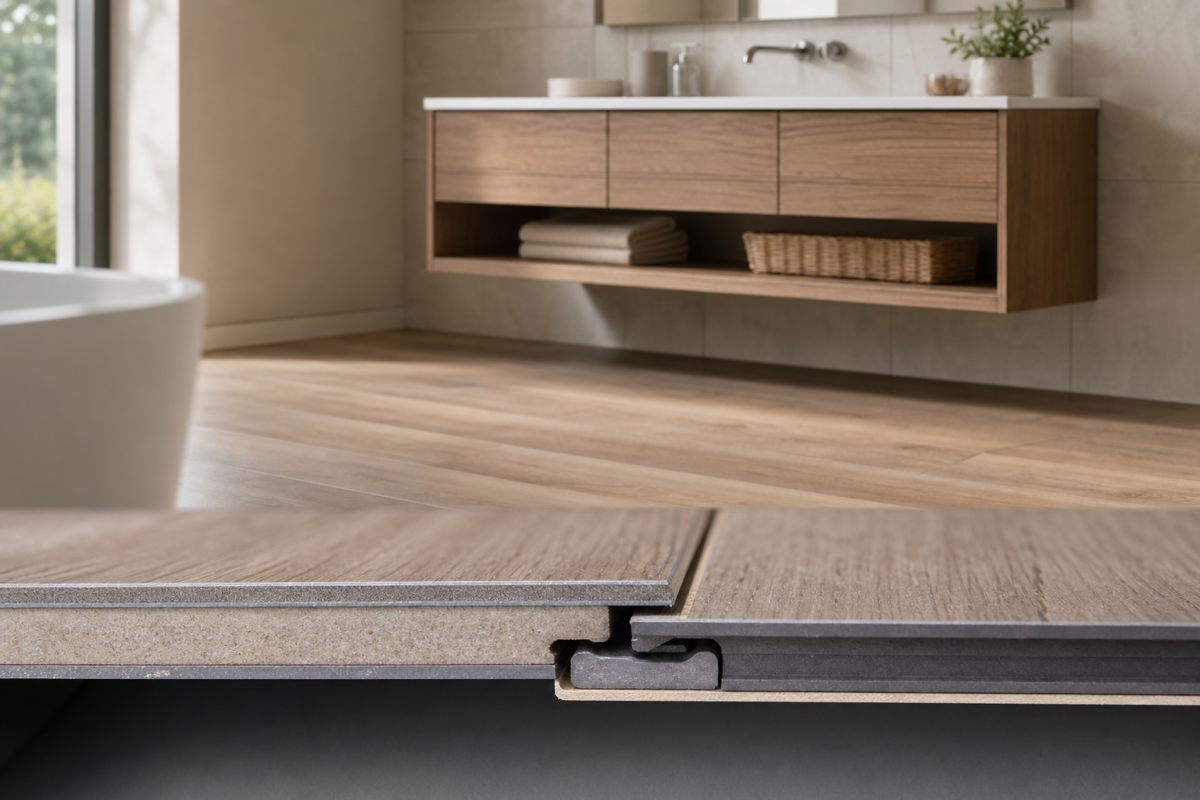
A wall-hung vanity requires solid blocking between the studs or a dedicated steel carrier bolted to the framing, because the wall alone carries the full weight of the cabinet, top, and anything inside. Skipping this step is the single most common floating-vanity failure.
Ideally the blocking goes in while the wall is open during framing or a remodel; retrofitting it means cutting and patching drywall. Mount the cabinet into the blocking with heavy lag bolts, not drywall anchors, and verify it is dead level before the top goes on. Floor-mounted units are far simpler: level the cabinet, shim the base to the floor, screw it to at least one stud, and caulk the backsplash. Either way, finish the flooring first so the vanity sits on a flat, waterproof surface; our bathroom flooring options guide covers the best choices.
Contractor’s take
If you love the floating look, decide before the walls close up. Adding a run of 2×8 or 3/4-inch plywood blocking behind the drywall costs almost nothing during framing and gives you a bombproof mount at any height. Retrofitting support into a finished, tiled wall is a different story. And be honest about who uses the bath: in a kids’ or guest bath where people grab the counter for balance, I steer clients to floor-mounted every time.
Which vanity is best for small bathrooms?
A wall-hung vanity is usually the better choice for a small bathroom because the exposed floor makes the room feel larger and more open. The visual breathing room often outweighs the modest storage you give up.
In a powder room or compact full bath, a shallow floating vanity can free up inches of walking space and still provide a sink and a drawer or two. A 18-inch-deep floating unit, versus a standard 21- to 22-inch floor cabinet, can be the difference between a door that clears the vanity and one that does not. Lighter-colored cabinets and a wall-mounted faucet amplify the open feel even further. If storage is critical, a floor-mounted unit with smart internal organization may still win, but for pure openness the floating style is hard to beat. See how fixtures fit tight footprints in our small bathroom remodel guide.
Style, design, and resale impact
Wall-hung vanities read as modern and spa-like, while floor-mounted units cover everything from traditional furniture-style pieces to transitional and contemporary looks. Match the base to the rest of the room rather than chasing a trend, because a vanity is a long-lived fixture.
Floating vanities pair naturally with linear drains, large-format tile, and minimalist hardware, and they photograph well, which can help in a design-forward market. Floor-mounted vanities with raised-panel doors and furniture legs suit classic and farmhouse baths and signal substance to buyers who value storage. Neither style clearly wins on resale; what matters is quality construction, a durable countertop, and a finish that fits the home. In a higher-end suite, either base can look custom when paired with the right top and fixtures, as shown in our bathroom vanity guide.
Durability, maintenance, and cleaning
Floor-mounted vanities tolerate moisture, leaning, and daily abuse better over the long haul, while wall-hung vanities win on floor cleaning and avoiding water-damaged toe kicks. Both last decades if built from plywood with a moisture-resistant finish rather than bare particleboard.
The most common failure in any bathroom vanity is swelling at the base from standing water, which is exactly the zone a floating vanity eliminates by keeping the cabinet off the floor. On the other hand, a floor cabinet protects the plumbing and resists the pull-out risk entirely. Wipe spills promptly, run the exhaust fan to control humidity, and reseal any natural-stone top on schedule. Whichever base you choose, the countertop and sink see the most wear, so invest there; weigh materials in our bathroom vanity countertops guide.
Accessibility and aging in place
Wall-hung vanities are the stronger choice for accessible and aging-in-place bathrooms because they can be mounted at a custom height with open knee space for a seated or wheelchair user. A floor cabinet’s fixed base blocks that clearance.
- Mount the top at a height that allows a seated user to roll underneath, per accessible design guidance.
- Choose a shallow bowl and insulate exposed pipes to prevent burns on knees.
- Use lever or touchless faucets that are easy to operate with limited grip.
- Confirm the wall support is rated for the cabinet plus any incidental leaning.
- Pair with a comfort-height toilet and grab bars for a complete accessible layout.
Follow the knee and toe clearance recommendations in the ADA standards, and verify fixture clearances against NKBA guidelines so the room works for every user. If you are weighing one sink against two in the same space, our double vanity guide covers the width tradeoffs.
Frequently asked questions
Your next move
You know the number. What are you deciding next?
Walk-in tub cost in 2026: $5,000 to $20,000 installed. Compare tub types, features, and the real Medicare coverage…
Continue →Bathroom remodel financing explained: compare home equity loans, HELOCs, cash-out refi, personal loans, and 0% cards with 2026…
Continue →Steam shower cost runs $3,000 to $10,000 installed in 2026. See prices by generator size, enclosure, and prefab…
Continue →Frequently asked
Are floating vanities less sturdy than floor vanities?
A properly installed floating vanity with correct blocking is very sturdy for normal use, but it cannot bear the leaning or sitting weight a floor-mounted unit can. If children or seniors routinely grab the counter for balance, a floor-mounted vanity is the safer choice.
Do wall-hung vanities cost more to install?
Yes, wall-hung vanities cost roughly $100 to $300 more in labor because the wall needs blocking or a steel carrier to bear the weight. The cabinets themselves cost about the same as comparable floor-mounted units.
Which vanity type offers more storage?
Floor-mounted vanities offer more storage because they are full height with doors and drawers down to the floor. Floating vanities are usually shorter and lose the lowest storage zone to the open base.
Can I convert a floor vanity to a floating one?
You can, but it usually means opening the wall to add blocking and relocating the plumbing stub-outs higher. Because of the added labor and patching, it is far cheaper to plan a floating vanity during a remodel than to convert later.
Is a floating vanity good for a small bathroom?
Yes, a floating vanity is one of the best upgrades for a small bathroom because the exposed floor makes the room feel larger. Choose a shallow model to free up even more walking space.

Comparison and pricing reflect 2026 US averages from Fixr and contractor labor rates.