Bathroom Grab Bars: Safety, Placement, and Cost Guide
The most cost-effective safety upgrade in any bathroom, done right.

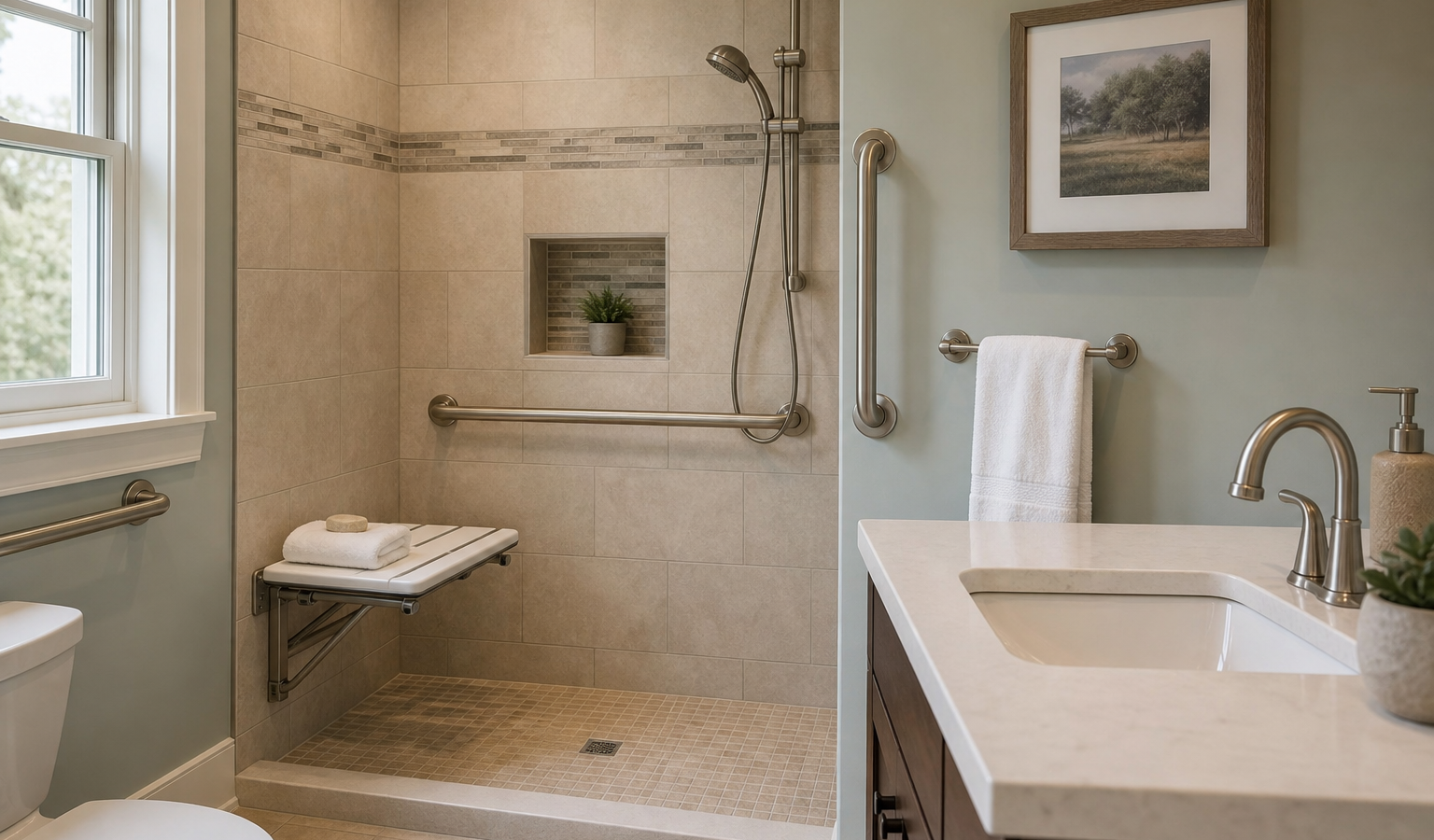
Well-placed bathroom grab bars are the single most cost-effective safety upgrade you can make in any home, turning the slickest, most fall-prone room into a space you can navigate with confidence. A $30 bar anchored into a wall stud routinely supports 500 pounds, and installing a small cluster of them can cut bathroom fall risk by roughly a third. This guide walks through the grab bar types that actually work, the ADA heights that make them usable, how to mount them so they hold, and what the hardware and professional installation cost in 2026.
Key takeaways
- Mount into studs or solid blocking; a bar screwed into bare drywall holds only 10 to 15 pounds and gives a false sense of safety.
- Standard horizontal bars belong 33 to 36 inches off the floor, with a 1.25 to 1.5 inch grip diameter and 1.5 inch wall clearance.
- ADA-compliant bars must carry at least 250 pounds; quality stainless bars are rated 500 pounds when stud-mounted.
- Expect $25 to $80 per bar for hardware and $100 to $300 per bar installed by a pro.
- Use suction-cup bars only as supplemental steadying aids, never as primary fall protection.
What bathroom grab bars do and who needs them
A grab bar is a wall-anchored bar that gives you a secure handhold for balance, transfers, and recovery from a slip in wet areas. Bathrooms account for a disproportionate share of household falls because tile, porcelain, and water combine into a low-traction surface right where people lower and raise their bodies. The U.S. Centers for Disease Control and Prevention reports that falls are the leading cause of injury among adults 65 and older, and a large share happen at home, many in the bathroom.
Grab bars are not only for seniors. They help anyone recovering from surgery, pregnant residents, people with balance disorders, and families who simply want a safer tub for young children. Because they add leverage at the toilet, the shower entry, and the tub wall, they reduce the awkward, off-balance movements that cause the worst spills. Planning them into an aging-in-place bathroom early is far cheaper than retrofitting after a fall, and the hardware has evolved enough that a well-chosen bar now reads as a towel bar rather than a hospital fixture.
Grab bar types compared
The best grab bar for a given spot depends on the motion it supports: pulling up, steadying sideways, or lowering down. Straight bars cover most needs, but vertical, angled, L-shaped, and flip-up bars each solve a specific problem. Suction bars are a different category entirely and should be treated as temporary.
| Type | Best use | Typical length | Notes |
|---|---|---|---|
| Straight horizontal | Side and back shower walls, tub long wall | 12 to 42 in (24 in common) | Most versatile; maximum stability for sideways balance |
| Vertical | Shower and tub entry, toilet side | 16 to 24 in | Helps pulling up from seated and stepping over a tub wall |
| Angled / diagonal | Beside the toilet, shower entry | 24 to 32 in | Set 30 to 45 degrees; easier for limited hand strength |
| L-shaped | Shower with a seat or bench | 24 x 24 in or 32 x 32 in | Combines sit-to-stand and lateral support in one unit |
| Flip-up (swing-away) | Toilet where there is no side wall | 28 to 32 in | Folds against the wall; some include a toilet paper holder |
| Suction cup | Light steadying only | 12 to 16 in | Temporary; rated 150 to 250 lb and loses hold over time |
When to choose a textured or knurled finish
Smooth chrome looks sleek but turns slick with wet or soapy hands. A lightly textured, knurled, or peened surface keeps grip security without the institutional ribbing of older medical bars. In a shower used by someone with arthritis or neuropathy, texture is worth prioritizing over the smoothest possible finish.
ADA height and placement standards
ADA guidance places horizontal grab bars 33 to 36 inches above the finished floor, with a 1.25 to 1.5 inch outside diameter and exactly 1.5 inches of clearance between the bar and the wall. That clearance matters: too little traps the hand, too much lets a falling arm slide through and jam at the elbow. These dimensions come from the U.S. Access Board and the Americans with Disabilities Act standards published at ada.gov, and even in a private home they are the right target because they match how bodies actually move.
Toilet grab bars
Place a 42-inch horizontal bar on the side wall, starting no more than 12 inches from the rear wall and running at least 54 inches from that wall, mounted 33 to 36 inches high. Add a 36-inch bar on the rear wall behind the toilet. Where there is no side wall, a swing-away flip-up bar fills the gap. A vertical bar from roughly 33 to 56 inches gives extra leverage for standing.
Shower grab bars
Run horizontal bars at 33 to 36 inches on the control wall and back wall, and add a vertical bar at the entry for balance while stepping over a curb. In a curbless shower the entry bar is even more valuable because the floor transition is subtle underfoot. If the shower has a bench, add a bar 8 to 10 inches above the seat.
Bathtub grab bars
Install two horizontal bars on the long wall, one at 33 to 36 inches and a lower one 8 to 10 inches above the tub rim for lowering into the water. A vertical bar at the faucet end supports the high, unstable step over the tub wall, which is the single most dangerous move in a traditional bathtub.
Weight capacity and materials
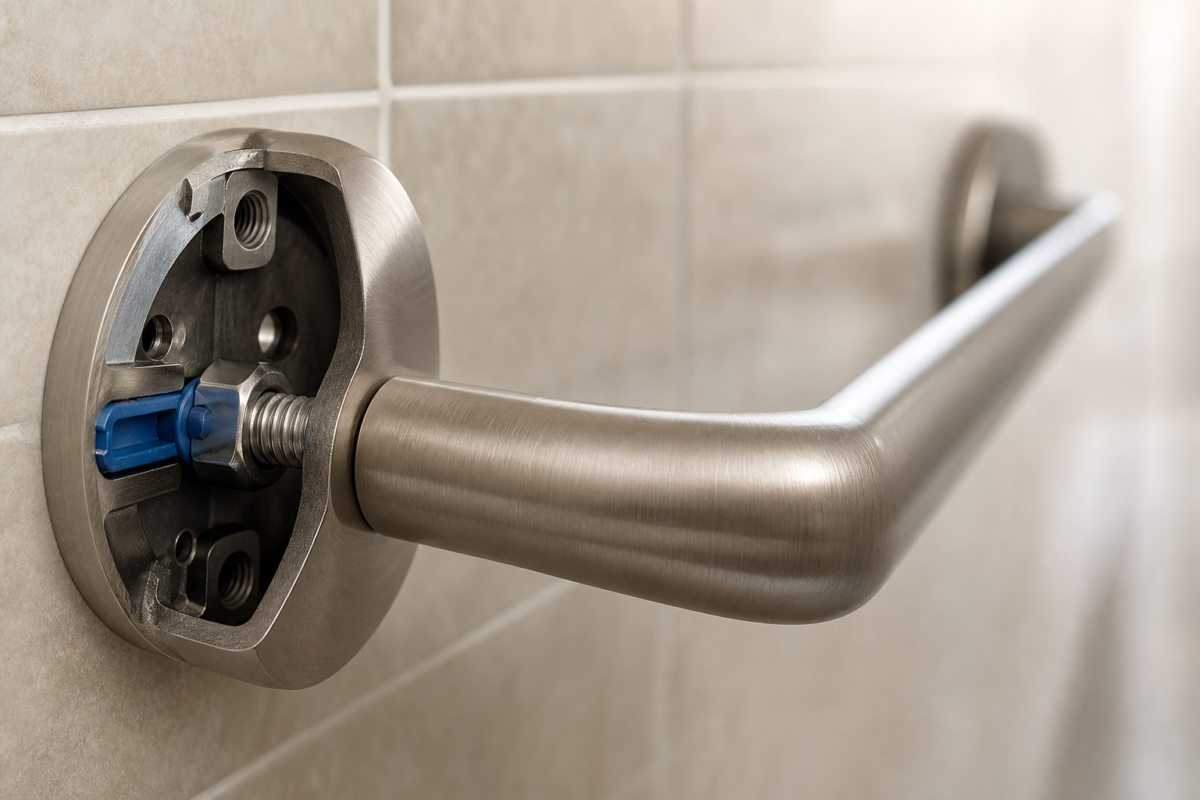
A compliant grab bar must support at least 250 pounds of force, but a quality stainless bar mounted into studs is typically rated to 500 pounds, and that margin is what you want under real fall conditions. The rating assumes correct mounting; the same bar in drywall anchors alone carries a fraction of its label.
Type 304 stainless steel is the workhorse material: strong, corrosion-proof in a wet room, and available in finishes from polished to matte black. Brass and bronze bars match period hardware and resist corrosion well. Avoid plastic and untreated wood for primary bars, since both degrade or grow slick in constant moisture. Match the bar finish to your faucet and other metals, a coordination step covered in depth in our guide to bathroom hardware and finish coordination, so safety hardware disappears into the design rather than announcing itself.
How grab bars mount so they actually hold
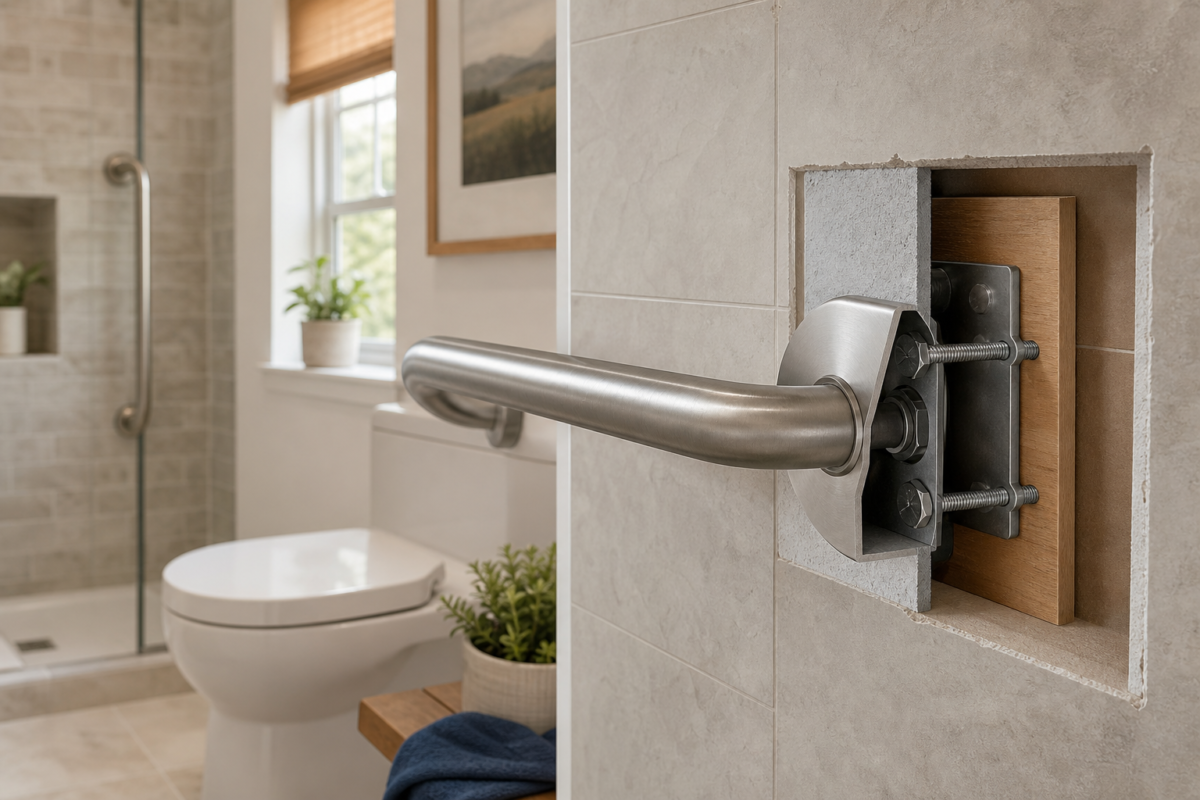
The strongest mount drives stainless lag screws directly into wall studs, which lets a bar carry its full 500-pound rating. Everything else is a compromise ranked by how reliably it transfers load into framing. The mounting method, not the bar itself, is what fails in most accidents.
Adding blocking during a remodel
If walls are open, add 2×6 or 3/4-inch plywood blocking between studs across the whole zone where bars might go, at toilet, shower, and tub. This costs almost nothing during framing and lets you place bars anywhere later, exactly where a body needs them rather than where a stud happens to land. It is one of the highest-value moves in a bathroom remodel and nearly impossible to add cheaply afterward.
Mounting into a fiberglass or acrylic surround
Through a shower surround, drive screws into the studs or blocking behind the panel, not into the panel alone, and seal every penetration with silicone to keep water out of the wall cavity. Steel mounting plates spread the load across a wider footprint and are the safest option when stud placement is awkward behind a one-piece unit.
What grab bars cost in 2026
Grab bar hardware runs $25 to $80 per bar, and professional installation adds $100 to $300 per bar depending on wall access and whether blocking must be added. Outfitting a full bathroom with four to six bars costs $150 to $400 in hardware alone, or $400 to $800 installed by a handyman or contractor.
| Scope | DIY (hardware) | Professional |
|---|---|---|
| Single bar, stud mount | $25 – $80 | $100 – $300 |
| Single bar needing blocking | $40 – $100 | $200 – $450 |
| Full bathroom (4 to 6 bars) | $150 – $400 | $400 – $800 |
| Designer / flip-up bars | $60 – $180 each | $160 – $480 installed |
Traditional Medicare does not cover grab bars, treating them as a home modification rather than durable medical equipment. Some Medicare Advantage plans, most Medicaid home and community-based services waivers, and the VA HISA grant do help, and groups like Rebuilding Together install bars free for qualifying low-income seniors and veterans. Folding grab bars into a larger project also improves bathroom remodel ROI by widening the pool of buyers who can live in the home.
Choosing finishes that match your bathroom
Pick a finish that matches your existing faucet, shower trim, and towel bars so the grab bar reads as intentional hardware. Designer lines from Moen, Delta, and Ponte Giulio offer grab bars in brushed nickel, matte black, polished chrome, and brushed gold that visually align with their faucet collections, and several double as towel bars or shelves.
The trick is to treat the grab bar as part of the same metal story as the rest of the room. If your shower niche trim and faucet are brushed nickel, a matte black bar will jump out. Consistency is what keeps safety hardware from looking clinical, and it is the same logic that governs mixing metals anywhere in the space.
Contractor’s take
Before I close up any bathroom wall, I run a continuous band of 2×6 blocking at 32 to 38 inches around the toilet, tub, and shower, whether or not the homeowner wants bars today. It adds maybe $40 in lumber and twenty minutes of labor, and it means that five years from now a bar goes up anywhere on that wall with four lag screws and no demolition. The homeowners who skip it always call back, and by then the fix means opening finished tile.
Installation mistakes that make bars dangerous
Most grab bar failures trace to a handful of avoidable errors, and nearly all involve how the bar meets the wall. Run through this checklist before trusting any bar with your weight.
- Never rely on drywall anchors for a primary bar; hit studs or solid blocking every time.
- Use stainless steel lag or wood screws at least 2.5 inches long, not short drywall screws.
- Seal every screw penetration in a wet wall with silicone to prevent rot and mold.
- Keep bars at 33 to 36 inches; mounting too high shifts your center of gravity on a pull.
- Install more than one bar so there are no unsupported gaps between the toilet, tub, and shower.
- Test each bar with your full body weight and a hard tug before the first real use.
Skipping bars while chasing a minimalist look is its own mistake, and it shows up often in our roundup of common bathroom remodel mistakes. Safety and style are not a trade-off once the hardware is coordinated.
Frequently asked questions
Your next move
You know the number. What are you deciding next?
Walk-in tub cost in 2026: $5,000 to $20,000 installed. Compare tub types, features, and the real Medicare coverage…
Continue →Bathroom remodel financing explained: compare home equity loans, HELOCs, cash-out refi, personal loans, and 0% cards with 2026…
Continue →Steam shower cost runs $3,000 to $10,000 installed in 2026. See prices by generator size, enclosure, and prefab…
Continue →Frequently asked
How much weight can a bathroom grab bar hold?
A grab bar mounted into studs or solid blocking typically holds 500 pounds, and ADA rules require a minimum of 250 pounds. That rating depends entirely on the mount; the same bar in drywall anchors alone may fail under 50 pounds.
Are suction-cup grab bars safe?
Suction bars are fine as a light steadying aid but should never be the only support in a shower or tub. Heat, humidity, and soap film loosen the seal over time, and they can release without warning when you shift your weight.
At what height should grab bars be installed?
Mount horizontal bars 33 to 36 inches above the finished floor. Near a tub, add a second bar 8 to 10 inches above the rim, and use vertical bars at entries where you need leverage to stand or step over a wall.
Can I install grab bars myself?
Yes, if you can locate studs and drive lag screws into them squarely. The job gets harder when no stud lands where you need the bar; then you need blocking behind the wall or heavy steel mounting plates, and that is where many homeowners bring in a pro.
Does Medicare pay for grab bars?
Original Medicare does not, because it classifies grab bars as a home modification rather than durable medical equipment. Some Medicare Advantage plans, Medicaid waivers, and the VA HISA grant can cover them, so check your specific plan before paying out of pocket.

Prices and specs reflect 2026 US averages and ADA guidance.