Bathroom Faucet Buying Guide: Types, Finishes, and 2026 Costs
Everything that goes into choosing a bathroom faucet that looks great and lasts - from hole spacing and valves to finishes and 2026 pricing.

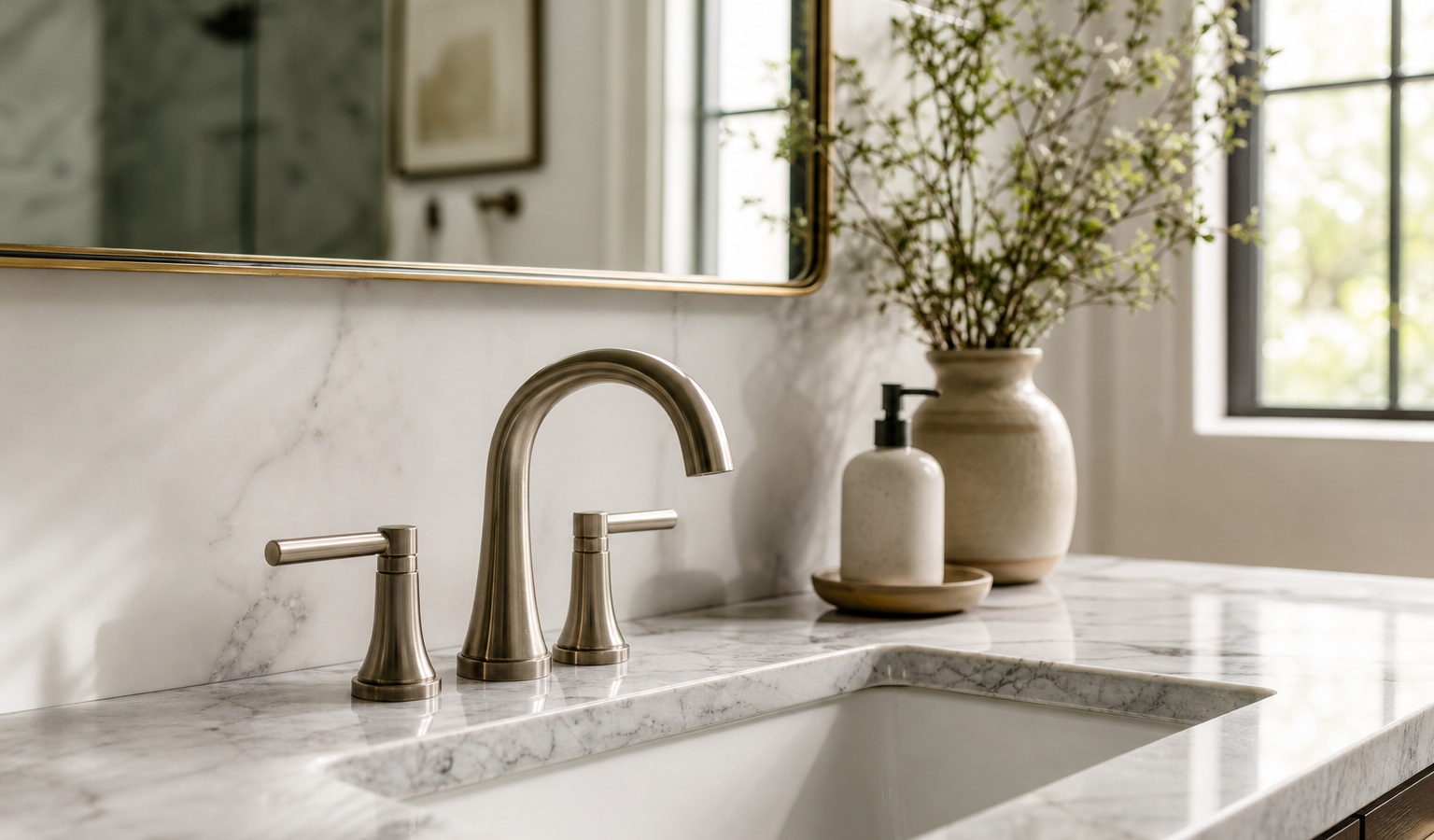
A new bathroom faucet is one of the highest-impact, lowest-cost upgrades you can make to a vanity, but the choices behind that shiny fixture are deeper than they look. Spout height, hole spacing, valve quality, finish durability, and flow rate all shape how the faucet looks, feels, and holds up over a decade of daily use. This guide breaks down every decision so you can buy the right faucet the first time, whether you are refreshing a powder room or planning a full renovation. Expect real 2026 US pricing, sizing rules that match your sink, and the trade-offs pros weigh before they ever pick up a wrench.
Most homeowners spend more time choosing tile than they do choosing the faucet they will touch a dozen times a day. That is backwards. A well-built faucet paired with the right vanity at the sink pays you back in reliability and feel, while a bargain model with a plastic cartridge starts dripping within a couple of years. We will show you how to spot the difference and where your money actually matters.
Key takeaways
- Expect to pay $80 to $400 for a quality bathroom faucet in 2026, with a sweet spot around $150 to $250 for a ceramic-disc model that lasts.
- Match the faucet to your sink first: single-hole, 4-inch centerset, or 8-to-16-inch widespread are the three configurations that cover most vanities.
- Prioritize a ceramic-disc valve and a solid-brass body – these two features separate a 15-year faucet from a 3-year one.
- Choose a WaterSense-labeled model (1.5 GPM or less) to cut water use about 30 percent without a noticeable drop in performance.
- Professional installation runs $150 to $350; a confident DIYer can do it in 1 to 2 hours with basic tools.
How much does a bathroom faucet cost in 2026?
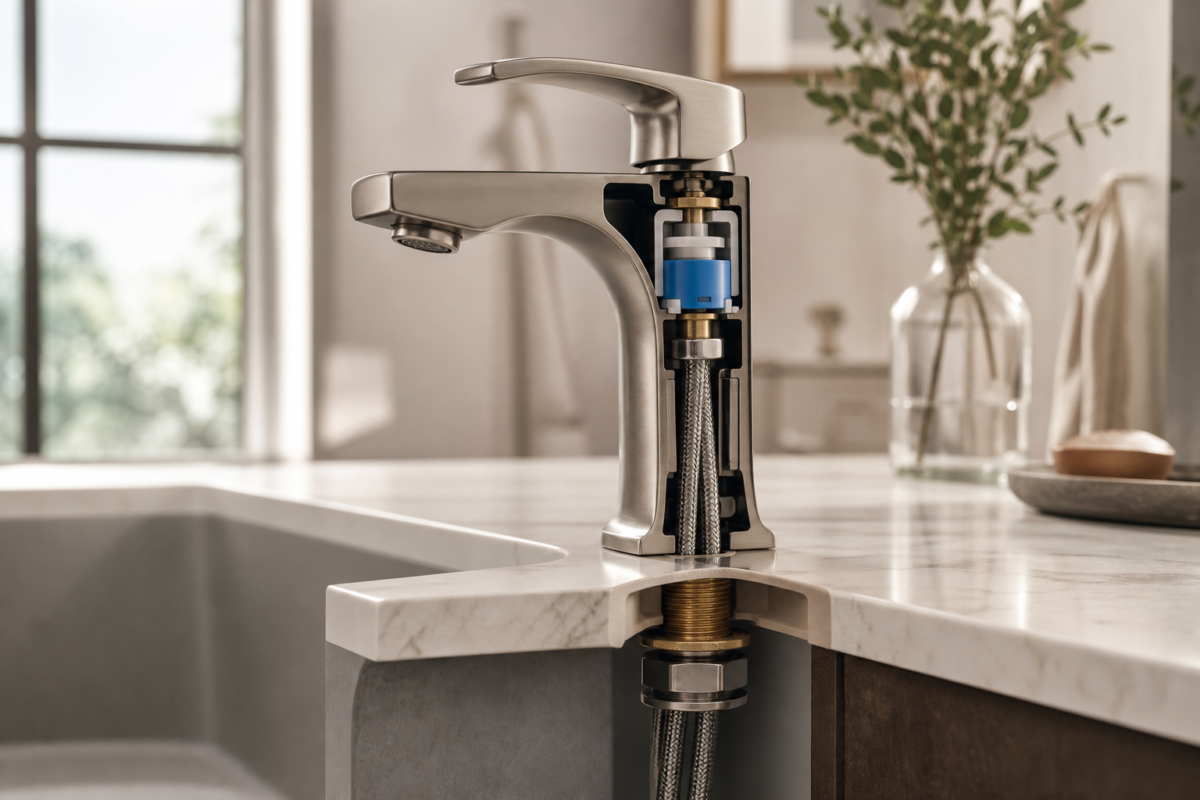
Most quality bathroom faucets cost $80 to $400 in 2026, and the reliable middle of the market sits at roughly $150 to $250. Below $80 you are usually buying a plastic-bodied fixture with a rubber-washer valve that will need service within a few years; above $500 you are paying for designer branding, exotic finishes, and premium spout geometry rather than better function.
Price is driven far more by internal build quality than by looks. A $120 faucet and a $600 faucet can look nearly identical on a vanity, but the expensive one typically has a heavier solid-brass body, a longer-warranty ceramic cartridge, and a finish that resists tarnish. If you are budgeting a whole room, our bathroom remodel cost guide and small bathroom remodel budget break down where the faucet fits in the larger picture.
| Tier | Price range (fixture only) | What you get | Typical lifespan |
|---|---|---|---|
| Budget | $40 – $80 | Plastic or zinc body, rubber-washer or basic cartridge, limited finish options | 2 – 5 years |
| Mid-range | $150 – $250 | Solid-brass body, ceramic-disc valve, WaterSense options, popular finishes | 10 – 15 years |
| Premium | $300 – $500 | Heavier brass, PVD finishes, precise spout design, longer warranty | 15 – 25 years |
| Designer | $500 – $1,200+ | Boutique brands, unusual finishes and forms, artisan handles | 15 – 25 years |
What drives the price of a bathroom faucet
The four levers below account for most of the difference between a cheap faucet and one worth keeping. Valve type and body material matter most for longevity; finish and features matter most for how the faucet looks and behaves day to day.
What are the main bathroom faucet types?
The five common bathroom faucet types are single-hole, centerset, widespread, wall-mount, and vessel – and the right one is dictated first by your sink, then by your style. Get the configuration wrong and no amount of good looks will save the install.
Single-hole faucets
A single-hole faucet mounts through one opening and combines spout and handle in a single unit, making it the easiest to install and the cleanest to look at. It is the default for small vanities, powder rooms, and modern designs. Many models ship with an optional escutcheon (deck plate) so they can also cover a three-hole sink, which makes them the most flexible choice for a vanity swap.
Centerset faucets
Centerset faucets fit sinks with three holes spaced 4 inches apart and mount the spout and handles on a single base plate. They are the workhorse of standard American bathrooms and the most budget-friendly three-hole option. Choose centerset when your existing sink has 4-inch centers and you want a simple, proven layout.
Widespread faucets
Widespread faucets separate the spout and two handles as individual pieces spanning 8 to 16 inches. They deliver an upscale, custom look and suit larger vanities and double-sink layouts. Because each piece mounts independently, installation is slightly more involved, but the payoff is a high-end appearance that pairs well with premium tile and finishes.
Wall-mount and vessel faucets
Wall-mount faucets install above the sink on the wall and require a separate in-wall valve, so they are best planned during construction or a full remodel rather than added later. Vessel faucets are tall models designed to arch over above-counter basins; they need a minimum spout height of about 4 inches of clearance above the vessel rim to avoid splashing. Both make a bold statement but demand precise rough-in planning.
How do I match a faucet to my sink hole configuration?
Count the holes in your sink or countertop and measure the distance between the outer holes before you buy anything. One hole means single-hole; three holes at 4 inches on center means centerset; three holes at 8 inches or more means widespread. This single measurement prevents the most common return at the plumbing counter.
If you are replacing an old faucet, the safest move is to match the existing hole pattern. If you are installing a new sink or countertop, decide on the faucet style first, then have the holes drilled to match – especially important when you are also updating a vanity top or countertop at the same time.
| Configuration | Holes | Spacing | Best for |
|---|---|---|---|
| Single-hole | 1 | n/a | Small vanities, modern powder rooms |
| Centerset | 3 | 4 in on center | Standard baths, budget-friendly builds |
| Widespread | 3 | 8 – 16 in | Large vanities, double sinks, upscale looks |
| Wall-mount | 0 (in-wall valve) | Varies | New construction, vessel and trough sinks |
Which bathroom faucet finish should you choose?
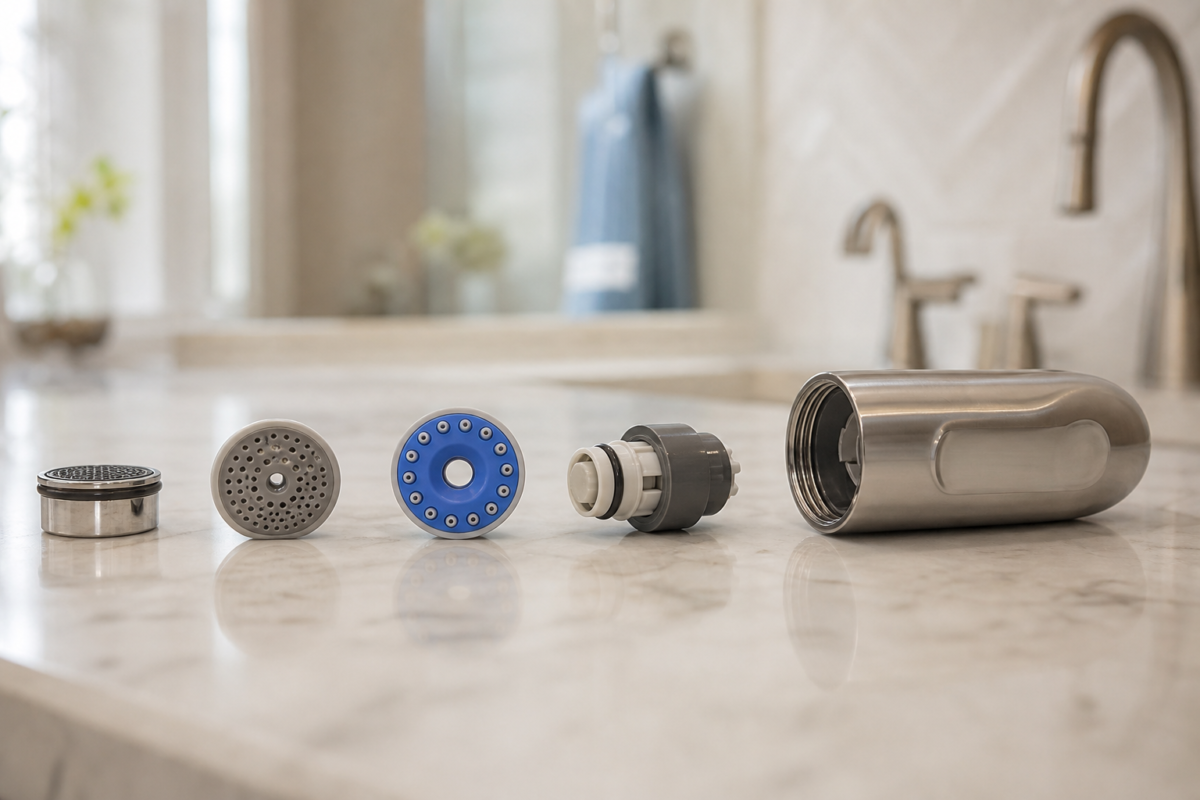
For most homeowners in 2026, brushed nickel and matte black are the safest, most durable, and most on-trend finishes – both hide water spots and fingerprints far better than polished chrome. The right finish balances durability, cleaning effort, and how well it coordinates with your hardware, lighting, and shower trim.
| Finish | Look | Fingerprints/spots | Notes |
|---|---|---|---|
| Brushed nickel | Warm, satin silver | Hides well | The reliable all-rounder; matches most decor |
| Matte black | Bold, modern | Hides well | On-trend; needs gentle cleaners to avoid dulling |
| Chrome | Bright, classic | Shows easily | Cheapest and most durable finish; high maintenance to keep spotless |
| Brushed gold/brass | Warm, luxe | Hides well | Popular warm accent; verify it is a PVD finish for longevity |
| Oil-rubbed bronze | Dark, traditional | Hides well | Living finish that ages; great for classic baths |
Matching finishes across the bathroom
You do not have to match every metal, but you should coordinate. A common pro approach is to keep the faucet, cabinet hardware, and towel bars in one finish family, then allow the light fixture or mirror frame to introduce a second accent. Mixing more than two metal tones usually reads as an accident rather than a choice.
What valve and handle types actually matter?
Insist on a ceramic-disc valve – it is the single most important spec for a drip-free faucet that lasts. Ceramic discs seal without rubber washers that wear out, which is why nearly every quality faucet uses them today. Cheaper compression and ball valves are more prone to leaks and service.
Handle choice is mostly ergonomic. Single-handle faucets let you set temperature and flow with one motion and are the easiest for kids and anyone with limited grip; two-handle designs give precise separate control and a traditional look. Lever handles meet accessibility guidance more easily than knobs, which is worth considering for aging-in-place or ADA-minded projects. Look for a solid-brass body under the finish – it resists corrosion far better than zinc alloy or plastic.
Contractor’s take
Before you buy, check the manufacturer warranty on the finish and cartridge separately. The best mid-range brands back both for life, and a lifetime cartridge warranty tells you they trust the valve. When I install a faucet, I also swap in braided stainless steel supply lines and a quarter-turn shutoff even if the old ones look fine – that $15 upgrade prevents the slow drip that rots a vanity floor from underneath.
How does flow rate and water efficiency affect your choice?
Choose a WaterSense-labeled faucet rated at 1.5 gallons per minute (GPM) or less to cut sink water use by about 30 percent versus the 2.2 GPM federal maximum, with no meaningful loss in everyday performance. Bathroom faucets are used for hand-washing and grooming, not filling pots, so a lower flow rate rarely feels different.
The EPA WaterSense program independently certifies these models, and many utilities offer rebates on them. Over a year, a WaterSense faucet in a busy household can save hundreds of gallons and trim both water and water-heating bills. If sustainability is a priority across your project, pair the faucet with efficient fixtures elsewhere and good ventilation to protect the room from moisture damage.
What faucet features are worth paying for?
Pay for a ceramic-disc valve, a WaterSense flow rate, and a durable PVD finish; treat touchless and smart features as nice-to-haves rather than necessities. The chart below shows where extra dollars deliver the most real-world value in a bathroom faucet.
Touchless faucets, once rare in homes, are more common and affordable in 2026 and genuinely help in shared or kids bathrooms. Just remember they need batteries or a transformer, so plan for power under the sink. A matching pop-up or grid drain is an inexpensive upgrade that makes a faucet look finished.
Should you install a bathroom faucet yourself or hire a pro?
Swapping a like-for-like faucet is a realistic 1-to-2-hour DIY job for a confident homeowner; hire a plumber ($150 to $350) when you are changing hole configurations, moving to a wall-mount, or dealing with corroded shutoffs. The work itself is straightforward, but tight cabinet access and stuck fittings are what turn a quick swap into an afternoon.
What a DIY faucet swap requires
You will need an adjustable wrench, a basin wrench for the nuts up behind the sink, plumber tape, a bucket, and a towel. Shut off the supply valves, disconnect the lines, remove the old faucet, set the new one with its gasket, reconnect braided supply lines, then run water and check every joint for leaks. Budget extra time if your shutoff valves are old – replacing a seized quarter-turn valve is the one step where many DIYers decide to call a pro.
- Confirm hole count and spacing match the faucet
- Verify a ceramic-disc valve and solid-brass body
- Choose a WaterSense 1.5 GPM model where possible
- Coordinate the finish with hardware and lighting
- Buy braided stainless supply lines and new shutoffs
- Check the finish and cartridge warranties before purchase
Common bathroom faucet mistakes to avoid
The biggest mistake is buying for looks and ignoring the valve and body material inside. Close behind is mismatching the faucet to the sink hole pattern, which forces returns or awkward deck plates. Homeowners also frequently overspend on a designer finish while underspending on the cartridge that actually determines lifespan.
Two more traps: forgetting to check spout reach and height (a spout that is too short splashes outside the bowl, one too tall splashes inside it), and skipping the drain assembly so a new faucet sits above a tired old drain. Plan the faucet, drain, and vanity as a set for a cohesive result.
Your next move
You know the number. What are you deciding next?
Compare bathroom sink types, vessel, undermount, pedestal, and wall-hung, with pros, cons, materials, and 2026 installed costs.
Continue →Walk-in tub cost in 2026: $5,000 to $20,000 installed. Compare tub types, features, and the real Medicare coverage…
Continue →Bathroom remodel financing explained: compare home equity loans, HELOCs, cash-out refi, personal loans, and 0% cards with 2026…
Continue →Frequently asked
Are expensive bathroom faucets worth it?
Up to the mid-range, yes – paying for a ceramic-disc valve and solid-brass body buys real longevity. Beyond about $400, you are mostly paying for brand, finish, and design rather than better function, so premium pricing is a style choice, not a performance one.
What is the most durable bathroom faucet finish?
Chrome is technically the most durable and easiest to keep from corroding, but it shows water spots. For a balance of durability and low maintenance, brushed nickel and PVD-coated finishes like brushed gold hold up extremely well and hide fingerprints.
How do I know if my faucet is 4-inch or 8-inch?
Measure center-to-center between the two outer holes in your sink. Four inches means a centerset faucet; eight inches or more means a widespread faucet. A single hole takes a single-hole faucet.
Can I replace a bathroom faucet myself?
Yes, a like-for-like swap takes most confident DIYers one to two hours with an adjustable wrench and a basin wrench. Call a plumber if you are changing the hole configuration or your shutoff valves are corroded and will not turn.
What GPM should a bathroom faucet be?
Aim for a WaterSense-labeled faucet at 1.5 GPM or lower. It uses about 30 percent less water than the 2.2 GPM federal maximum while still feeling perfectly normal for hand-washing and grooming.

Prices reflect 2026 US retail and installation ranges from major plumbing retailers and contractor estimates.