Bathroom Lighting Guide: Layers, Fixtures and 2026 Costs
Light your bathroom in layers with the right lumens, color and code-rated fixtures. Here is what a smart plan costs in 2026.

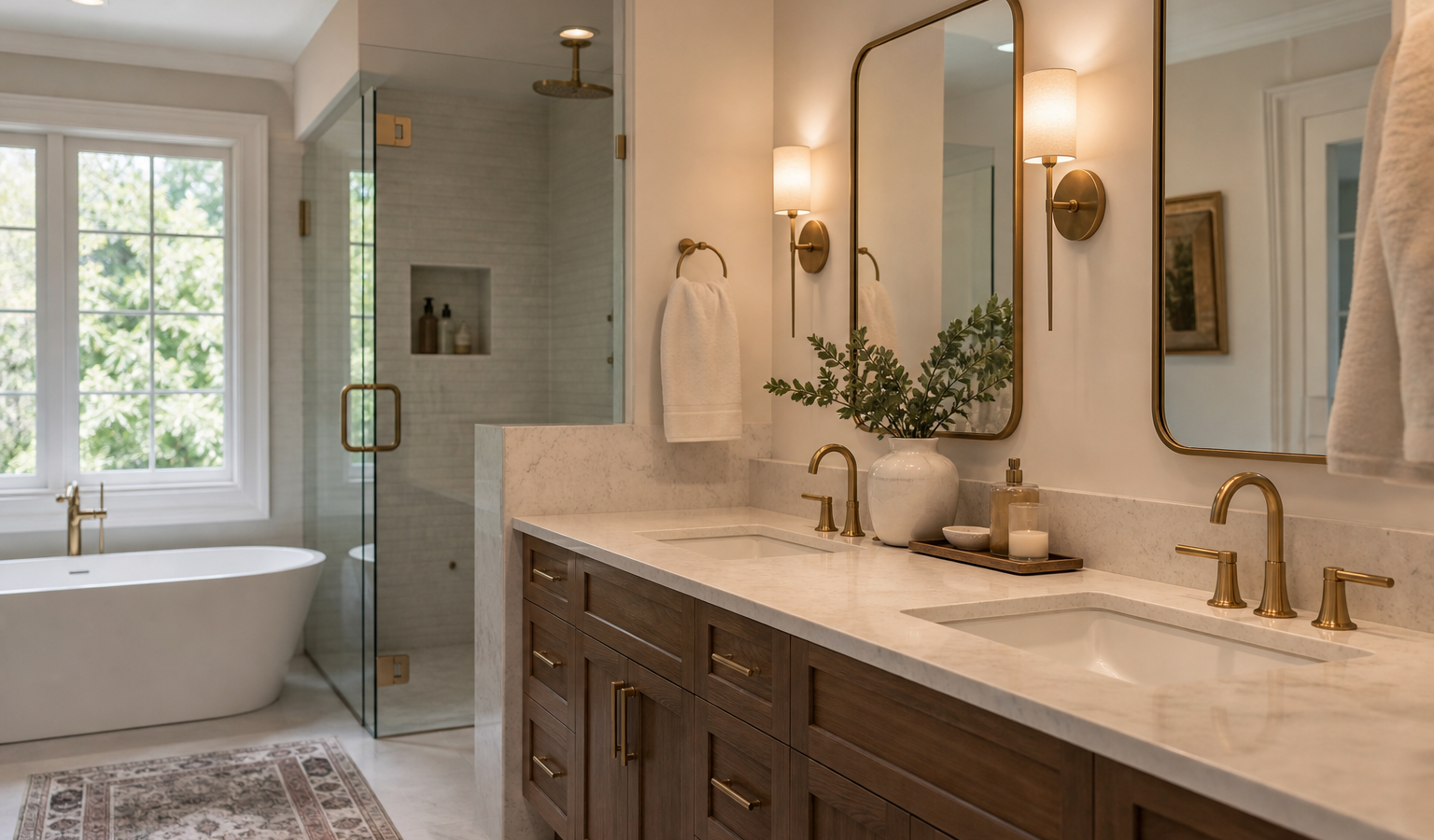
Good bathroom lighting is the difference between a room that feels like a spa and one that makes you look tired before your morning coffee. Yet lighting is the layer most homeowners underthink, defaulting to a single fixture over the mirror and calling it done. This bathroom lighting guide walks through the layers, fixtures, bulb specs, and real 2026 US costs so you can plan a scheme that flatters your face, meets electrical code, and fits your budget. Whether you are refreshing a powder room or wiring a full primary suite, the principles are the same: light in layers, put the right output where you actually use it, and choose fixtures rated for a wet environment.
Key takeaways
- A full bathroom lighting plan runs $300 to $2,000 installed in 2026, with a national average near $850.
- Light in three layers: ambient for the room, task at the mirror, and accent for depth.
- Aim for 1,600 to 2,000 lumens at the vanity, 3000K to 4000K color, and 90+ CRI for accurate skin tone.
- Every fixture near the tub or shower must be damp or wet rated, and receptacles need GFCI protection.
- Dimmers on each layer are the single cheapest upgrade for comfort and resale appeal.
How much does bathroom lighting cost in 2026?
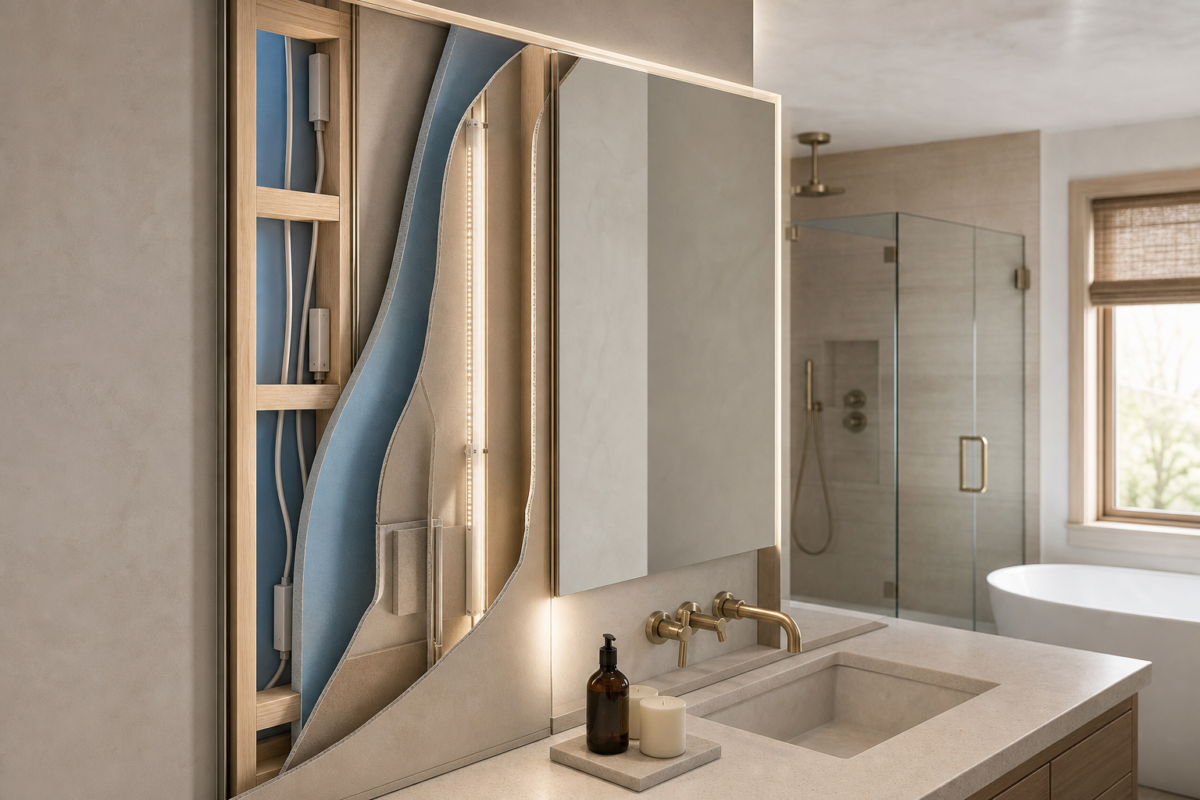
A complete bathroom lighting upgrade costs $300 to $2,000 installed in 2026, with a national average around $850 for a standard full bath. Simple fixture swaps on existing wiring land near $300, a mid-range multi-layer plan runs about $1,000, and a premium primary bath with backlit mirrors, recessed cans, and dimmers can reach $3,000 or more. The single biggest cost driver is whether an electrician has to run new wiring and cut into walls, or simply replace fixtures on circuits that already exist. Swapping a vanity bar for another vanity bar is fast; adding four recessed cans, a shower light, and a new switch loop is a small electrical project.
Because lighting rides along with the rest of a renovation, it helps to see the number in context of your full project budget planning approach and the return on remodeling investment you can expect. Lighting is inexpensive relative to cabinetry or tile, but it punches far above its weight in how finished a space feels.
| Fixture type | Fixture price | Installed cost each | Best use |
|---|---|---|---|
| Vanity light bar | $40 – $500 | $140 – $650 | Primary task light over mirror |
| Wall sconces (pair) | $120 – $400 | $200 – $600 | Shadow-free face lighting |
| Recessed can light | $20 – $60 | $150 – $300 | Ambient and shower fill |
| Backlit LED mirror | $200 – $800 | $300 – $1,100 | Modern task plus accent glow |
| Flush-mount ceiling | $50 – $250 | $150 – $400 | General ambient in small baths |
What are the three layers of bathroom lighting?
The three layers of bathroom lighting are ambient (overall room fill), task (focused light for grooming), and accent (decorative depth). A room that uses all three feels balanced and adjustable; a room with only one feels flat and often casts unflattering shadows. Professional designers, including guidance echoed by the National Kitchen and Bath Association, treat these layers as the backbone of any lighting plan, exactly the same principle we cover in our kitchen lighting layers guide.
Ambient lighting for the whole room
Ambient light is your baseline. Plan for roughly 20 lumens per square foot of floor area, delivered by recessed cans, a central flush mount, or a combination. In a 50 square foot bath, that means about 1,000 lumens of general light before you add anything at the mirror. Spread recessed cans 3 to 4 feet apart and keep them out of the exact center so the ceiling does not create a single hot spot.
Task lighting at the vanity
Task light is the layer that actually helps you shave, apply makeup, or check your reflection. The best task lighting comes from the sides of the mirror, not overhead, because top-down light drops shadows into your eye sockets and under your chin. This is the bathroom equivalent of the shadow-free task light we recommend from under-cabinet lighting in a kitchen.
Accent lighting for depth and mood
Accent light is the finishing touch: toe-kick LEDs under a floating vanity, a small pendant in a corner, a niche light in the shower, or a statement fixture that works like the pendant lights over a kitchen island. It carries no functional load, so keep it low output and on its own dimmer for evening ambiance.
How do you light a vanity mirror correctly?
Light the vanity from both sides at eye level, aiming for 1,600 to 2,000 total lumens across the mirror. Two vertical sconces mounted at 60 to 66 inches from the floor and 3 to 4 inches out from each mirror edge produce the most flattering, shadow-free result. If a side-mount layout will not fit, a horizontal bath bar is the fallback: extend it to about three-quarters of the mirror width and center it above.
Each individual sconce should output 700 to 800 lumens, so a matched pair lands squarely in the 1,600 to 2,000 lumen sweet spot. For a double vanity, treat each sink as its own zone and light it independently rather than stretching one long bar across the whole wall, which leaves the middle bright and the ends dim. Sconce height should fall between one-third and two-thirds of the mirror height so the light source sits near face level.
What color temperature and CRI should bathroom lighting use?
Use bulbs rated 3000K to 4000K with a Color Rendering Index of 90 or higher. This neutral-to-soft-white range reads clean without turning clinical, and high CRI means the light reveals true skin tone and makeup color instead of muddying it. Skip 2700K, which is too yellow for grooming, and avoid 5000K and up, which feels like a hospital corridor.
Consistency matters as much as the number itself. Mixing a 2700K vanity bulb with a 4000K recessed can will make the room look mismatched and your reflection unreliable, so buy all your bathroom bulbs in one color temperature. Choose ENERGY STAR certified LED lamps where possible; the ENERGY STAR program verifies both efficiency and light-quality claims, and quality LEDs now hold their color for well over a decade of daily use.
Which bathroom light fixtures work best?
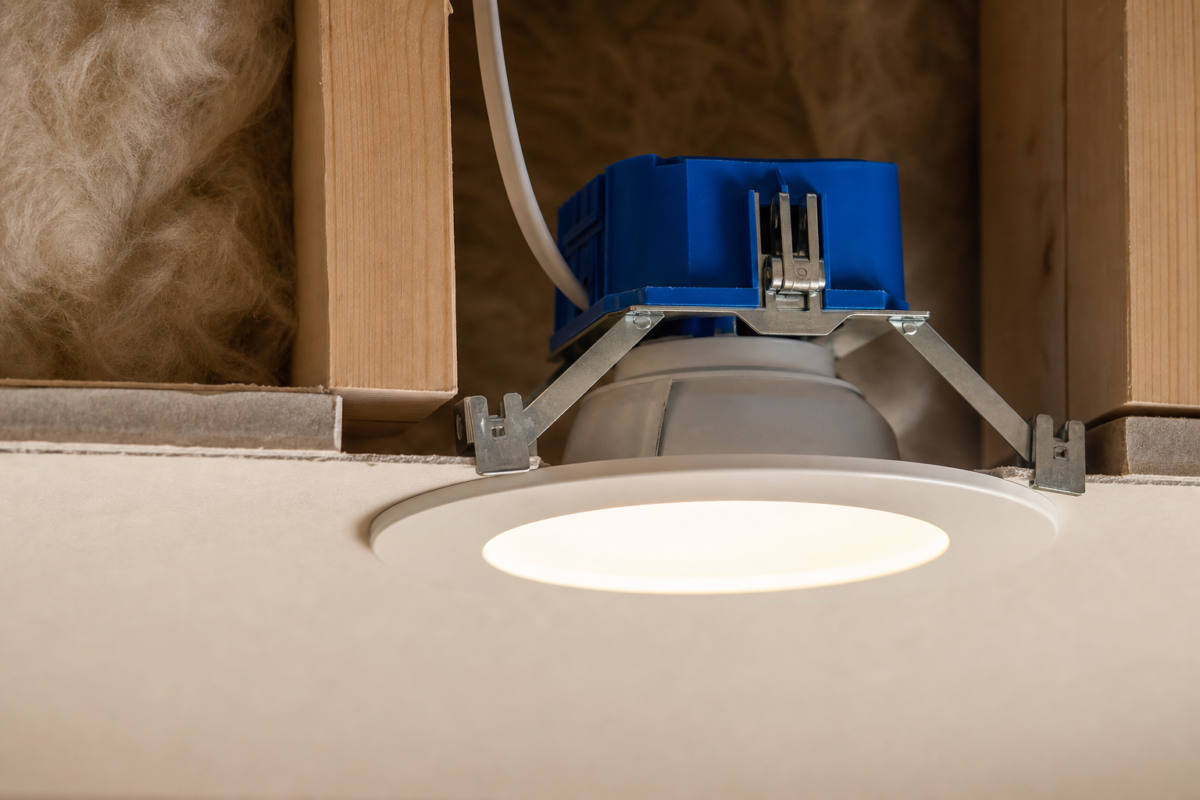
The best fixture depends on the layer it serves: sconces and backlit mirrors for task, recessed cans and flush mounts for ambient, and small pendants or LED strips for accent. There is no single winner, because a complete plan uses several fixture families together. What follows is how each type earns its place and where it tends to disappoint.
Vanity bars versus side sconces
A vanity bar is the budget-friendly default and installs on a single junction box, but it lights from above and can shadow the face. Side sconces cost more and need two boxes, yet they deliver noticeably better task light. If your walls are already open during a remodel, spend the extra to wire for sconces; retrofitting them later means patching drywall.
Backlit and lighted mirrors
Backlit LED mirrors have become the signature look of 2026 baths, combining task and accent in one clean fixture. They cost $200 to $800 for the mirror plus $100 to $300 to install, and many include anti-fog heating pads and integrated dimming. The tradeoff is that a backlit-only mirror throws light around your face rather than onto it, so pair it with recessed or ambient light for grooming.
Recessed cans and shower lights
Recessed cans are the workhorse of ambient light and the only sensible way to light a shower. A single wet-rated can inside the shower, outputting 500 to 750 lumens, keeps the enclosure from becoming a dark cave. Use IP44 rated trims at minimum and IP65 for direct-spray zones.
What are the code rules for bathroom lighting?
Any fixture in the bathroom must be damp rated, and any fixture inside a tub or shower zone must be wet rated, while all receptacles require GFCI protection. These are not optional style choices; they are National Electrical Code requirements enforced at inspection, and skipping them creates a genuine shock hazard in a room full of water. Fixtures carry a UL listing that states damp or wet location, so check the label before you buy.
New wiring runs, added circuits, and relocated switches typically require a permit and inspection in US municipalities. This is exactly why lighting that involves new electrical work benefits from a licensed electrician and factors into your overall renovation timeline planning. A simple fixture swap on existing wiring is often a legal DIY job; cutting new holes and running cable usually is not.
What factors drive your bathroom lighting cost?
Your final price is set mostly by how much new wiring is involved, how many fixtures you add, and how premium those fixtures are. The bars below show the relative weight each factor carries in a typical 2026 bathroom lighting budget.
Should you add dimmers and smart controls?
Yes, put every layer on a dimmer; it is the highest-value, lowest-cost upgrade in the whole plan. Dimmers let one room shift from bright grooming light in the morning to a soft glow for a bath at night, and they extend LED lifespan. A quality dimmer switch runs $25 to $60, and a smart dimmer with app and voice control runs $40 to $120.
Match the dimmer to the driver; not every LED fixture dims smoothly, and a mismatch causes flicker or buzz. Look for fixtures labeled dimmable and pair them with a compatible ELV or TRIAC dimmer. Motion sensors and timers on the exhaust fan and a nightlight-mode toe-kick strip are small touches that make a bath feel considered.
Contractor’s take
When my crews open walls for a bath remodel, I always run wiring for side sconces even if the client plans to start with a vanity bar. The rough-in costs almost nothing while the wall is open, and it saves a drywall repair and repaint down the road. The pro move is to light the face from the sides and save the overhead can for fill, not the other way around.
How do you plan a bathroom lighting layout step by step?
Start by mapping where you stand and what you do there, then assign a layer to each zone. Work through this checklist before you buy a single fixture, and the rest of the plan tends to fall into place. A lighting plan that pairs beautifully with comfort upgrades like a heated bathroom floor turns an ordinary bath into a room you actually want to linger in.
- Measure the room and calculate ambient lumens at 20 per square foot.
- Fix the vanity task light first: two sconces or a bar at 1,600 to 2,000 lumens.
- Add recessed cans for ambient fill and one wet-rated can in the shower.
- Confirm every fixture is damp or wet rated for its location.
- Put each layer on its own dimmer and standardize on one color temperature.
- Verify GFCI protection and pull a permit for any new wiring.
What bathroom lighting mistakes should you avoid?
The most common mistake is relying on a single overhead fixture, which flattens the room and shadows your face. Close behind are mixing color temperatures, under-lighting the shower, forgetting dimmers, and choosing fixtures that are not rated for a wet environment. Each of these is cheap to prevent at the planning stage and expensive to fix after the tile is set.
Another quiet failure is ignoring the switch plan. If you have to reach across the room in the dark or flip four switches to get the light you want, the fanciest fixtures still feel clumsy. Group switches logically near the door, label the dimmers, and your daily experience of the room improves far more than any single luxury fixture could deliver.
Your next move
You know the number. What are you deciding next?
Walk-in tub cost in 2026: $5,000 to $20,000 installed. Compare tub types, features, and the real Medicare coverage…
Continue →Bathroom remodel financing explained: compare home equity loans, HELOCs, cash-out refi, personal loans, and 0% cards with 2026…
Continue →Steam shower cost runs $3,000 to $10,000 installed in 2026. See prices by generator size, enclosure, and prefab…
Continue →Frequently asked
How many lumens do I need in a bathroom?
Plan about 20 lumens per square foot for ambient light plus 1,600 to 2,000 lumens at the vanity. A typical 50 square foot bath needs roughly 1,000 ambient lumens and 2,000 task lumens combined. Add 500 to 750 lumens for a shower can.
Can I install bathroom lighting myself?
Swapping a fixture on existing, properly grounded wiring is a common DIY job if you kill the breaker and verify GFCI protection. Running new circuits, relocating switches, or adding cans usually requires a permit and is best left to a licensed electrician. Check your local code first.
What is the difference between damp and wet rated fixtures?
Damp rated fixtures tolerate humidity and are fine for general bathroom use away from direct spray. Wet rated fixtures resist direct water contact and are required inside showers and tub enclosures. The rating is printed on the UL label.
Are backlit mirrors worth it?
They are worth it for a modern look and space savings, and many add anti-fog and dimming. Because backlighting glows around your face rather than onto it, pair a backlit mirror with recessed or side task light for grooming. Budget $300 to $1,100 installed.
What color light is most flattering in a bathroom?
Bulbs in the 3000K to 4000K range with a CRI of 90 or higher are most flattering and accurate. This neutral white shows true skin tone without the yellow cast of 2700K or the harshness of 5000K. Keep every bulb in the room the same temperature.

Cost ranges reflect 2026 US fixture and installation pricing from national remodeling cost data.