Shaker Cabinets: The Complete 2026 Guide to Style, Cost, and Materials
The framed door that never dates - how shaker cabinets are built, what they cost in 2026, and how to make the style feel current.

RenHive may earn a commission when you buy through links on this page. It never affects which products we recommend or how we rank them, and we do not accept product samples. How we review →
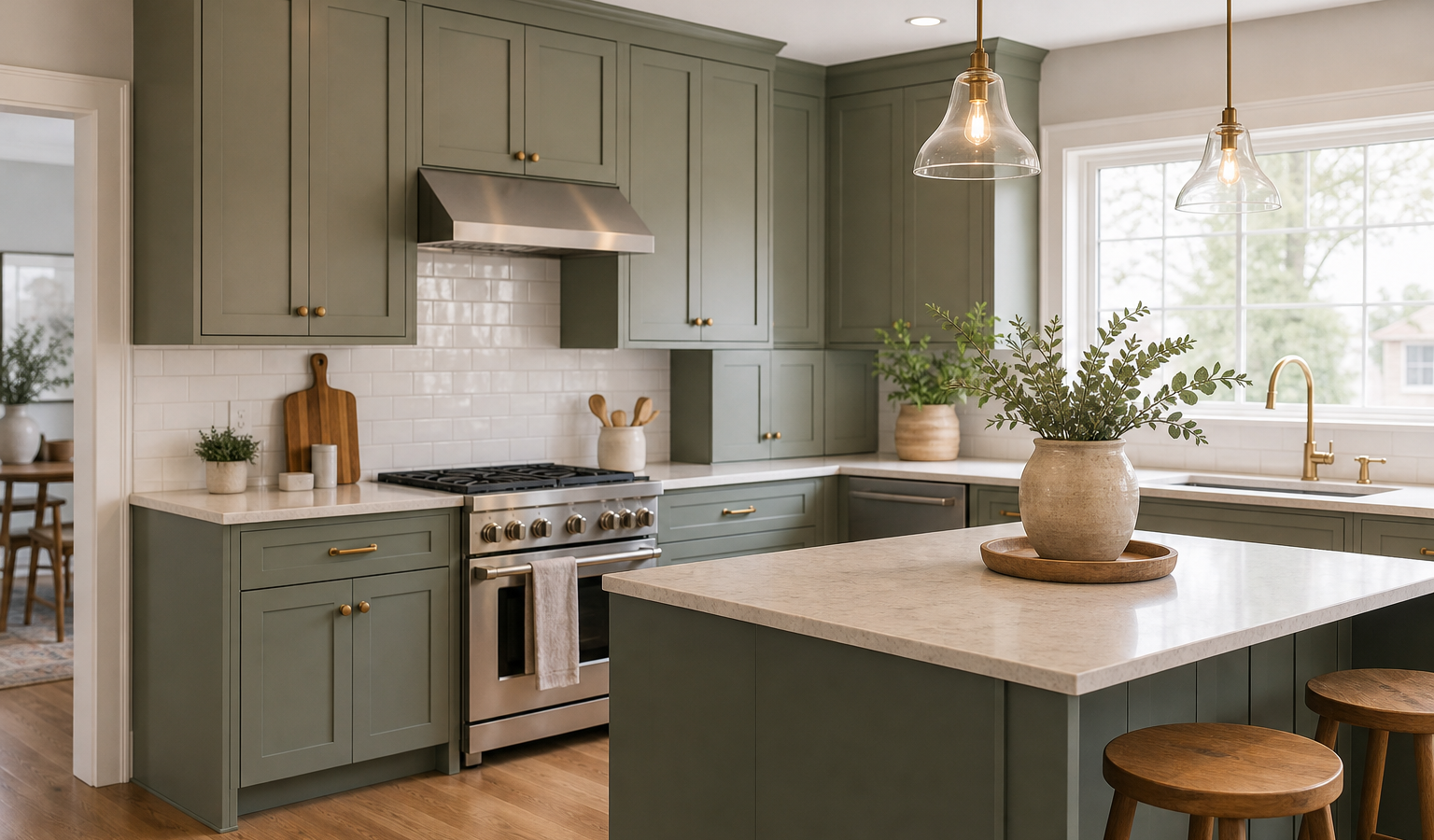
Shaker cabinets are the quiet workhorse of the American kitchen. If you have walked through a model home, scrolled a real estate listing, or flipped through a remodeling magazine in the last twenty years, you have seen them – the clean, framed door with a recessed flat center panel and no ornamentation. Shaker cabinets earned that ubiquity honestly: they pair with almost any color, hardware, and countertop, they cost less to build well than ornate alternatives, and they rarely look dated. This guide breaks down how the style is built, what it costs in 2026, which materials to specify, and how to make it feel current rather than generic.
Whether you are choosing between door styles for a full remodel or just want to understand what you are paying for, the details below will help you spend smart and pick a look you will still like in a decade.
What Makes a Cabinet “Shaker”
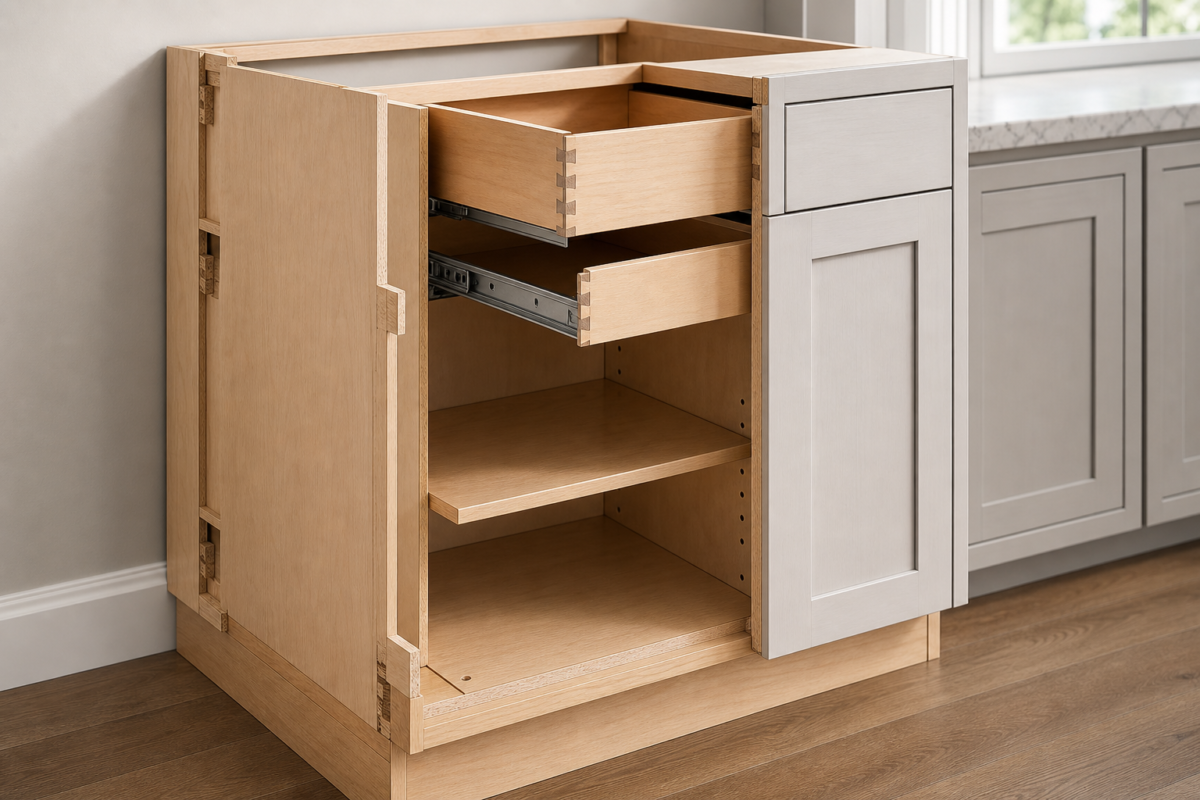
The term describes a specific door construction, not a color or a finish. A true Shaker door is a five-piece door: two vertical stiles, two horizontal rails, and a single recessed flat center panel that sits inside the frame. The frame pieces are typically 2 to 2.5 inches wide with a simple square or slightly eased edge. There are no raised profiles, no applied moldings, and no carving. The look is defined entirely by the crisp shadow line where the center panel steps down below the frame.
The five-piece door and rail-and-stile frame
The rail and stile frame is the structural heart of the door. Stiles run vertically, rails run horizontally, and together they form a sturdy border that resists warping. The recessed center panel floats inside a groove cut into that frame, which lets the panel expand and contract with humidity without cracking the paint or splitting the wood. This floating-panel detail is exactly why the style has lasted: it is honest joinery that happens to look good. If you want to compare it against raised-panel, slab, beadboard, and inset options before you commit, our overview of cabinet door styles lays them out side by side.
Why the recessed panel matters
The recessed panel is the feature that gives Shaker its subtle depth. Because the center sits below the surrounding frame, light catches the reveal – the small step between frame and panel – and creates a soft shadow that reads as detail without clutter. That same reveal is also the style’s one maintenance quirk, since the recess and inside corners collect a thin line of dust. It wipes clean in seconds, but it is worth knowing before you buy.
A Short History of Shaker Design
The style takes its name from the Shakers, a religious community that flourished in the United States in the late 18th and 19th centuries. Their design philosophy prized simplicity, utility, and honest craftsmanship, and they built furniture and cabinetry stripped of anything decorative that did not serve a function. Every element had a purpose, and the beauty came from proportion and joinery rather than embellishment.
From a religious sect to a kitchen staple
Those original Shaker pieces were plain by conviction, but the clean lines translated beautifully to modern manufacturing. As kitchens moved away from heavily ornamented traditional cabinetry in the late 20th century, the Shaker door offered a middle ground: warm and classic enough for a traditional home, restrained enough for a contemporary one. That flexibility turned a religious community’s furniture ethic into the single most specified cabinet door in the country.
Why Shaker Cabinets Stay Popular
Trends in kitchens come and go, but the Shaker door keeps its footing. The reason is versatility. Change the paint color and the hardware and the same door reads as farmhouse, transitional, contemporary, or classic. That adaptability protects your investment: a bold cabinet profile can feel dated in five years, while a Shaker door usually just needs a fresh handle to feel current again.
The versatility factor
Because the door itself is neutral, it becomes a background for the decisions that actually date a kitchen – color, metal finish, and countertop. That is a feature, not a bug. It also means Shaker plays well in nearly any room, from a busy family kitchen to a laundry room, mudroom, or bathroom vanity, keeping a home visually consistent. The chart below shows where the style tends to score across the decisions buyers care about most.
Materials: Paint-Grade MDF vs Solid Wood
Material choice affects price, finish quality, and durability more than almost any other decision. Shaker doors are commonly built from paint-grade MDF, solid hardwood, or a hybrid of the two. There is no single right answer – the best material depends on whether you are painting or staining, and how much you want to spend. Our deeper look at kitchen cabinet materials covers box construction and drawer boxes too, but here is how it applies to the door itself.
When paint-grade MDF wins
If you are painting your cabinets, paint-grade MDF is often the smarter choice for the center panel and sometimes the whole door. MDF has no grain to telegraph through paint and no natural seams that can crack along a joint as wood expands and contracts. Many painted Shaker doors are actually routed from a single MDF slab so there are no joints at all, which is the most crack-resistant option for a smooth painted finish. MDF is also less expensive than solid hardwood.
When solid wood wins
If you want a stained or natural finish that shows off grain, solid hardwood is the way to go – maple, white oak, walnut, and cherry are common. A frequent hybrid uses a solid wood frame around a veneer center panel, which keeps the visible grain while adding stability. Solid wood costs more, is heavier, and can be sensitive to humidity swings, but it can be sanded and refinished down the road, which MDF cannot.
Slim and Modern Shaker Variants
The classic Shaker frame is 2 to 2.5 inches wide, but manufacturers now offer several proportions that push the style toward either a more contemporary or a more traditional feel. Adjusting the rail and stile width is the simplest way to change the whole personality of a kitchen without abandoning the door style buyers trust.
Slim, micro, and wide-rail options
Slim Shaker doors narrow the frame to roughly 1 to 1.5 inches, and micro Shaker styles go as tight as a quarter inch to half an inch, producing a crisp, minimal look that sits between a traditional Shaker and a flat slab. Wide-rail Shaker moves the other direction with 3 to 4 inch frames for a heavier, more architectural presence. The narrower the frame, the more precision the finish demands, because a tight reveal magnifies any flaw. Slim variants read as modern and transitional; wider frames feel more traditional and substantial.
Color Choices That Work
Because the door is a neutral canvas, color does most of the styling work in a Shaker kitchen. A handful of palettes have proven themselves reliable, and they photograph and age well, which matters for both daily living and resale.
Classic white and warm neutrals
White remains the runaway favorite because it is bright, flexible, and easy to update with hardware. Soft whites like Benjamin Moore White Dove and crisp whites like Chantilly Lace are perennial picks. Greige – the gray-beige blend – has become the go-to warm neutral for buyers who find pure white too clinical. For a room full of ideas built around this palette, see our roundup of white kitchen ideas.
Navy, green, and two-tone
Deep navy such as Hale Navy and muted greens like sage or forest have moved from bold accent to mainstream choice, especially on islands and lower cabinets. That naturally leads to two-tone layouts, where dark or colored base cabinets pair with white or wood-tone uppers to add depth without overwhelming the room. It is one of the most requested looks going into 2026; our guide to two-tone kitchen cabinets covers how to split the colors so the balance feels intentional.
What Shaker Cabinets Cost in 2026
Shaker pricing tracks closely with the three broad tiers of cabinetry: stock, semi-custom, and custom. Shaker is one of the most affordable framed door styles to produce, so within any tier it is usually at or below the average price. Costs are quoted per linear foot, which measures the horizontal run of cabinetry along your walls, and they do not include countertops, appliances, or installation labor.
Cost by tier
| Tier | Cost per linear foot (2026) | Typical 10×10 kitchen | Best for |
|---|---|---|---|
| Stock / RTA | $100 – $300 | $2,000 – $6,000 | Budget remodels, rentals, standard layouts |
| Semi-custom | $200 – $650 | $4,000 – $13,000 | Most homeowners; size and finish tweaks |
| Custom | $500 – $1,200+ | $10,000 – $24,000+ | Unusual layouts, premium wood, exact specs |
Add roughly $50 to $450 per linear foot for professional installation depending on complexity, plus about $300 to $500 to remove and haul away old cabinets. For a full picture of where cabinetry fits in a project budget, see our kitchen cabinet cost breakdown.
What drives the price
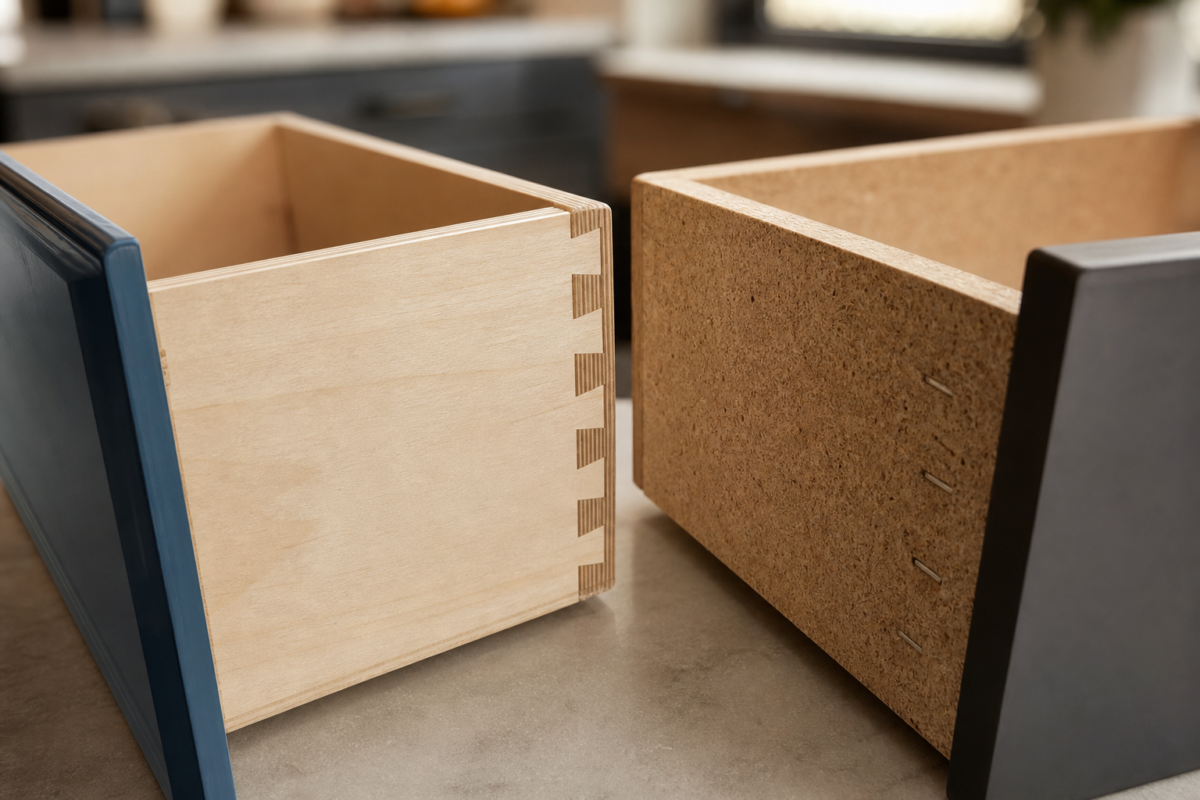
The biggest cost levers are material and construction. Solid hardwood costs more than paint-grade MDF, full plywood boxes cost more than particleboard, and dovetailed drawers with soft-close hardware add up. Specialty touches like inset doors, beaded frames, or a wide-rail profile can raise the price by 30 to 50 percent over a standard overlay Shaker. Deciding how much customization you actually need is the single fastest way to control the bill; our comparison of stock vs custom cabinets helps you find that line.
Contractor’s take
On nine kitchens out of ten I steer clients to semi-custom Shaker with plywood boxes and a painted MDF door. You get the durability that matters, the finish holds up, and you are not paying custom-shop prices for a door style the whole market already makes well. Save the custom budget for the boxes and the layout, not the door profile.
Hardware Pairing
Hardware is the fastest and cheapest way to steer a Shaker kitchen toward a specific style. The flat frame gives you a clean mounting surface, so almost anything works, and swapping handles years later is an afternoon project that can refresh the whole room.
Knobs, pulls, and finishes
Cup pulls and round knobs in brass or bronze lean farmhouse and traditional. Straight bar pulls in brushed nickel, chrome, or matte black read modern and transitional. Mixing metals – say, black on the perimeter and brass on the island – is a deliberate two-tone move that suits the current transitional look. For sizing rules and finish combinations, see our guide to kitchen cabinet hardware.
Pros, Cons, Durability, and Cleaning
No door style is perfect for every household. Shaker’s strengths are real, but so is its one honest drawback, and knowing both helps you decide whether it fits how you actually live and clean.
Shaker vs the alternatives
| Style | Look | Cleaning | Versatility | Relative cost |
|---|---|---|---|---|
| Shaker | Framed, timeless | Reveal holds dust | Very high | Low to mid |
| Flat / slab | Sleek, modern | Wipes clean fast | Lower | Low to mid |
| Raised panel | Traditional, ornate | More grooves | Lower | Mid to high |
| Inset Shaker | Refined, tailored | Reveal holds dust | High | High |
Cleaning the profile
The trade-off for that handsome shadow line is that the recessed panel and inside corners catch a fine film of dust and cooking grease. A flat slab door wipes down in one pass; a Shaker door benefits from a soft cloth run along the reveal every week or two. It is a minor chore, not a dealbreaker, and it is the price of the detail that makes the style look like more than a plain box. Structurally, a well-built Shaker door is very durable, and the floating panel design specifically guards against the seasonal cracking that plagues cheaper doors.
Best Rooms, Styles, and Resale
Shaker earns its keep because it fits nearly everywhere and appeals to nearly everyone. That combination makes it the safe-but-not-boring default for anyone planning to sell within the next several years, and a comfortable choice for those staying put.
Where Shaker shines
Beyond the kitchen, the style carries into bathrooms, mudrooms, laundry rooms, and built-ins, letting you keep one visual language throughout the house. It anchors farmhouse and transitional interiors especially well, and with slim frames and dark paint it holds its own in contemporary spaces. Use the checklist below to confirm Shaker is the right call before you order.
- You want a look that will still feel current in ten years
- You plan to update style through paint and hardware, not new doors
- You value broad resale appeal over a bold statement
- You are comfortable wiping the panel reveal every week or two
- You want one door style to unify kitchen, bath, and utility rooms
- You want strong quality per dollar within your chosen tier
Resale value
Real estate agents consistently favor Shaker for listings because it photographs cleanly and offends no one, which tends to help a kitchen sell faster than a highly stylized alternative. A neutral Shaker kitchen in white or greige is one of the lowest-risk upgrades you can make before a sale, and it reassures buyers who might otherwise budget for a redo.
Shaker Cabinet FAQs
Common questions answered
Your next move
You know the number. What are you deciding next?
Everything you need to plan a kitchen remodel in 2026 - budget, layout, cabinets, countertops, appliances, timeline, hiring,…
Continue →A kitchen remodel costs $18,000 to $120,000 in 2026, with a national average near $42,000. Here's the full…
Continue →Kitchen cabinets cost $80-$800 per linear foot installed in 2026. Here's what stock, semi-custom, and custom really cost,…
Continue →Frequently asked
Are Shaker cabinets going out of style in 2026?
No. Shaker remains the most-specified door style in the country because it adapts to nearly any color and hardware. Trends shift toward slimmer frames, warmer neutrals, and two-tone layouts, but the door itself stays firmly in favor.
Are Shaker cabinets more expensive than flat-panel?
They are usually comparable. Both are simple to build, so within a given tier and material, Shaker and flat-panel doors are priced close together. Ornate raised-panel and inset styles cost noticeably more.
Should I choose MDF or solid wood Shaker doors?
Choose paint-grade MDF if you are painting, since it resists grain telegraphing and joint cracking. Choose solid wood or a wood-frame veneer panel if you want a stained finish that shows grain and can be refinished later.
How much do Shaker cabinets cost per linear foot?
In 2026, expect roughly $100 to $300 per linear foot for stock, $200 to $650 for semi-custom, and $500 to $1,200 or more for custom, before installation labor of about $50 to $450 per linear foot.
Are Shaker cabinets hard to keep clean?
Not hard, just slightly more attentive. The recessed panel and inside corners collect a thin line of dust and grease, so a quick wipe along the reveal every week or two keeps them looking sharp.

Pricing and specifications compiled from HomeAdvisor, HomeGuide, Homes & Gardens, and cabinet manufacturer data, September 2026.