Stock vs Custom Cabinets: 2026 Cost, Lead Time, and Fit
How stock, semi-custom, and custom kitchen cabinets compare on 2026 price, lead time, fit, and durability, plus how to mix tiers.

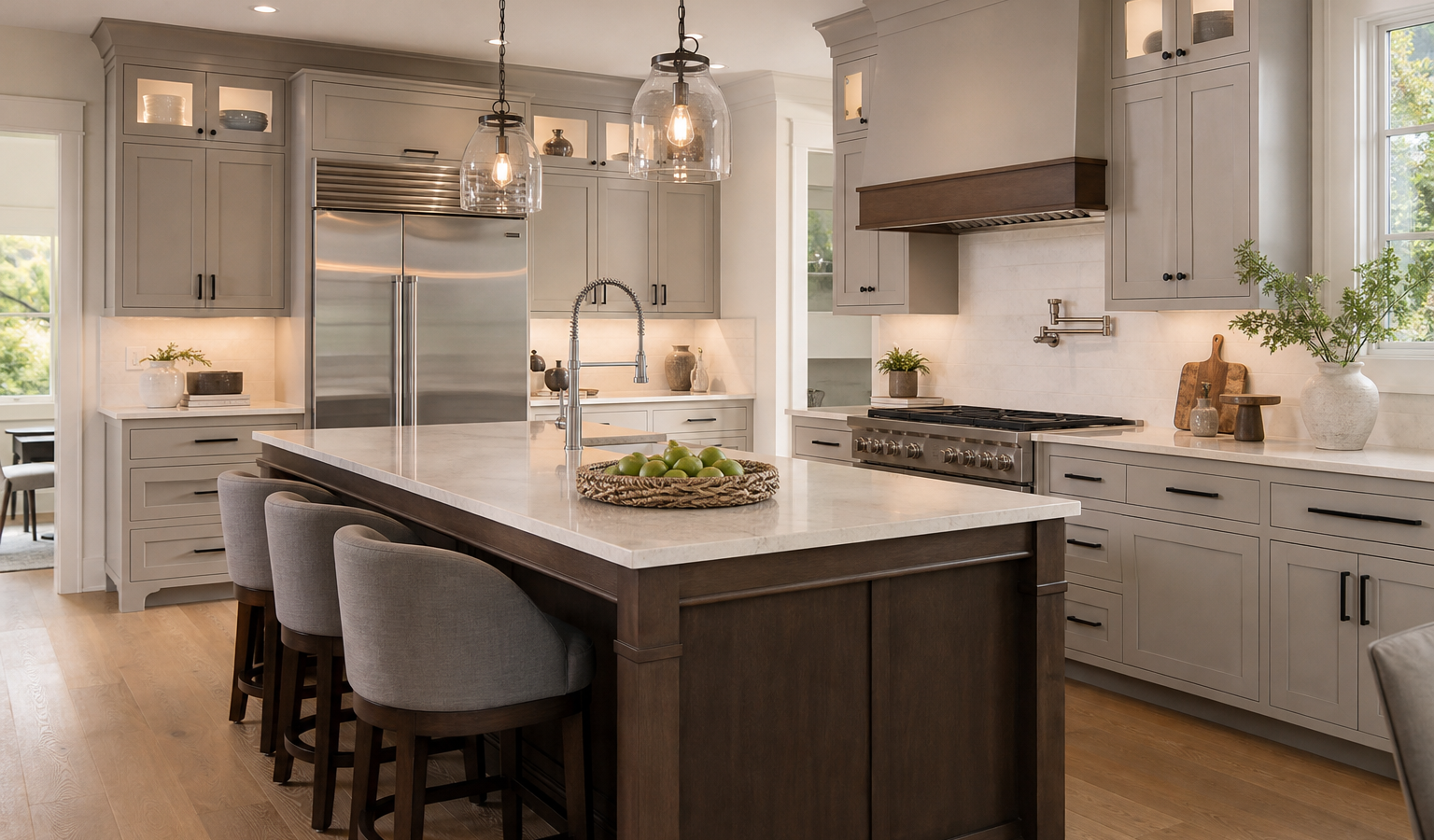
Choosing between stock vs custom cabinets is one of the biggest fork-in-the-road decisions in any kitchen remodel, because cabinetry usually eats 30 to 40 percent of the whole budget. Stock cabinets ship fast and cheap in fixed sizes, custom cabinets are built to your exact wall, and semi-custom sits in the middle. Get the pick right and you save thousands without regret. Get it wrong and you either overpay for flexibility you never use or fight awkward filler strips and dead corners for the next 20 years. This guide breaks down the three tiers on 2026 pricing, lead times, sizing, and build quality so you can match the cabinet to the kitchen and the wallet.
By the end you will know what each tier actually delivers, roughly what it costs per linear foot this year, how long it takes to arrive, and where mixing tiers can stretch a budget further than committing to just one.
What stock, semi-custom, and custom actually mean
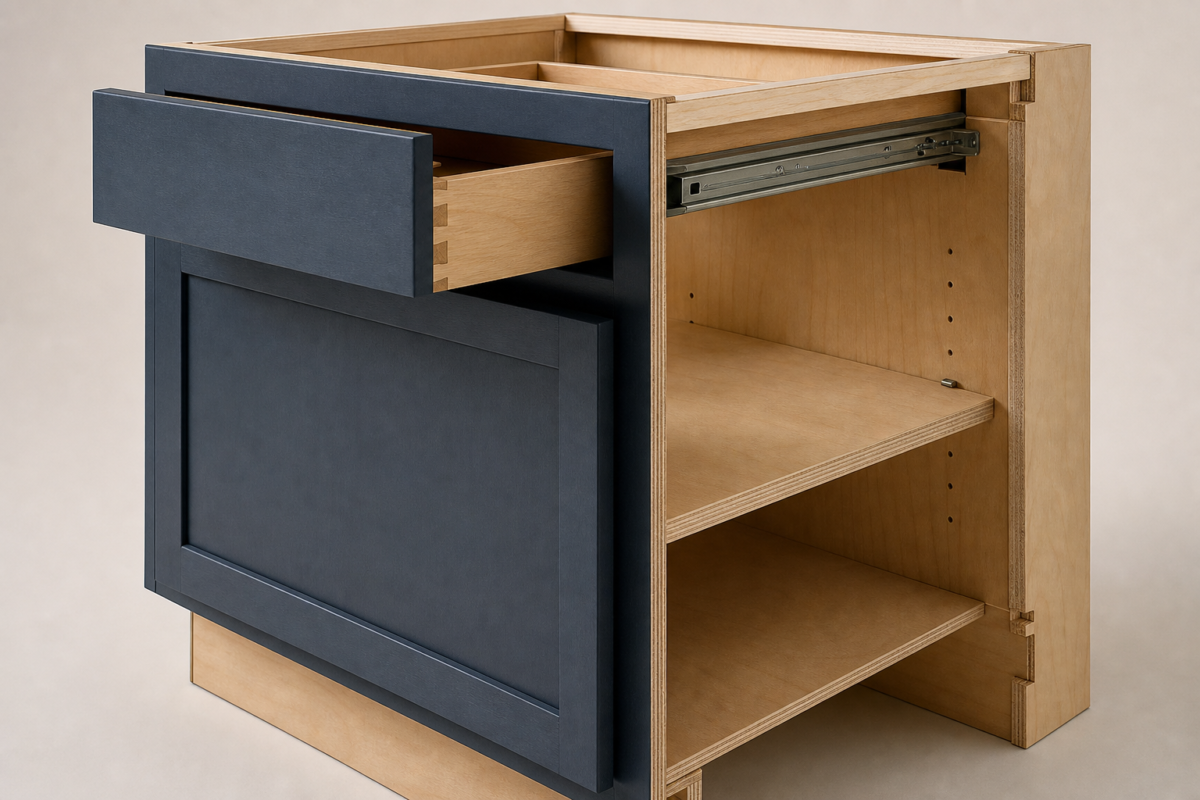
The three labels describe how much a factory bends to your kitchen rather than how nice the doors look. Stock cabinets are mass-produced in a fixed catalog of sizes and finishes and boxed for immediate sale. Semi-custom cabinets start from that same catalog but let you modify dimensions, door styles, finishes, and interior fittings within set limits. Custom cabinets are built from scratch by a shop or high-end line to whatever spec you hand them, down to the eighth of an inch.
Where RTA and framed construction fit in
RTA (ready-to-assemble) cabinets are a subset of stock: the same fixed sizes, shipped flat to save on freight, and you or your installer assemble the box with cam locks and screws. They are the cheapest way to get real plywood boxes. Separately, all three tiers come in two structural styles. Face-frame cabinets have a solid wood frame across the front of the box, the traditional American look. Frameless (also called full-overlay or European) cabinets skip the frame so doors cover almost the entire box, giving cleaner lines and slightly more interior access. You can find both styles at every price tier, so framed versus frameless is a separate choice from stock versus custom.
Price per linear foot in 2026
Cabinets are priced by the linear foot, meaning the horizontal run of cabinetry measured along the wall, counting base and wall cabinets together. In 2026, stock runs about $100 to $300 per linear foot, semi-custom lands around $150 to $650 per linear foot, and custom starts near $500 and climbs past $1,200 per linear foot for exotic woods and inset doors. A typical 25-linear-foot kitchen therefore ranges from roughly $2,500 in basic stock to $30,000 or more in full custom before installation. Installation adds $50 to $450 per hour of labor, and a full cabinet install commonly totals in the $2,000 to $11,000 range on top of the boxes.
| Factor | Stock | Semi-custom | Custom |
|---|---|---|---|
| Price per linear foot (2026) | $100 – $300 | $150 – $650 | $500 – $1,200+ |
| Lead time | In-stock to 1-2 weeks | 4 – 8 weeks | 8 – 16+ weeks |
| Sizing increments | 3-inch fixed | 3-inch plus modifications | Any dimension |
| Box material | Particleboard or MDF | MDF or plywood | Hardwood plywood or solid wood |
| Typical lifespan | 10 – 15 years | 15 – 20 years | 25+ years |
| Best for | Rentals, flips, tight budgets | Most mid-range remodels | Unusual layouts, forever homes |
What drives the number up or down
Within any tier, the biggest cost swings come from box construction (plywood costs more than particleboard), drawer quality (dovetail drawers with soft-close glides cost more than stapled boxes on side-mount slides), door material and finish (a painted shaker costs more than a thermofoil slab because paint requires more prep and coats), and accessories like pull-out trays and lazy Susans. For a full picture of how cabinetry stacks against countertops, appliances, and labor, see our kitchen cabinet cost breakdown and the broader kitchen remodel cost guide before you lock a number.
Lead times: from same-day to four months
Timeline is where the tiers separate hardest, and it is the factor homeowners underestimate most. Stock cabinets are on the shelf: you can carry them out same day or wait one to two weeks for a store to restock a popular size. RTA ships in one to two weeks and needs a weekend of assembly. Semi-custom runs 4 to 8 weeks because the factory builds to your modified order. Custom takes 8 to 16 weeks and stretches further for specialty wood species, vintage finishes, or a backed-up shop.
Why lead time is not shipping time
The quoted weeks bundle four stages: order processing (3 to 5 business days), manufacturing or assembly (zero for stock, up to 12 weeks for custom), transit (2 days to 2 weeks), and delivery scheduling (2 to 7 days). If your remodel has a hard deadline, such as a holiday or a home sale, build the cabinet lead time into the very first week of planning. A custom order placed late is the single most common reason a kitchen project slips past its move-in date. Our complete kitchen remodeling guide walks through sequencing so cabinets never become the bottleneck.
Contractor’s take
Order cabinets before you demo anything. I have seen too many clients gut a kitchen, then learn their custom boxes are 11 weeks out, and now they are washing dishes in the bathtub until spring. Confirm the delivery date in writing, then schedule demo for the week the truck is due, not before.
Sizing and fit: the 3-inch problem
Stock and semi-custom cabinets come in widths that jump in 3-inch increments: 9, 12, 15, 18, 21, 24 inches and up. That grid rarely matches a real wall exactly, so installers close the gap with filler strips, blank pieces of matching material that bridge the leftover space next to a wall or appliance. A few inches of filler is normal and invisible. But a galley wall that needs 94 inches of cabinet and can only be built to 90 leaves you with a 4-inch filler and lost storage.
When any-size custom earns its keep
Custom cabinets are built to any dimension, so a run fills the wall wall-to-wall with usable storage and no fillers. That matters most in older homes with out-of-square walls, kitchens with unusual ceiling heights where you want cabinets to the crown, and tight spots where 2 or 3 inches of drawer is the difference between a usable and useless corner. Semi-custom splits the difference: many lines offer 1-inch width adjustments or depth reductions for an upcharge, capturing most of the fit benefit at a fraction of full-custom cost.
Materials and box construction quality
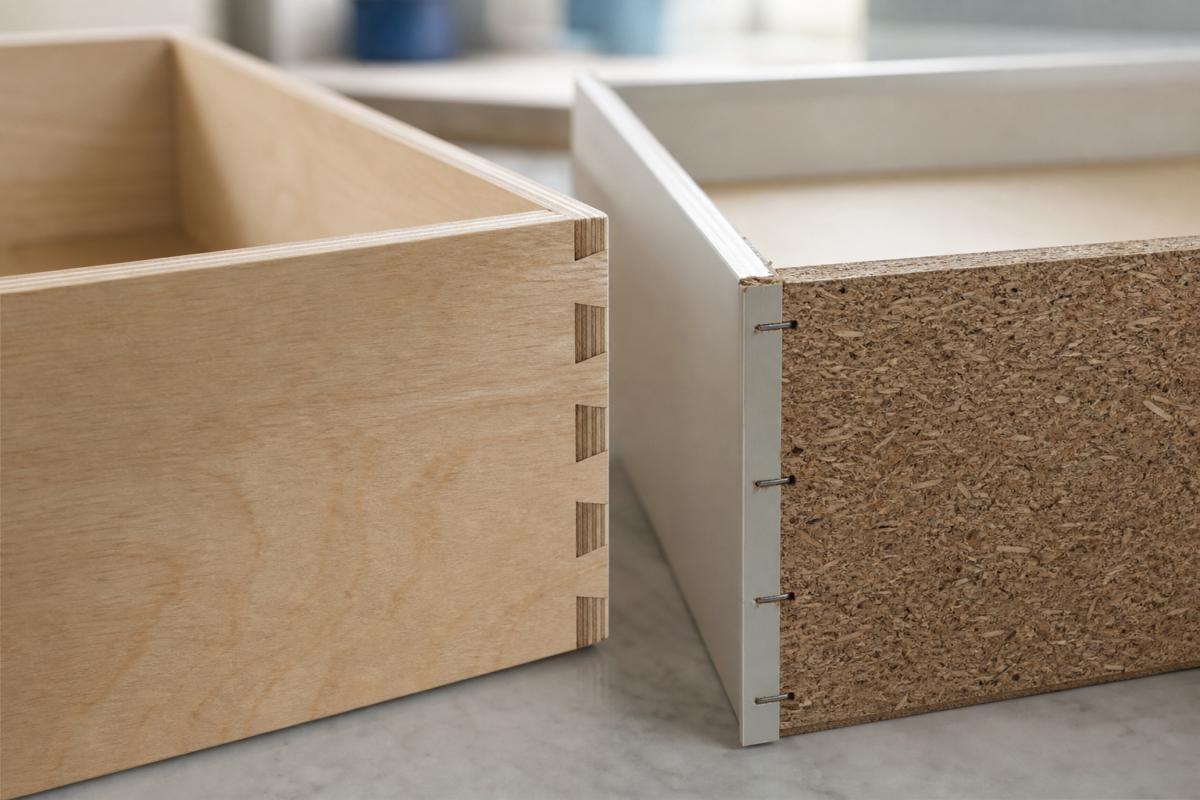
The part you never see, the box, determines how long cabinets last. Stock boxes are usually particleboard or MDF with a laminate or thermofoil surface, which holds up fine in a low-traffic kitchen but swells if water sits in a seam. Semi-custom typically upgrades to MDF or plywood sides. Custom uses hardwood plywood or solid wood throughout, the most water-resistant and screw-holding option, which is why custom boxes routinely outlast the homeowners who install them.
Drawers are where quality shows fastest
Look inside a drawer before you judge any cabinet. Budget stock uses stapled particleboard boxes on side-mount slides that sag over time. Better cabinets use solid-wood drawers with dovetail joints (interlocking fingers that never loosen) riding on full-extension, soft-close undermount glides that pull the drawer shut silently and keep it from slamming. Soft-close and dovetail construction are standard on good semi-custom and universal on custom, and they are the features you will appreciate every single day. If your current boxes are solid but dated, repainting can buy years; our guide to how to paint kitchen cabinets covers when a refinish beats replacement.
Door styles, finishes, and hardware
Stock lines carry a handful of door styles, usually a shaker, a raised panel, and a flat slab, in maybe 6 to 10 finishes. Semi-custom expands that to dozens of door profiles and a broad paint and stain palette, often including glazes and specialty finishes. Custom means any door you can draw and any color you can color-match, including inset doors that sit flush inside the frame, the hardest and most expensive door to build well.
Overlay style changes the whole look
Full-overlay doors cover nearly the entire face for the seamless modern look, while partial-overlay doors (common on cheap stock) reveal a strip of face frame between doors and read as more traditional or dated. Frameless construction is inherently full-overlay. If a contemporary, gap-free front is your goal, confirm the overlay before you fall in love with a finish. Playing two finishes against each other is a popular way to add depth without custom pricing.
When each type makes the most sense
Match the tier to the project, not to your aspirations. Stock wins for rental units, flips, garages, and any kitchen where budget and speed beat perfection. Semi-custom is the sweet spot for the majority of owner-occupied remodels: real quality, a fit-your-wall option, and a reasonable price. Custom is worth it in forever homes, in genuinely oddball spaces, and when you want a specific look no catalog offers. The bars below show how the three tiers trade off against each other.
Quick gut-check before you decide
Run through this short list and the right tier usually becomes obvious.
- Is this a rental, flip, or short-term home? Lean stock or RTA.
- Are your walls square and standard-height? Semi-custom will fit well.
- Do you have odd angles, tall ceilings, or a specific rare look? Go custom.
- Is your deadline under 6 weeks? Custom is likely off the table.
- Do you cook hard and plan to stay 15+ years? Pay up for plywood boxes and soft-close.
Resale value and return on investment
Cabinets sell kitchens, and kitchens sell houses, but the return does not scale linearly with what you spend. A clean, well-fitted semi-custom kitchen in a mid-priced home returns a strong share of its cost at sale, while a $40,000 custom kitchen in a starter-home neighborhood rarely returns the premium because buyers there will not pay for it. Match the cabinet investment to the home’s price band, not to the fanciest showroom you visited.
What buyers actually notice
Buyers register soft-close drawers, a cohesive finish, and storage that clearly works far more than they register whether the boxes are technically custom. That is good news for budgets: you can get most of the perceived value from smart semi-custom choices. For the numbers behind kitchen returns and where to spend for resale, see our kitchen remodel ROI guide, and if you are working lean, our budget kitchen remodel ideas show where the dollars stretch furthest.
How to mix stock, semi-custom, and custom
The savviest move is often not picking one tier but blending them. Run stock or semi-custom along the standard perimeter walls where boxes are hidden by counters and backsplash, then spend on one custom feature that carries the whole room, such as a furniture-style island, a range hood surround, or a floor-to-ceiling pantry wall. Because most of the linear footage stays budget-friendly, you capture a custom look for a fraction of an all-custom price.
Making mixed tiers look intentional
The trick is a shared thread across the tiers: match the door style and either match or deliberately contrast the finish so the mix reads as design, not compromise. Order the perimeter and the accent piece close together so finishes match, and have your installer plan filler and scribe details where the tiers meet. Deciding where to splurge and where to save across the whole kitchen is exactly what our splurge vs save guide is built for.
Your next step
Start by measuring your kitchen in linear feet and mapping any odd walls, then set a cabinet budget as a share of your total remodel. If the walls are standard and the timeline is normal, price semi-custom first, it satisfies most kitchens. If a wall is truly awkward or the look is non-negotiable, price one custom element and keep the rest efficient. That single decision framework prevents both overspending and the slow frustration of cabinets that never quite fit.
Before you sign the order
Open a drawer, check for dovetail joints and soft-close, confirm the box material, get the lead time in writing, and verify the overlay style matches the look you want. Those five checks catch the vast majority of buyer regret regardless of which tier you land on.
Frequently asked questions
Your next move
You know the number. What are you deciding next?
Everything you need to plan a kitchen remodel in 2026 - budget, layout, cabinets, countertops, appliances, timeline, hiring,…
Continue →A kitchen remodel costs $18,000 to $120,000 in 2026, with a national average near $42,000. Here's the full…
Continue →Kitchen cabinets cost $80-$800 per linear foot installed in 2026. Here's what stock, semi-custom, and custom really cost,…
Continue →Frequently asked
Are semi-custom cabinets worth it over stock?
For most owner-occupied remodels, yes. Semi-custom adds plywood box options, dovetail soft-close drawers, far more door and finish choices, and size modifications that eliminate awkward fillers, usually for a modest step up from stock pricing.
How much more do custom cabinets cost than stock?
Roughly three to five times more per linear foot. Stock runs $100 to $300 while custom runs $500 to $1,200 or higher, so a 25-foot kitchen can swing from about $2,500 to $30,000 before installation.
What is the lead time difference between stock and custom?
Stock is in-stock to 1 to 2 weeks, semi-custom is 4 to 8 weeks, and custom is 8 to 16 weeks or more. Custom lead time is the number most homeowners underestimate, so order before you demo.
Can I mix stock and custom cabinets in one kitchen?
Yes, and it is a smart budget move. Use stock or semi-custom on hidden perimeter runs and spend on one custom feature like an island or pantry. Match door style and finish so the mix looks intentional.
Are RTA cabinets the same as stock cabinets?
RTA is a subset of stock shipped flat for you to assemble. Sizes are the same fixed increments, but flat shipping cuts cost, and many RTA lines offer plywood boxes, making them the cheapest way to get real plywood construction.

Pricing and lead times synthesized from 2026 US cabinet cost guides and contractor field data.