Cabinet Door Styles: The 2026 Guide to Every Look and Cost
Shaker, slab, raised panel, glass, inset and more, decoded, with 2026 costs, cleaning realities, and the trends worth following.

RenHive may earn a commission when you buy through links on this page. It never affects which products we recommend or how we rank them, and we do not accept product samples. How we review →
When people picture a finished kitchen, they are really picturing its cabinet door styles. The boxes behind the doors are nearly identical from brand to brand, but the door is the face of the room, and it does more visual work for less structural cost than almost any other decision in a remodel. The right door profile makes stock cabinetry read as custom; the wrong one can make an expensive kitchen feel dated the day it is installed.
This guide covers every major cabinet door style used in American kitchens in 2026, from the ever-popular Shaker to slab, raised panel, beadboard, glass-front, and louvered doors. It also covers the two decisions that quietly control your budget: how the door overlays the frame, and how it is finished. By the end you will know which styles are cheaper, which command a premium, how they clean up, and where 2026 taste is heading.
The five door styles at a glance
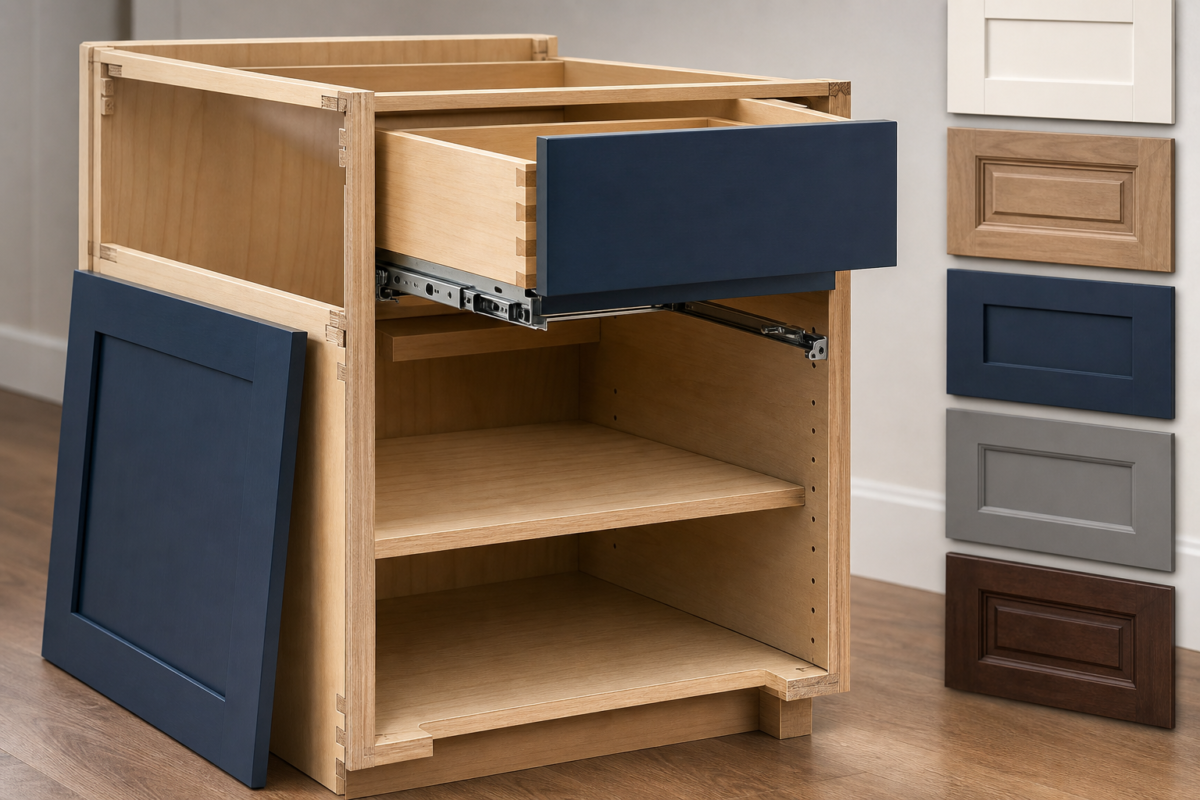
Before diving into each profile, it helps to see how the common cabinet door styles compare on look, relative cost, and best use. The table below uses a 2026 baseline: a mid-grade semi-custom kitchen where slab and Shaker anchor the affordable end and raised panel and inset sit on top.
How to read the cost column
Costs here are relative, not absolute. Cabinet pricing in 2026 runs roughly $120 to $220 per linear foot installed for mid-grade semi-custom lines, and door style shifts that number up or down. Across a full kitchen, moving from a slab door to a raised panel can add $1,500 to $4,000. For the full picture, see our breakdown of what kitchen cabinets actually cost.
| Door style | The look | Relative cost | Best for |
|---|---|---|---|
| Shaker | Clean square frame, flat center panel | Mid (baseline) | Nearly any kitchen; safest resale bet |
| Flat / slab | Single flat surface, no frame | Lowest | Modern, minimalist, budget builds |
| Raised panel | Contoured, dimensional center panel | Highest profile | Traditional, formal, French country |
| Recessed panel | Flat panel, softly profiled frame | Mid | Transitional kitchens wanting soft detail |
| Beadboard | Vertical grooves in the center panel | Mid to high | Cottage, farmhouse, coastal accents |
Contractor’s take
Nine out of ten of my clients land on Shaker or a slim-Shaker variant, and I rarely talk them out of it. It photographs well, it never looks like a trend you will regret, and every buyer recognizes it later. Save your risk budget for color and hardware, not the door profile.
Shaker doors: the default for good reason
The Shaker door is a five-piece build: two vertical stiles and two horizontal rails frame a single flat center panel, with clean square edges and no ornamentation. That rail-and-stile construction is more than decoration. Because the center panel floats inside the frame, it expands and contracts with humidity without cracking, which is why well-built Shaker doors age gracefully.
Cost and maintenance
Shaker sits in the middle of the pack, typically 10 to 15 percent more than a plain slab and 10 to 20 percent less than a raised panel. Cleaning is straightforward, though dust and grease settle into the inside corners where the panel meets the frame. A slim-Shaker version with narrower two-inch rails is the fastest-growing variant for 2026 because it keeps the recognizable look while reading more contemporary.
Contractor’s take
If you want Shaker on a tighter budget, ask for a five-piece MDF paint-grade door rather than solid wood. The center panel and frame take paint beautifully, there is no grain to telegraph through, and you can put the savings toward soft-close hardware you will feel every day.
Flat-panel and slab doors: the modern minimalist
Strip a door to a single unbroken surface with no frame and no profile and you have a flat-panel, or slab, door. It is the cheapest style to build per door, which makes it the workhorse of frameless European-style and budget kitchens. Slab doors also define modern and mid-century looks, where an uninterrupted plane is the whole point.
The finish caveat
Slab doors are the easiest of all to wipe down because there are no grooves to trap debris, but a glossy slab shows every fingerprint, which is exactly why matte and satin finishes have taken over this category. Solid-wood slabs can warp, so most quality slab doors use an engineered core such as MDF or a torsion box wrapped in veneer, laminate, or thermofoil for stability and a lower price.
Contractor’s take
Slab doors reward a flawless finish because there is nowhere for the eye to hide. Spend on the finish, not the door blank. A cheap slab with a thin laminate wrap will chip at the edges within a couple of years of daily use.
Raised-panel doors: traditional and dimensional
Raised-panel doors use the same five-piece frame as Shaker, but the center panel is contoured, beveled, or profiled so it stands proud of the surrounding rails and stiles. The frame often carries a decorative edge such as an ogee or a cathedral arch. The result is a three-dimensional, formal door tied to traditional, Georgian, colonial, and French country kitchens, most often in cherry or maple.
Why it costs more
All that shaping is labor. Expect a 15 to 25 percent premium over Shaker for the extra routing and contouring, and plan on more cleaning: grease and dust settle into every groove, which matters most on cabinets flanking a cooktop. Raised panel can also overwhelm a small kitchen, so it suits medium-to-large, traditionally styled rooms best.
Contractor’s take
Raised panel is not dated, but it is committed. It anchors a formal kitchen and looks out of place the moment you introduce modern hardware or a waterfall island. If you are on the fence between eras, a recessed panel gives you softness without locking you into a period look.
Recessed panel and beadboard: the transitional middle ground
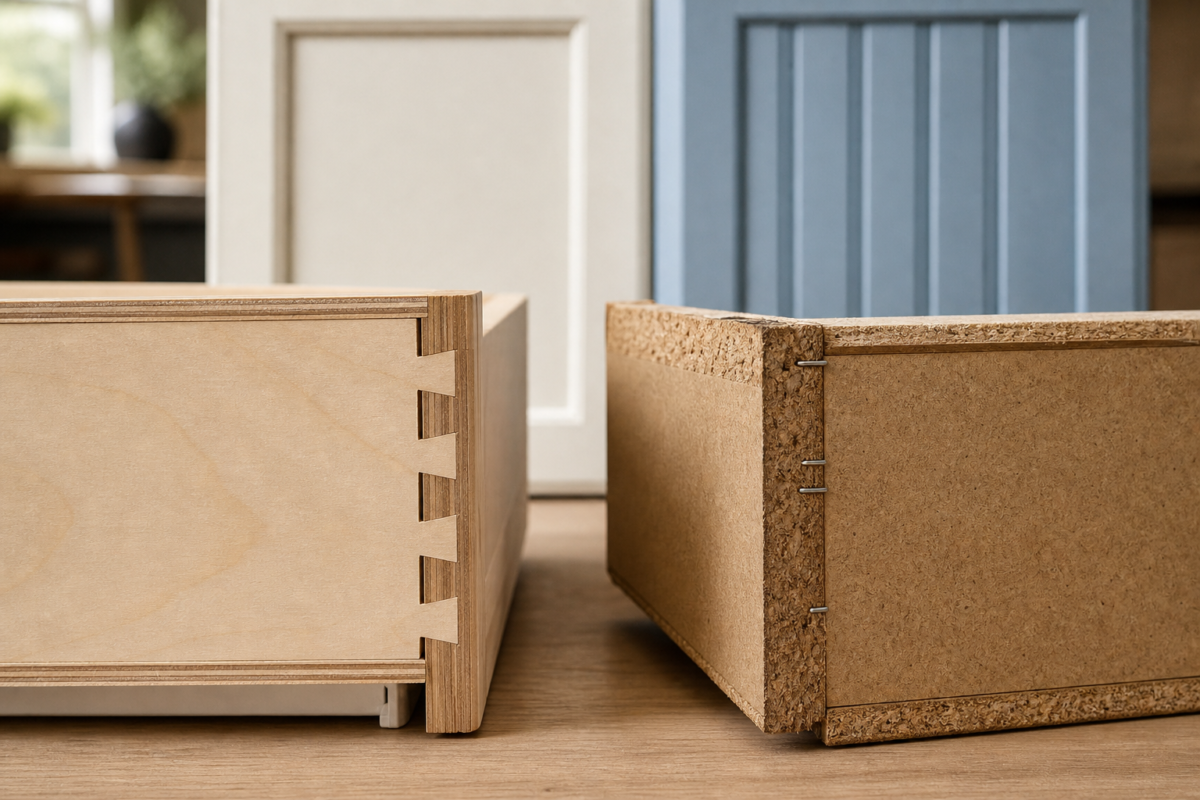
Not every door is dead flat or dramatically raised. Two styles live in between, and both are having a moment in transitional kitchens.
Recessed panel
A recessed-panel door is a close cousin to Shaker: a flat center panel, but with a softened or lightly profiled inner edge on the frame rather than a hard square shoulder. It reads a touch more traditional than a crisp Shaker while staying clean enough for a transitional room, and it prices similarly.
Beadboard
Beadboard doors carry vertical grooves across the center panel, instantly signaling cottage, farmhouse, or coastal style. They pair best with painted finishes and work best as an accent, on an island or a run of glass-adjacent uppers, rather than across an entire kitchen where the texture becomes busy and harder to wipe clean.
| Style | Character | Cleaning | Where it shines |
|---|---|---|---|
| Recessed panel | Soft transitional detail | Easy, minor corners | Whole-kitchen transitional looks |
| Beadboard | Textured cottage charm | Harder; grooves trap grime | Islands and accent runs |
Glass-front and louvered doors: the specialty players
Some doors exist to break up a wall of solid fronts. Used sparingly they add rhythm; used everywhere they make work.
Glass-front and mullion doors
A glass-front door is a five-piece frame holding a glass panel; add a mullion and the glass is divided into smaller sections for a classic, furniture-like feel. They lighten a room and turn upper cabinets into display, which is why they pair so naturally with two-tone cabinet schemes where a glass upper anchors the lighter tone. The trade-off is that whatever sits behind the glass is now on permanent display.
Louvered doors
Louvered doors use horizontal slats for airflow, a legacy of pantry and appliance-garage uses and a nod to coastal styling. They are niche in the main kitchen because the slats are the hardest of any style to dust and clean, but they earn their place where ventilation matters.
Contractor’s take
Glass fronts are the single easiest way to make a kitchen feel custom, but only if you are disciplined about what goes behind them. I tell clients to reserve glass for things they would happily show a dinner guest and keep the cereal boxes behind solid doors.
Overlay and inset: how the door meets the frame
Door style is what you see; overlay is how much of the box that door covers. This choice changes the look and the price as much as the profile does, and it only applies to framed cabinets.
Full, partial, and inset explained
With full overlay, the doors cover almost the entire face frame, leaving only a narrow reveal between doors for a clean, seamless front. Partial overlay is the old builder-grade standard: the door leaves roughly an inch or two of face frame visible, and it is the least expensive to build. Inset is the premium: the door sits flush inside the frame like fine furniture, with tight, even gaps all around. Inset demands precise construction and runs 15 to 30 percent more than full overlay, and because the door lives inside the opening, hinges and hardware must be chosen with more care.
| Overlay type | Reveal / gap | Relative cost | Look |
|---|---|---|---|
| Partial overlay | 1 to 2 in. of frame shows | Lowest | Builder-standard, traditional |
| Full overlay | Narrow reveal between doors | Mid | Clean, modern, seamless |
| Inset | Flush, tight even gaps | Highest (+15-30%) | Furniture-grade, timeless |
Contractor’s take
Inset is gorgeous and unforgiving. It only stays flush if the boxes are built and installed dead square, and wood movement can leave you fussing with a rubbing door in humid months. It is worth it for the right kitchen, but it is a place where custom or top-tier semi-custom construction pays off. It is one of the clearest cases for weighing stock against custom cabinetry.
Thermofoil, painted, and stained: finish changes everything
Two identical Shaker doors can look and perform worlds apart depending on finish, which drives durability, cleaning, repairability, and a meaningful slice of the cost.
The three main finishes
Painted doors, usually on MDF paint-grade or smooth hardwood, give the crispest color and are the 2026 favorite; they can be sanded and repainted if they chip, and matte now commands around 70 percent of painted orders. Stained doors show off real wood grain and hide minor wear, which is why warm woods like white oak are surging. Thermofoil wraps an MDF core in a vinyl film for a seamless, easy-wipe surface that costs roughly 20 to 30 percent less than a quality painted door, but it cannot be repaired and can delaminate near sustained heat above about 150 degrees.
| Finish | Relative cost | Durability note | Best use |
|---|---|---|---|
| Painted (MDF/wood) | Higher | Repairable; can chip on edges | Primary kitchens; any color |
| Stained wood | Mid to high | Hides wear; grain-dependent | Warm-wood and traditional looks |
| Thermofoil | Lowest (-20-30%) | Cannot repair; peels near heat | Budget zones away from heat |
If you love your current boxes and only want a fresh face, repainting is often the smartest money in the whole kitchen; our guide to painting kitchen cabinets covers when a refresh beats a replacement.
Edge profiles, hardware, and reveals
The finishing details are where a door style resolves cleanly or looks off. They are cheap to specify and expensive to change later.
Edge profiles
The outer edge can be a crisp square, a soft eased edge, or a decorative bevel. Square and eased edges suit Shaker and slab and read modern; ogee and beveled edges reinforce a traditional raised-panel look. Match the edge to the profile so the two tell the same story.
Hardware pairing and reveals
- Slab and slim-Shaker doors pair with linear tab or bar pulls, or go handleless with integrated edge pulls
- Classic Shaker takes both knobs and pulls; knobs on doors with pulls on drawers is a safe default
- Raised panel and inset look best with substantial cup pulls, knobs, and finishes like unlacquered brass
- Keep the reveal (the gap between doors) consistent; an even reveal is what makes full overlay read as intentional
- Order one sample door in your exact style and finish before committing the whole kitchen
Contractor’s take
Hardware is jewelry and the cheapest way to shift a kitchen’s era. I tape samples to the client’s actual door in daylight before we order. What looks perfect online often looks undersized once it is on a real 30-inch drawer front.
2026 trends and how style drives cost
The all-white kitchen is no longer automatic. For 2026, warm and natural is leading: white oak and other warm woods are taking a large share of the market, matte finishes dominate paint orders, and soft blues, sage and hunter greens, and warm greige neutrals are replacing stark white. Two-tone layouts, often a colored island against a lighter perimeter, remain among the most requested looks.
Where the money actually goes
If you rank the levers by cost, profile and overlay matter most: slab and partial-overlay Shaker anchor the budget end, while raised-panel doors and inset construction sit at the top. Finish is the next lever, with thermofoil cheapest and premium paints and stains costing more. White remains a safe resale choice, so if you love it, our roundup of white kitchen ideas pairs well with a simple Shaker. For the rest of the project, start with the complete kitchen remodeling guide.
Contractor’s take
If budget is tight, spend in this order: sound boxes and soft-close hardware first, then a durable painted or stained finish, then the door profile, and only then the upgrade to inset. A slab or Shaker door on a well-built box beats a fancy profile on a flimsy cabinet every day.
Frequently asked questions
Your next move
You know the number. What are you deciding next?
Everything you need to plan a kitchen remodel in 2026 - budget, layout, cabinets, countertops, appliances, timeline, hiring,…
Continue →A kitchen remodel costs $18,000 to $120,000 in 2026, with a national average near $42,000. Here's the full…
Continue →Kitchen cabinets cost $80-$800 per linear foot installed in 2026. Here's what stock, semi-custom, and custom really cost,…
Continue →Frequently asked
Which cabinet door style is cheapest?
Flat-panel slab doors are the least expensive to build, followed closely by partial-overlay Shaker. Raised-panel and inset construction sit at the top of the range, and across a full kitchen the gap between slab and raised panel can run $1,500 to $4,000.
Is Shaker still in style for 2026?
Yes. Shaker remains the most popular door style in the U.S. and the safest resale choice. The main shift is toward slim-Shaker doors with narrower two-inch rails, which read more contemporary while keeping the familiar look.
What is the difference between overlay and inset cabinets?
Overlay describes how much of the face frame the door covers. Full overlay covers most of it, partial overlay leaves an inch or two showing, and inset sets the door flush inside the frame. Inset is the most expensive, running 15 to 30 percent above full overlay.
Are thermofoil doors a good idea near a stove?
Not usually. Thermofoil is a vinyl film over MDF that can delaminate at sustained temperatures above roughly 150 degrees, so keep it away from ovens, toasters, and cooktops. Use painted or stained doors in high-heat zones.
Do painted or stained doors last longer?
Both last well when built properly. Painted doors can be sanded and repainted if they chip, while stained wood hides everyday wear in its grain. Thermofoil cannot be repaired once it peels.

Synthesized from 2026 cabinet manufacturer and contractor pricing guides; figures are US ranges and vary by region and line.