Kitchen Cabinet Organization: 2026 Ideas and Real Costs
Every cabinet organizer worth the money in 2026, with real US prices and a plan for tackling your worst cabinet first.

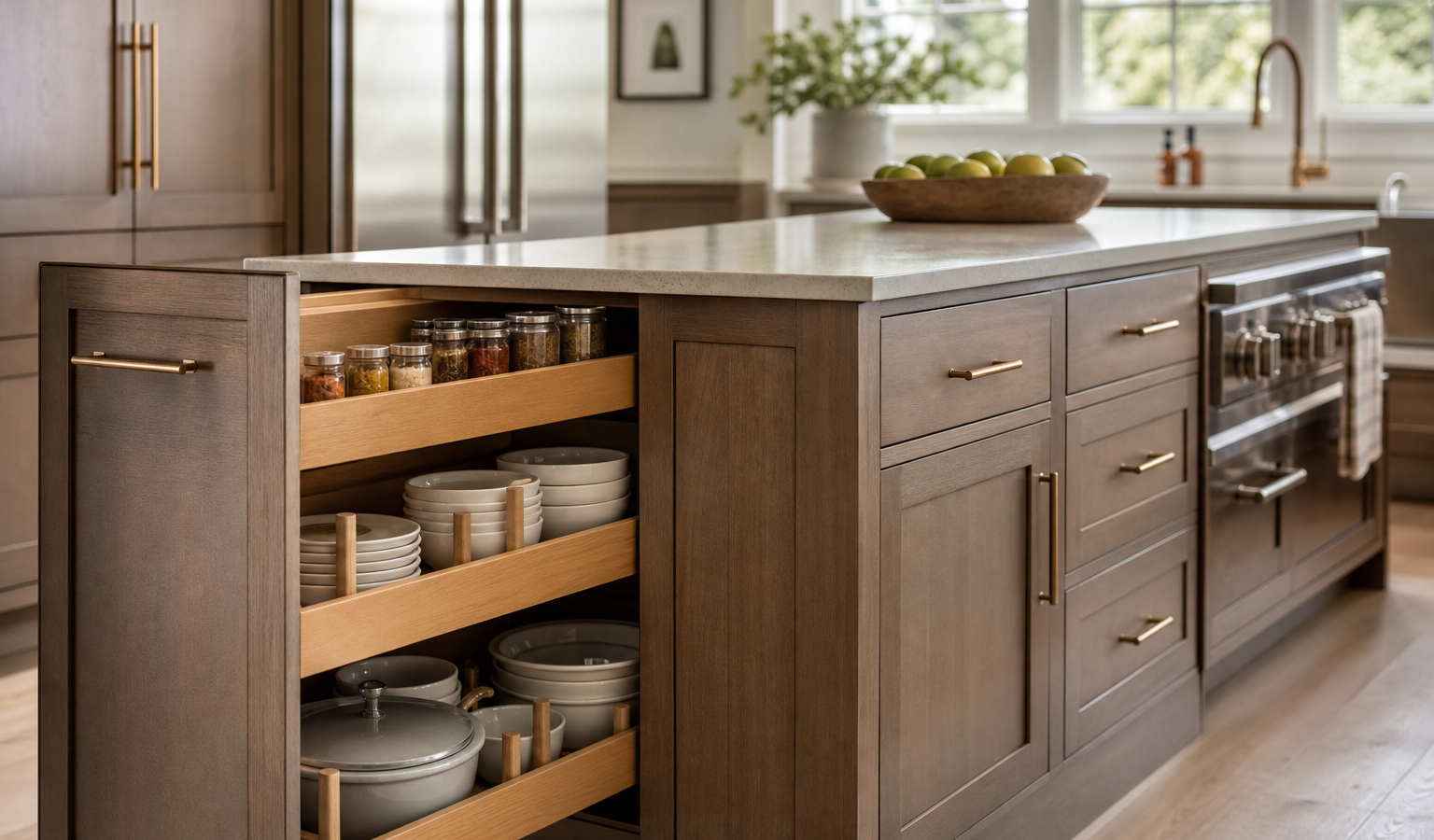
Great kitchen cabinet organization is the quiet upgrade that makes an ordinary kitchen feel custom. You do not need to gut the room or replace a single door to get there. The right mix of roll-out shelves, drawer inserts, corner solutions, and pull-out hardware turns dead space into usable storage and cuts the daily friction of digging for a pot lid or a buried spice jar.
This guide walks through every proven kitchen cabinet organization idea worth the money in 2026, from base cabinet pull-outs to toe-kick drawers, with real US prices for each accessory so you can budget honestly. We will also cover how to prioritize your upgrades and when to hire a pro versus doing the install yourself. If you want the wider picture first, our overview of kitchen storage solutions maps how these pieces fit together.
The goal is not a magazine-perfect pantry. It is a kitchen where every item has a home, everything is easy to reach, and cleanup takes half the time. Start with your most frustrating cabinet and work outward. That single principle will save you more money than any product on this page.
Start where the frustration is
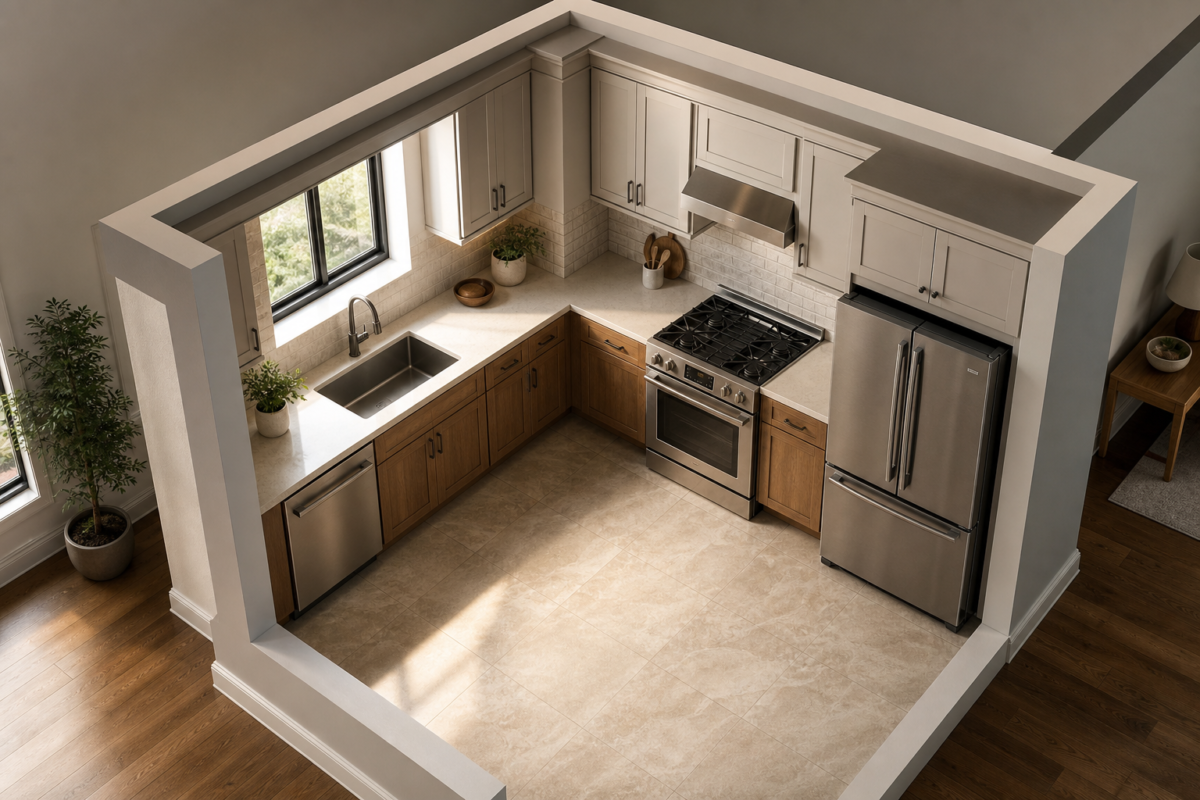
The fastest way to waste money on kitchen cabinet organization is to buy a matching set of bins for a cabinet that already works. Instead, spend a week paying attention to which doors you dread opening. The cabinet where lids avalanche out, the base cabinet you have to kneel and crawl into, the corner that swallows your stockpots – those are your first three projects.
Map your zones before you buy
Professional designers organize kitchens into zones: prep, cooking, cleanup, food storage, and daily dishes. Group items by how you actually use them, then match each zone to the right hardware. Pots and pans belong near the range in deep drawers or roll-out shelves. Everyday plates and glasses live between the dishwasher and the table. Spices sit within arm’s reach of the stove. Decluttering first is free, and it often reveals you need less storage than you thought.
Once you know your zones, rank upgrades by daily payoff per dollar. A $40 drawer divider you touch twenty times a day beats a $600 corner unit you open twice a week. Use this checklist to plan a sequence you can fund in stages.
- Empty and declutter each target cabinet before measuring anything
- Measure the interior opening width and depth, not the door
- List the exact items each cabinet must hold, by height and weight
- Rank cabinets by how often the current setup frustrates you
- Match each cabinet to one accessory type from the cost table below
- Confirm hinge and face-frame clearance for pull-out hardware
- Set a per-cabinet budget so upgrades can happen in phases
Base cabinet pull-outs and roll-out trays
Base cabinets are the biggest offenders because standard fixed shelves waste the back half of the cabinet. Anything you store beyond arm’s reach becomes invisible and forgotten. Roll-out trays and full pull-out shelves fix this by bringing the entire shelf out to you, so you see and reach everything at once. For most homeowners this is the single highest-payoff upgrade in the kitchen.
Roll-out trays vs full pull-out shelves
A roll-out tray is a shallow sliding shelf that sits on top of an existing shelf or the cabinet floor. It is the budget-friendly choice, ideal for canned goods, small appliances, and baking supplies. A full pull-out shelf mounts on heavy-duty slides and often replaces the fixed shelf entirely, carrying more weight for pots, mixers, and cookware. Wire baskets are the cheapest option, while solid wood or dovetailed trays cost more but look built-in. Prioritize soft-close, full-extension slides rated for at least 75 to 100 pounds if you plan to load them with cast iron.
Deep drawer inserts and dividers
Deep drawers have quietly replaced lower cabinets in most new kitchens because a drawer brings its contents to you without any bending. But an unorganized deep drawer is just a pit where pans clang together. Inserts and dividers turn that volume into tidy, protected storage that stays put when the drawer slides.
Adjustable dividers and drawer peg systems
Adjustable dividers snap or pin into place so you can resize compartments as your needs change – a huge advantage over fixed inserts. For dishes and cookware, a drawer peg system uses movable wood pegs set into a pegboard base to cradle stacks of plates and bowls, keeping them from sliding and chipping. Shallow drawers benefit from tiered cutlery trays and expandable bamboo dividers. When you plan new cabinetry, it is worth comparing stock versus custom cabinets, because factory drawer organizers are often cheaper ordered with the box than retrofitted later.
Corner cabinet solutions that actually work
The corner cabinet is where storage goes to die. A rotating or pull-out mechanism is the only way to make that deep, awkward volume usable without a flashlight and a long reach. Which one you need depends entirely on whether your corner is open or blind.
Lazy Susan, blind-corner pull-out, or magic corner
A lazy Susan rotates shelves so items come to the door – full-circle trays suit square corner cabinets, while kidney and D-shaped trays clear an offset door frame. Choose steel ball-bearing hardware over molded plastic for daily-use kitchens; it costs $30 to $60 more but survives years of spinning. A blind corner has one door and a hidden dead section beside it. For those, a blind-corner pull-out or a magic corner – a two-part swing-and-glide system that pulls the front basket out and the rear basket forward – retrieves everything from the void. Always measure the interior opening: a 33-inch cabinet typically needs a 24 to 26 inch tray, and a 36-inch cabinet needs 28 to 32 inches.
Contractor’s take
Nine times out of ten, the culprit behind a jammed pull-out is a face frame that narrows the opening. Before you order any corner unit or pull-out, open the door fully and measure the clear opening between the face-frame edges, then subtract another quarter inch for the slide brackets. Buying to the cabinet width instead of the opening is the number one reason a returned organizer shows up in my truck.
Vertical dividers and dedicated spice storage
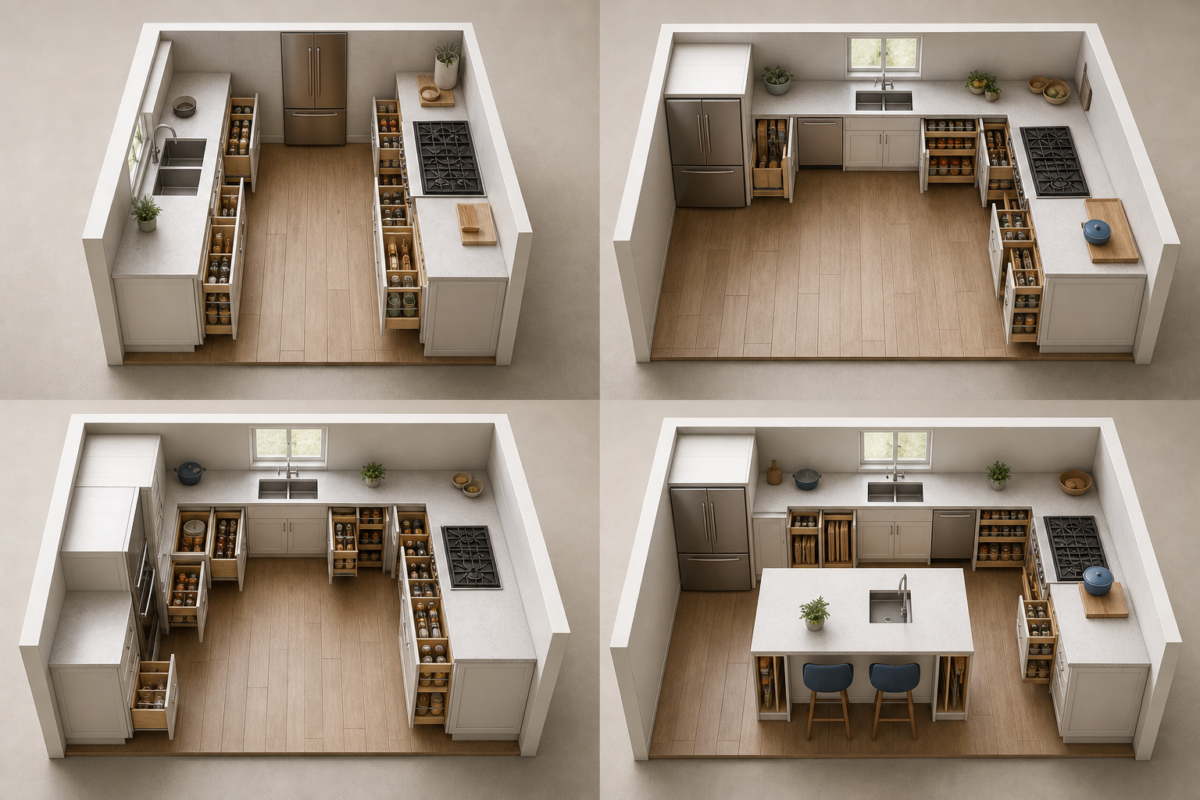
Not everything should lie flat. Baking sheets, cutting boards, muffin tins, and platters store far better on edge, where you can grab one without unstacking the pile on top of it. Spices, meanwhile, disappear the moment they sit two rows deep on a shelf.
Tiered spice pull-outs and tray dividers
Tray dividers are simple vertical partitions installed in a base or upper cabinet to hold flat items upright. They are inexpensive and one of the most satisfying quick wins in the kitchen. For spices, a narrow pull-out spice rack fits the awkward gaps beside a range or refrigerator and presents every jar label at once. A tiered drawer insert works just as well, angling jars so you read them from above. Keep spice storage out of direct heat and sunlight to protect flavor, and store the jars you reach for most in the front row so the whole rack stays fast to use.
Under-sink organization
Under the sink is the hardest cabinet in the kitchen: no floor plan is the same twice thanks to the plumbing that runs through it. That P-trap and the shutoff valves eat the exact center of the space, so ordinary shelves do not fit. The trick is hardware built to work around the pipes.
Working around the P-trap
Two-tier pull-out baskets with a U-shaped cutout slide around the drain pipe and bring cleaning supplies forward. Where a full pull-out will not clear the plumbing, use freestanding stacking shelves with an open back, tension rods to hang spray bottles by their trigger handles, and a shallow caddy on the door. A slim rollout tray on the cabinet floor keeps dish soap refills and sponges corralled. Line the base with a waterproof mat so a slow leak is a wipe-up, not a warped cabinet.
Pantry cabinet pull-outs
Whether you have a dedicated pantry cabinet or a couple of tall food cabinets, pull-outs transform them from black holes into full-view storage. The same roll-out principle that rescues base cabinets works even better here because pantry items are small, numerous, and easy to lose in the back.
Full-height systems and roll-out shelves
The premium option is a full-height pull-out pantry: a tall frame on heavy slides that carries five or six tiers of food and glides out as one unit, accessible from both sides. It is a serious investment but unmatched for capacity in a narrow footprint. A budget-conscious alternative is to fit an existing pantry cabinet with several independent roll-out shelves at staggered heights, plus door-mounted racks for cans and packets. Group by category, keep frequently used items at eye level, and use clear bins so you can spot when you are low. For a deeper layout treatment, see our guide to kitchen pantry ideas.
Trash, appliances, and hidden drawers
A few specialized upgrades punch well above their footprint. They handle the items that otherwise clutter counters or force you to bend and dig, and they are what make a kitchen feel genuinely custom.
Trash pull-outs, appliance garages, and toe-kick drawers
A pull-out trash and recycling unit hides one or two bins behind a cabinet door on a sliding frame, freeing the floor and containing odors – a soft-close model is worth the small premium so the door does not slam. An appliance garage is a countertop cabinet, often with a roll-up or lift door, that hides the coffee maker, toaster, and stand mixer while keeping them plugged in and ready. Toe-kick drawers claim the dead four-inch strip under your base cabinets for flat items like platters, seldom-used bakeware, or even pet bowls. None of these is essential, but each removes a specific daily annoyance.
What kitchen cabinet organization costs in 2026
Prices vary with material, size, and whether you buy a drop-in accessory or a factory upgrade ordered with new cabinets. The figures below reflect typical 2026 US ranges for the accessory itself; add labor if you hire out the install. Wire and plastic sit at the low end, solid wood and soft-close hardware at the high end.
Where the money goes
As a rule, mechanisms cost more than trays, and anything with a hidden swing or two-part motion (magic corners, full-height pull-outs) commands a premium. Buying organizers built into new cabinetry is often cheaper per piece than retrofitting, which is why it pays to plan storage before you order boxes. For the bigger budget picture, our breakdown of kitchen cabinet cost shows how accessories fold into a full cabinet order.
| Organizer type | Typical 2026 cost (accessory) | Payoff |
|---|---|---|
| Roll-out tray / pull-out shelf | $30 to $300 each | Highest daily use; reaches the back half of base cabinets |
| Deep drawer dividers / inserts | $15 to $120 | Stops rattle and clutter; resizes as needs change |
| Drawer peg system | $40 to $200 | Protects stacked dishes from sliding and chipping |
| Lazy Susan (corner) | $70 to $470 | Rotates dead corner space into full reach |
| Blind-corner pull-out / magic corner | $150 to $650 | Recovers the hidden void in a blind corner |
| Tray / vertical dividers | $20 to $260 | Stores pans and boards on edge; easy grab |
| Pull-out spice rack | $40 to $325 | Every label visible; uses narrow gaps |
| Under-sink pull-out organizer | $25 to $250 | Works around the P-trap; contains cleaning gear |
| Pantry roll-out shelf (each) | $100 to $400 | Full-view food storage; no more lost cans |
| Full-height pull-out pantry | $300 to $1,200 | Maximum capacity in a narrow footprint |
| Trash / recycling pull-out | $50 to $400 | Hides bins; frees floor and counter |
| Appliance garage | $150 to $500 | Clears counters while keeping devices ready |
| Toe-kick drawer | $150 to $400 | Reclaims dead space under base cabinets |
DIY versus professional installation
Many of these upgrades are genuine weekend projects, and doing them yourself can cut the total cost by more than half. The dividing line is whether the accessory needs precise slide alignment or cutting into the cabinet itself.
What you can install in an afternoon
Drop-in dividers, freestanding under-sink shelves, door-mounted racks, tiered spice inserts, and most roll-out trays that sit on an existing shelf are beginner-friendly – a drill, a level, and careful measuring are all you need. Hire a pro for full-extension pull-out shelves that mount to the cabinet sides, blind-corner and magic-corner mechanisms, full-height pantry systems, and anything requiring you to modify the face frame or cut a toe-kick. A handyman typically charges $50 to $100 per hour, and most retrofits take thirty to sixty minutes each once the layout is set. If you are staging a larger refresh, our budget kitchen remodel ideas show how to fold organization into a broader plan without overspending.
Frequently asked questions
Your next move
You know the number. What are you deciding next?
Everything you need to plan a kitchen remodel in 2026 - budget, layout, cabinets, countertops, appliances, timeline, hiring,…
Continue →A kitchen remodel costs $18,000 to $120,000 in 2026, with a national average near $42,000. Here's the full…
Continue →Kitchen cabinets cost $80-$800 per linear foot installed in 2026. Here's what stock, semi-custom, and custom really cost,…
Continue →Frequently asked
Which cabinet organizer gives the best return for the money?
Roll-out trays and pull-out shelves in your base cabinets. At $30 to $300 each they solve the most common complaint – the unreachable back half of a cabinet – and you use them every single day. Start there before spending on corner units or full-height systems.
Do cabinet pull-outs and organizers add home value?
They help a kitchen show and function like a higher-end space, which buyers notice, though they rarely appear as a separate line item in an appraisal. Their bigger return is daily livability. Soft-close, full-extension hardware reads as custom and holds up over time.
Lazy Susan or blind-corner pull-out – which should I choose?
It depends on your corner. An open corner cabinet with a diagonal or bi-fold door takes a lazy Susan. A blind corner, where one door hides a dead section beside it, needs a blind-corner pull-out or a magic corner to reach the hidden space. Measure the interior opening before ordering either.
Can I add organizers to existing cabinets, or do I need new ones?
Almost all of these retrofit into existing cabinets. Roll-out trays, dividers, spice racks, and under-sink units are designed for it. The main constraint is the interior opening width and any face frame that narrows it, so measure carefully. Ordering organizers with new cabinets is often cheaper per piece but not required.
How do I organize a small kitchen with few cabinets?
Go vertical and use every hidden inch. Tray dividers, door-mounted racks, tiered shelf risers, toe-kick drawers, and slim pull-outs beside appliances all add capacity without a footprint. Declutter first, then store by zone so the space you have works harder.

Pricing synthesized from 2026 US cabinet accessory retailers and manufacturer upgrade lists; reviewed by a licensed general contractor.