Bathroom Paint Colors 2026: Best Shades and Finishes
Warm whites, soft greens, and moody blues lead 2026, but the finish you choose decides whether your bathroom paint colors last.

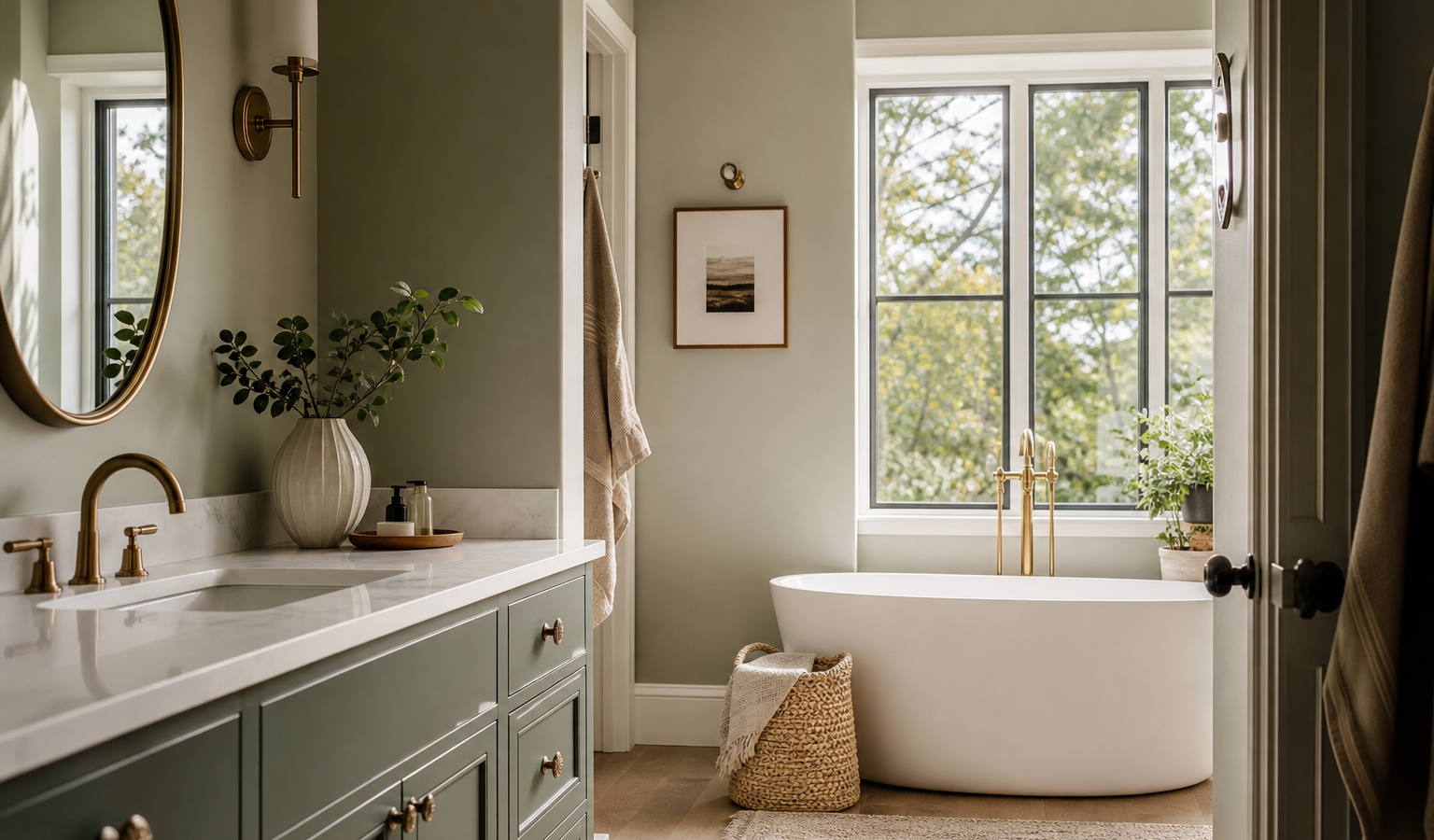
The best bathroom paint colors do two jobs at once: they set the mood you want and they stand up to the heat, steam, and daily splashes a bathroom throws at them. In 2026, homeowners are moving past plain builder white toward warm neutrals, soft greens, moody blues, and spa-inspired earth tones, but the color is only half the decision. Get the paint sheen and the moisture-resistant formula right and your bathroom paint colors will look fresh for years; get them wrong and you will be repainting over peeling, mildew-spotted walls within a season.
This guide covers the most popular bathroom paint colors for 2026 with real brand names and codes, the finish that actually survives a bathroom, how to choose shades for small and windowless spaces, and what a repaint costs. Whether you are refreshing a powder room for a weekend or coordinating a full remodel, use it alongside our bathroom remodel cost guide so paint fits the rest of the plan.
Key takeaways
- Satin and semi-gloss are the only finishes to use in a full bathroom; they repel moisture and wipe clean, while flat and eggshell trap mildew.
- Warm whites, soft sage greens, and muted blue-grays lead 2026 bathroom color trends; moody navy and forest green work as accents.
- Small and windowless baths look bigger in light, cool-toned colors that reflect artificial light evenly.
- Use a bathroom-specific, mildew-resistant paint line for humid, poorly ventilated rooms.
- Painting a bathroom yourself costs about $150 to $300; hiring out runs $250 to $650 for an average room.
What are the best bathroom paint colors for 2026?
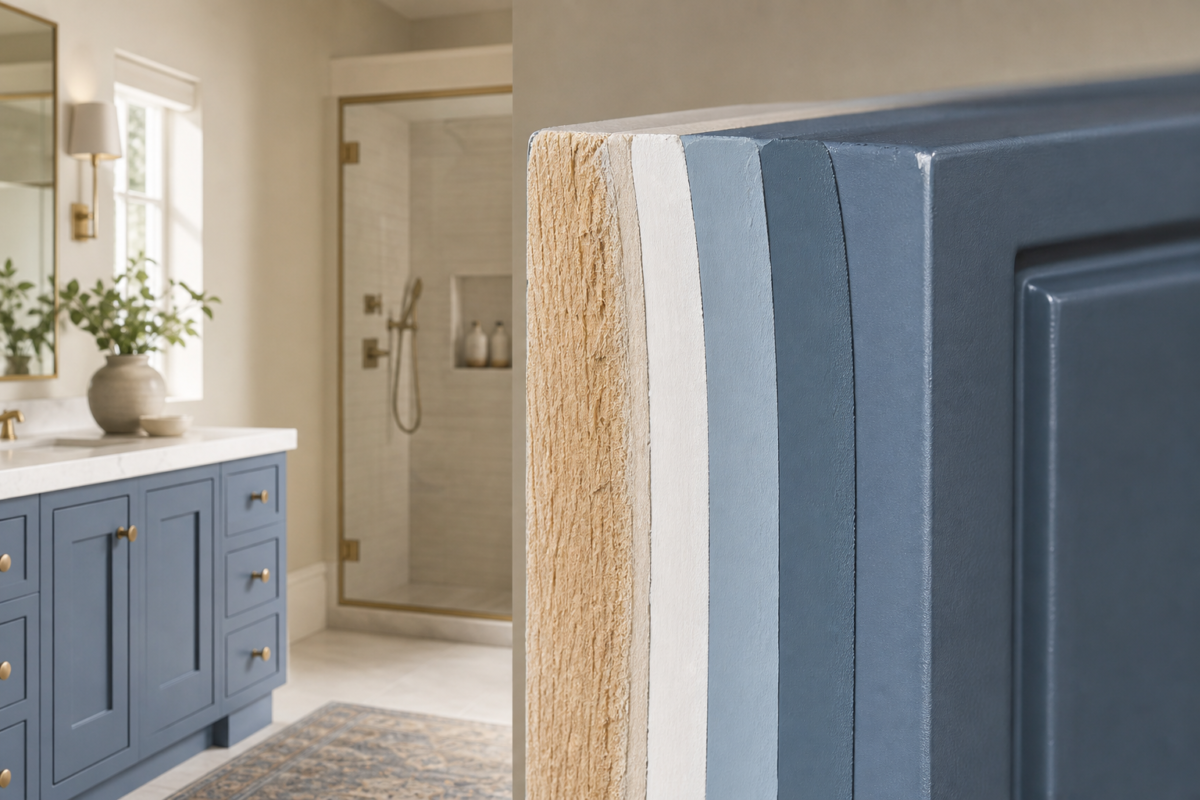
The best bathroom paint colors for 2026 are warm whites like Benjamin Moore White Dove and Sherwin-Williams Pure White, soft greens like Saybrook Sage and Softened Green, calming blue-grays like Quiet Moments and Raindrop, and moody accent tones like Naval navy and Essex Green. These shades read clean, feel spa-like, and flatter both natural and artificial light.
The overall direction this year is warmth and calm. Cool gray has given way to greige, creamy whites, and nature-inspired greens and blues that make a bathroom feel restful. Saturated colors have not disappeared; instead of covering every wall, they show up on a single feature wall, a vanity, or the lower half of a two-tone scheme. Pairing your color with the right vanity finish and tile pattern keeps the whole room cohesive rather than a collection of separate choices.
Trending warm whites and greiges
Warm whites are the safest high-impact choice for 2026. Benjamin Moore White Dove (OC-17) has a soft cream undertone that avoids the sterile feel of a stark white, while Sherwin-Williams Pure White (SW 7005) reads clean without going cold. Creamy beige-browns like Sherwin-Williams Latte (SW 6108) and Benjamin Moore Cinnamon Slate (2113-40) add cozy warmth for larger baths and pair beautifully with wood vanities and brass fixtures.
Soft greens and calming blues
Nature tones are the story of 2026. Benjamin Moore Saybrook Sage (HC-114) and Sherwin-Williams Softened Green (SW 6177) bring a whisper-soft, organic calm, while Benjamin Moore Quiet Moments (1563) and Sherwin-Williams Raindrop (SW 6485) deliver airy blue-greens perfect for smaller rooms. For drama, Sherwin-Williams Naval (SW 6244) and Benjamin Moore Essex Green (HC-188) make rich, enveloping accent walls.
What paint finish is best for a bathroom?
Satin and semi-gloss are the best paint finishes for a bathroom because they resist moisture and wipe clean, while flat and eggshell absorb humidity and grow mildew. Use satin on most walls for a soft, forgiving sheen, and step up to semi-gloss for shower surrounds, ceilings above tubs, and trim, where water contact is heaviest.
The tradeoff is simple: the glossier the finish, the tougher and more washable the surface, but the more it highlights wall imperfections. Satin hits the sweet spot for bathroom walls, hiding minor flaws while still shedding water. Reserve high-gloss for trim and doors. Because the wrong sheen is the number one reason bathroom paint fails, this choice matters more than the exact color.
When to use semi-gloss versus satin
Choose semi-gloss for any surface that gets direct steam or splashes: the ceiling over a tub or shower, walls immediately around the tub, window trim, and baseboards. Choose satin for the main wall field in a full bath, and for powder rooms that see little moisture you can use satin throughout. Avoid flat and eggshell in any room with a shower, no matter how appealing the low-sheen look is, because they will not survive the humidity.
Moisture-resistant and mildew-resistant paint
For humid, poorly ventilated bathrooms, use a premium bathroom-specific paint with built-in mildew resistance rather than a standard interior paint. These lines add antimicrobial agents that inhibit mold and mildew growth on the paint film, which is critical where steam lingers.
Top performers in 2026 include Benjamin Moore Aura Bath and Spa, Sherwin-Williams Emerald, and Behr Ultra with Scuff Defense. They cost more per gallon than basic paint but hold color, resist staining, and clean up without burnishing. Even the best paint cannot beat chronic moisture on its own, so pair it with a working exhaust fan; our bathroom exhaust fan guide explains how to size ventilation so paint and surfaces stay dry.
Ventilation and low-VOC health considerations
Two health-minded details round out a good paint job. First, run the fan during and after showers to keep humidity down; persistent dampness causes both mildew and peeling. The US EPA mold guidance offers practical guidance on preventing bathroom mold. Second, choose a low-VOC or zero-VOC paint to limit indoor air pollutants, especially in a small, enclosed room; the EPA explains why volatile organic compounds matter for indoor air quality. Most premium bathroom paints are now available in low-VOC formulas.
Best paint colors for small and windowless bathrooms
For small and windowless bathrooms, choose light, cool-toned colors that reflect available light and create a sense of depth. Soft whites, pale blue-greens, and light greiges make a cramped or dark room feel open, while very dark colors can work only when the lighting is strong and intentional.
Top picks for tight spaces include Benjamin Moore Quiet Moments (1563), Sherwin-Williams Pure White (SW 7005), and Sherwin-Williams Repose Gray (SW 7015), a true neutral that stays balanced under artificial light. In windowless rooms, favor colors with balanced undertones such as Aegean Teal, Repose Gray, and White Dove, which do not turn muddy or garish when only bulbs are lighting them.
How lighting changes paint color
Paint color shifts dramatically with the light source, so test before you commit. Warm LED bulbs (2700K) push colors toward yellow and can make cool grays look dingy; cooler bulbs (3500K to 4000K) render colors closer to their true tone. Because bathroom lighting is often the only light a color ever sees, coordinate paint and fixtures together; our bathroom lighting guide helps you plan layered, color-accurate lighting. Always paint a large sample swatch and view it morning, noon, and night before buying gallons.
Choosing a color scheme by style and mood
Pick your scheme by deciding the mood first, then choosing a color family that delivers it: airy and clean, warm and cozy, or moody and dramatic. Match that mood to your tile, vanity, and fixtures so the palette feels intentional rather than accidental.
The factors below show how the main 2026 color families rank on the qualities buyers ask about most: how well they brighten a small room, how on-trend they are, how forgiving they are of imperfections, and how bold a statement they make. Use it to narrow your palette before you buy samples.
Two-tone and accent-wall schemes
Two-tone bathrooms are a strong 2026 look: a deeper color on the lower third or on the vanity wall, with a light shade above, adds depth without shrinking the room. An accent wall behind the vanity or tub lets you use a bold navy or green in a controlled dose. If you also plan to refinish cabinetry, our guide to painting cabinets covers durable prep and product choices that apply equally to a painted vanity.
Contractor’s take
Homeowners obsess over the color chip and ignore the sheen, and that is exactly backwards for a bathroom. I have repainted more baths because someone used a flat or eggshell finish than for any color reason. My rule: satin on the walls, semi-gloss on the ceiling over the shower and on all the trim, and a mildew-resistant line if the fan is weak or there is no window. Buy a quart of your top color, paint a two-foot square next to the vanity and next to the shower, and live with it for two days under your actual bathroom lights before you commit to gallons.
How much does it cost to paint a bathroom?
Painting a bathroom costs about $150 to $400 for a small or half bath and $300 to $1,500 for a large primary bathroom in 2026, with a national average near $420. Doing it yourself drops the cost to roughly $150 to $300 in paint and supplies, since labor is the biggest expense.
Costs scale with the scope and the surfaces you include. Walls only run about $1 to $3 per square foot, while walls plus ceiling and trim run $2 to $6 per square foot. Bathroom-specific, mildew-resistant paint costs $20 to $60 per gallon, and primer adds $15 to $50 per gallon; an average bath needs one to two gallons plus primer. The table below breaks down typical 2026 pricing.
| Bathroom type / scope | DIY materials | Pro total | Notes |
|---|---|---|---|
| Small / half bath | $150 – $250 | $150 – $400 | 1 gallon plus primer |
| Average full bath | $200 – $300 | $250 – $650 | Walls, ceiling, trim |
| Large primary bath | $250 – $350 | $300 – $1,500 | 2 gallons, more trim |
| Walls only (per sq ft) | n/a | $1 – $3 | Fastest, lowest cost |
| Walls + ceiling + trim (per sq ft) | n/a | $2 – $6 | Full refresh |
Because paint is one of the cheapest ways to transform a bathroom, it delivers strong value against bigger line items; weigh it against tile and fixtures using our bathroom remodel cost guide to prioritize your budget.
Prep and application checklist for lasting results
The paint job lasts as long as the prep, so clean, repair, and prime before you open a can of color. Bathrooms accumulate soap film and mildew that stop paint from bonding, and skipping prep is the fastest route to peeling.
Work in this order for a professional, durable finish that resists the room’s humidity and holds its color through years of steamy showers.
- Clean walls with a mildew-killing solution and rinse; let fully dry.
- Scrape any peeling paint, then patch and sand holes and cracks smooth.
- Spot-prime repairs and any stains with a stain-blocking primer.
- Run the exhaust fan and, if possible, open a window while painting.
- Apply satin to walls and semi-gloss to the ceiling over the shower and to trim.
- Use two coats and allow full cure time before hot showers resume.
Pair the finished color with a complementary bathroom tile choice and coordinated tile so the palette reads as one deliberate scheme rather than a set of separate decisions.
Bathroom paint color FAQ
Your next move
You know the number. What are you deciding next?
Walk-in tub cost in 2026: $5,000 to $20,000 installed. Compare tub types, features, and the real Medicare coverage…
Continue →Bathroom remodel financing explained: compare home equity loans, HELOCs, cash-out refi, personal loans, and 0% cards with 2026…
Continue →Steam shower cost runs $3,000 to $10,000 installed in 2026. See prices by generator size, enclosure, and prefab…
Continue →Frequently asked
What is the best paint finish for a bathroom?
Satin for most walls and semi-gloss for the ceiling above the shower and for trim. Both resist moisture and wipe clean, while flat and eggshell trap humidity and grow mildew, so avoid them in any room with a shower.
What are the most popular bathroom paint colors for 2026?
Warm whites (White Dove, Pure White), soft sage greens (Saybrook Sage, Softened Green), calming blue-grays (Quiet Moments, Raindrop), and moody accents like Naval navy and Essex Green lead the 2026 trends.
What color makes a small bathroom look bigger?
Light, cool-toned colors such as soft whites, pale blue-greens, and light greiges reflect the most light and create a sense of depth, making a small or windowless bathroom feel more open.
Do I need special paint for a bathroom?
In humid or poorly ventilated baths, yes. Bathroom-specific lines like Benjamin Moore Aura Bath and Spa or Sherwin-Williams Emerald add mildew resistance. Well-ventilated powder rooms can use quality standard interior paint in a satin finish.
How much does it cost to paint a bathroom?
About $150 to $400 for a small bath and $300 to $1,500 for a large primary bath if you hire a pro, or roughly $150 to $300 in materials if you do it yourself.

Color codes from Sherwin-Williams, Benjamin Moore, and Behr; cost ranges reflect 2026 US averages.