Bathroom Mirror Guide: Sizing, Styles, and Lighted Mirrors
Size the mirror to the vanity, mount it at the right height, and pick framed, frameless, or lighted with confidence.

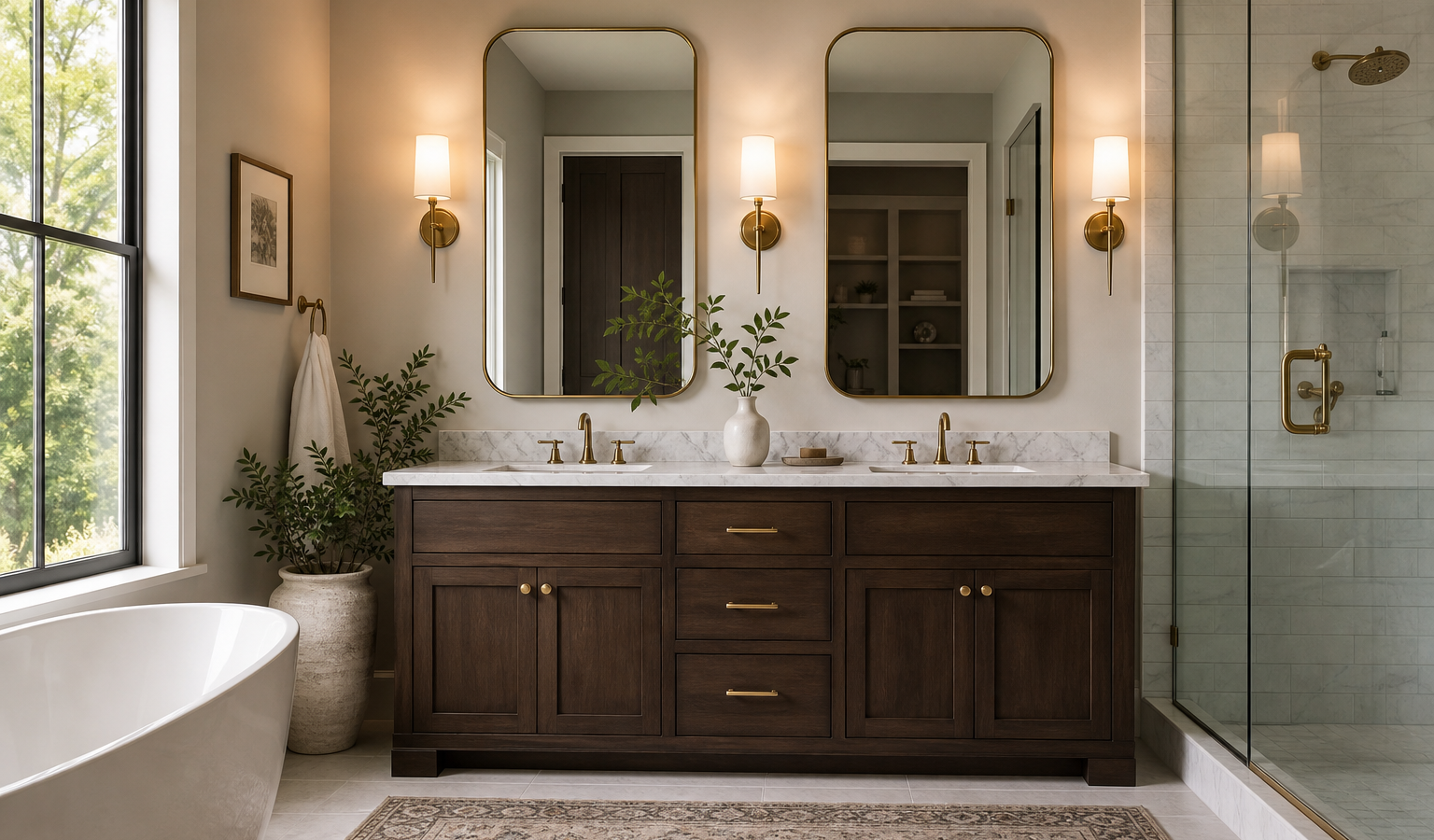
A bathroom mirror is the one thing you look at every single morning, yet it is often the last decision in a remodel and the easiest to get wrong. Too small and the vanity looks unfinished; too high and you cut off the top of your head; wrong lighting and the reflection is useless for grooming. This bathroom mirror guide covers exactly how to size a mirror to your vanity, where to mount it, how framed, frameless, and LED lighted mirrors differ, and what each option costs in 2026 so you can choose with confidence.
The good news is that a mirror is one of the most affordable, high-impact upgrades in the room. Swapping a builder-grade sheet of glass for a properly sized framed or lighted mirror instantly modernizes a bathroom, and it pairs naturally with a lighting update for a complete transformation.
Key takeaways
- Size the mirror equal to or 2 to 6 inches narrower than the vanity, leaving 2 to 4 inches of wall on each side.
- Center the glass at eye level, roughly 60 to 65 inches off the floor, with the bottom edge a few inches above the backsplash or faucet.
- For a double vanity, choose one wide mirror for a seamless look or two mirrors centered over each sink.
- LED lighted mirrors add shadow-free front or back light, anti-fog defoggers, tunable color, and dimming in one unit.
- Budget $50 to $250 for a framed mirror, $100 to $650 for a lighted LED mirror, and $120 to $300 for a mirrored medicine cabinet in 2026.
How do you choose a bathroom mirror?
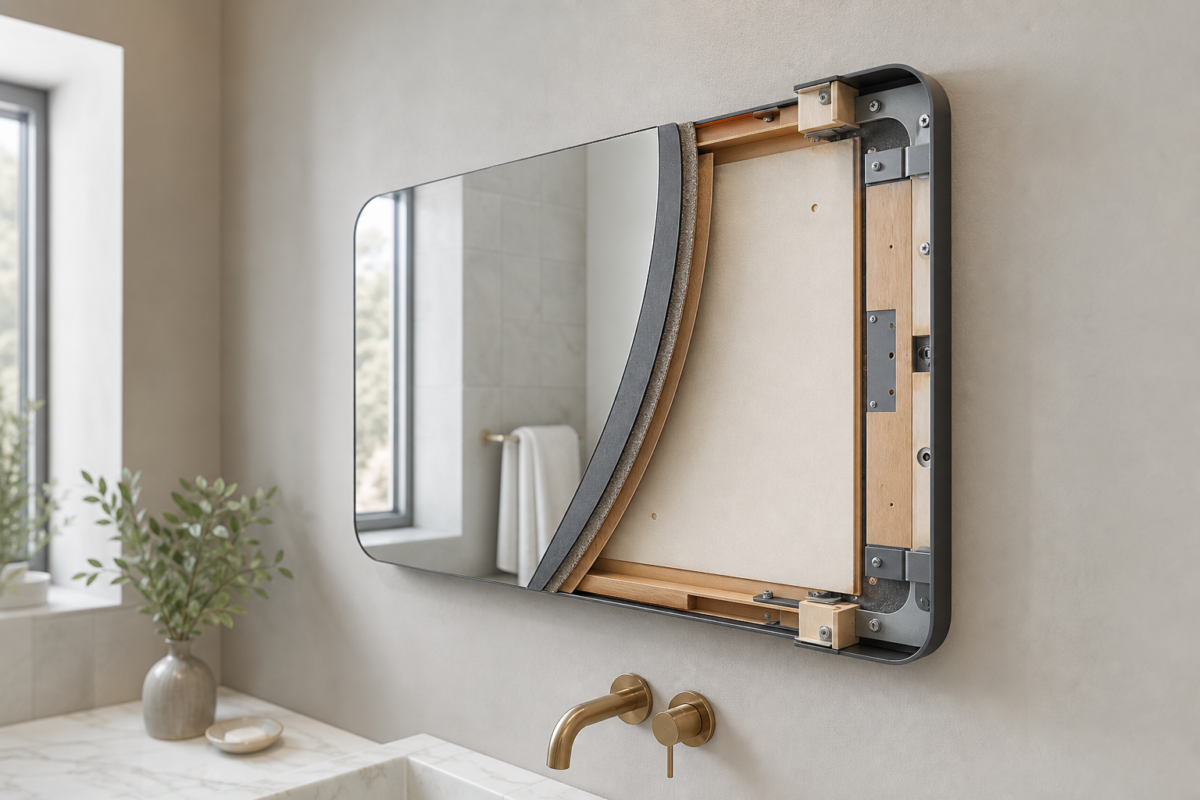
Start with size and placement, then choose style and lighting; get the proportions right and almost any style will look intentional. The most common regret is buying a mirror that is too small for the vanity because it looked fine in the store. Measure first, and treat the mirror as part of the vanity wall composition rather than a standalone accessory.
Coordinate the mirror with the fixtures around it. The mirror, the vanity, and the lighting are a set, and choosing them together prevents the mismatched look of a modern frameless mirror over a traditional vanity. If you are still finalizing the cabinet, our bathroom vanity guide will help you lock in the width the mirror needs to relate to.
How to size a bathroom mirror to your vanity
Your bathroom mirror should be equal to or a few inches narrower than the vanity, never wider. A mirror that overhangs the cabinet looks top-heavy and unbalanced. The vanity width is your anchor measurement, so start there and work outward.
The width rule that always works
Match the mirror width to the vanity or go 2 to 6 inches narrower, leaving roughly 2 to 4 inches of wall on each side to breathe. For a 36-inch vanity, a 30- to 34-inch mirror looks right; for a 48-inch vanity, aim for 42 to 46 inches. In a small bathroom, err slightly larger rather than smaller: a generous mirror bounces light and makes the room feel bigger, an effect worth chasing in any tight small bathroom project.
Single mirror vs two mirrors for a double vanity
Over a double vanity you have two good moves. One wide mirror spanning both sinks reads seamless and hotel-like and makes the wall feel expansive. Two mirrors, each centered over its own sink, look structured and symmetrical and suit walls with natural divisions such as a window or a sconce between stations. If you run two mirrors, keep them the same size and center each on its faucet.
Height, shape, and proportion
Mirror height should relate to the vanity and ceiling: taller mirrors suit high ceilings and draw the eye up, while a standard rectangular mirror around 30 to 40 inches tall fits most baths. Round and arch mirrors soften a room full of hard tile lines but generally need to be a bit larger to cover the same functional viewing area, so size up when going round.
Bathroom mirror mounting height and placement
Center the mirror at eye level, about 60 to 65 inches from the floor, with the bottom edge a few inches above the backsplash and clearly below the light fixture. Placement is where most DIY installs go wrong, usually by hanging the mirror too high because that is where the existing anchor happened to be.
Getting the height right
The center of the glass should land near the eye level of the household, which averages around 60 to 65 inches off the floor. Leave about 5 to 10 inches between the top of the backsplash or the faucet and the bottom of the mirror so the counter does not feel cramped, and keep the top of the mirror below an overhead light bar by the 3 to 6 inches that fixture needs. Tape a paper template to the wall and live with it for a day before drilling.
Coordinating with lighting
Mirror and lighting decisions are inseparable. If you plan flanking sconces, leave room on each side of the mirror for them; if you want a light bar above, the mirror cannot run all the way to the ceiling. A lighted mirror can replace the vanity fixture entirely, which simplifies the wall. Work through both together using our bathroom lighting guide so nothing collides.
Framed vs frameless bathroom mirrors
Framed mirrors add warmth, style, and a finished edge, while frameless mirrors read clean and modern and cost less. Neither is objectively better; the choice follows your design and how much the mirror should stand out as a feature.
When to choose a frame
A frame is a low-cost way to inject personality and tie the mirror to other finishes, such as matte-black hardware or warm brass fixtures. Wood frames suit transitional and farmhouse baths; metal frames suit modern and industrial looks. Framed mirrors also hide minor wall imperfections at the edge. Coordinate the frame finish with your faucet and hardware finishes for a pulled-together result.
When frameless wins
Frameless mirrors, including polished-edge and beveled styles, disappear into a contemporary room and let the tile or vanity be the star. They are the most budget-friendly option for a plain wall mirror and pair beautifully with a bold tile choice or a statement stone counter. The tradeoff is that a frameless edge shows every flaw in the wall behind it, so the substrate must be flat.
Lighted and LED bathroom mirrors explained
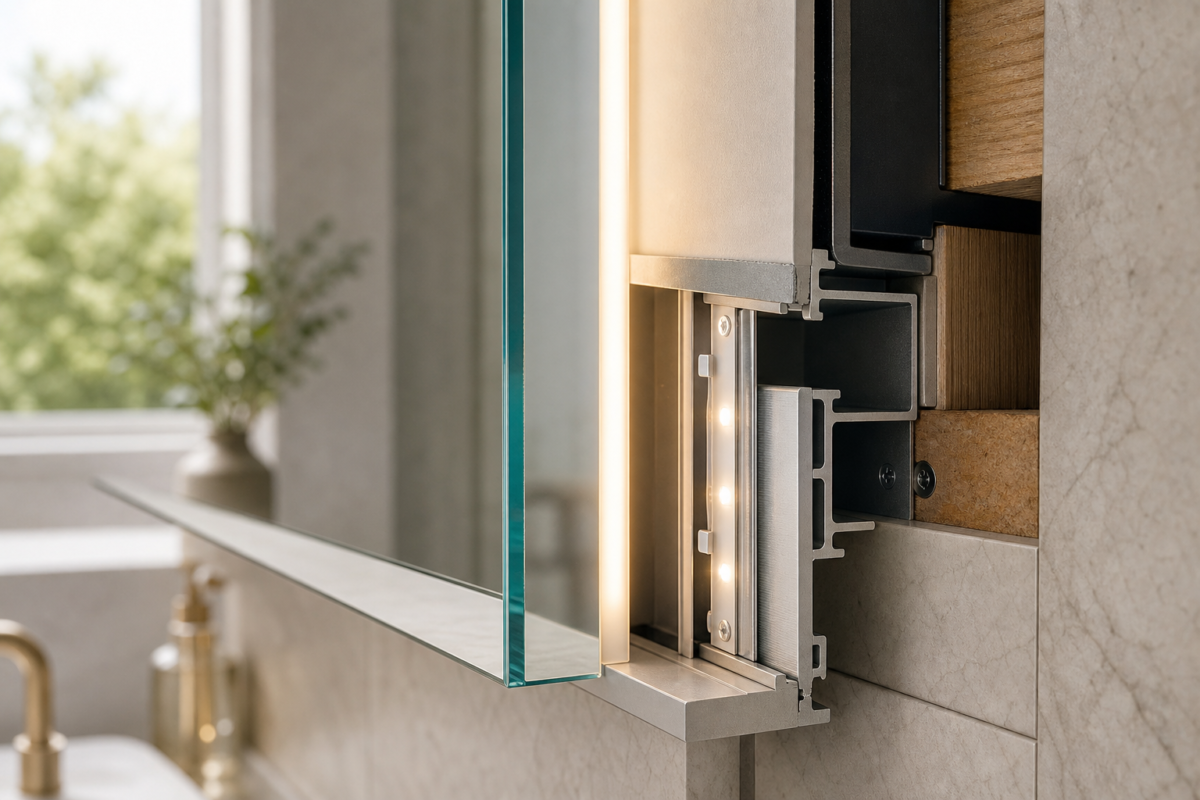
An LED lighted mirror builds even, shadow-free light into the glass itself, and the best models add anti-fog, tunable color temperature, and dimming. These have become the default upgrade in modern baths because they light the face better than most wall fixtures and save wall space. They do require a dedicated power connection, so plan the wiring during a remodel.
Front-lit vs backlit
Front-lit mirrors have a lit border or perimeter that throws light onto the face, making them excellent task lights for makeup and shaving. Backlit mirrors glow softly around the edges against the wall for ambiance and a floating look but provide gentler face light. Many premium mirrors combine both. If the mirror is your only vanity light, prioritize a front-lit or perimeter-lit design with high output.
Anti-fog, color tuning, and smart features
A built-in defogger pad keeps a clear zone through hot showers, a genuinely useful feature in a busy bath. Better mirrors offer adjustable color temperature (commonly 3000K to 6000K) so you can switch between warm and daylight, plus touch dimming. Smart models add Bluetooth speakers, clocks, and even displays. Look for 90-plus CRI and the ENERGY STAR mark for efficient, true-color LEDs, and confirm the unit is damp-rated for bathroom use.
Medicine cabinets vs plain mirrors
Choose a mirrored medicine cabinet when you need storage and a plain or lighted mirror when you want a cleaner look or a larger reflective surface. Storage versus statement is the core tradeoff. In small baths the hidden storage of a recessed cabinet is often worth more than the drama of an oversized mirror.
Recessed vs surface-mounted
Recessed cabinets sit inside the wall between studs (a standard bay is about 14.5 inches wide) for a flush, built-in look with no lost floor space, but installation means cutting into the wall and avoiding plumbing and wiring. Surface-mounted cabinets bolt to the wall and install in minutes, projecting a few inches into the room. Lighted medicine cabinets combine storage and vanity lighting in one unit, a smart pick for compact primary baths where wall space is tight.
Bathroom mirror shapes and styles
Rectangular mirrors are the safe, space-efficient default, while round and arched shapes add softness and character. Shape is where you can express style once size and placement are settled. Match the shape to the room’s geometry and the vanity below it.
Choosing a shape that fits the room
Rectangles and squares maximize viewing area and suit most vanities, especially wide ones. Round mirrors soften a boxy, tile-heavy room and pair well with pedestal sinks and single vanities, though they cover less usable area. Arched mirrors bridge classic and modern and feel current in 2026. For a double vanity, twin round or arched mirrors can look striking, but confirm each still gives a full-face reflection before committing.
Bathroom mirror cost in 2026
Expect $50 to $250 for a quality framed mirror, $100 to $650 for an LED lighted mirror, and $120 to $300 for a mirrored medicine cabinet in 2026, plus $50 to $150 in labor if you hire out the hanging. Plain frameless mirrors start as low as $10 to $100, while designer and oversized pieces climb well past $1,000. The table below sets expectations by type.
| Mirror type | Material cost | Install labor | Best for |
|---|---|---|---|
| Frameless plain mirror | $10 to $100 | $50 to $150 | Budget, modern, flat walls |
| Framed vanity mirror | $50 to $250 | $50 to $150 | Style and warmth |
| LED lighted mirror | $100 to $650 | $100 to $250 | Grooming, saving wall space |
| Backlit smart mirror | $250 to $780 | $100 to $250 | Ambiance and tech |
| Mirrored medicine cabinet | $120 to $300 | $120 to $300 | Storage in small baths |
| Custom cut wall mirror | $6 to $20+ per sq ft | included above | Large or odd-size walls |
Lighted and custom mirrors are where budgets stretch, but they also do the most work. Fold the mirror into your broader bathroom remodel cost plan, and remember that a great mirror and good lighting together cost less than most single tile upgrades while changing the room more.
What drives your mirror budget
Contractor’s take
Buy the mirror before you finalize the vanity light, not after. I have re-drilled too many walls because a homeowner mounted a beautiful light bar and then discovered their new mirror was two inches too tall to fit under it. Decide the mirror size and height first, then let the lighting follow. And if you are choosing an LED mirror, run the electrical during rough-in; adding a hidden outlet later means opening the wall.
Installation and safety basics
Anchor heavy mirrors into studs or with rated hollow-wall anchors, and treat any lighted mirror as an electrical fixture that must be damp-rated and properly grounded. Mirrors are heavier than they look, and a lighted unit adds wiring to the equation.
Hanging it safely
Use a level, mark stud locations, and choose hardware rated for well above the mirror’s weight; large glass can weigh 30 pounds or more. For lighted and smart mirrors, have an electrician provide a properly located, GFCI-protected supply during a remodel, and confirm the mirror is listed for damp locations. Following recognized NKBA bathroom planning guidelines for clearances keeps the finished layout comfortable and code-friendly.
Common bathroom mirror mistakes to avoid
The top mistakes are buying a mirror too small for the vanity and hanging it too high. Both are easy to prevent with a tape measure and a paper template. Avoid the pitfalls below and your mirror will look custom rather than an afterthought.
- Choosing a mirror wider than the vanity, which looks top-heavy.
- Undersizing the mirror so the vanity wall feels bare.
- Mounting the mirror too high and cutting off the top of your reflection.
- Forgetting to leave room for sconces or a light bar you also want.
- Skipping anti-fog on a mirror that faces a heavy-use shower.
- Installing a lighted mirror without planning the electrical supply first.
Bathroom mirror FAQ
Your next move
You know the number. What are you deciding next?
Walk-in tub cost in 2026: $5,000 to $20,000 installed. Compare tub types, features, and the real Medicare coverage…
Continue →Bathroom remodel financing explained: compare home equity loans, HELOCs, cash-out refi, personal loans, and 0% cards with 2026…
Continue →Steam shower cost runs $3,000 to $10,000 installed in 2026. See prices by generator size, enclosure, and prefab…
Continue →Frequently asked
What size mirror should I get for my bathroom vanity?
Choose a mirror equal to or 2 to 6 inches narrower than the vanity, leaving 2 to 4 inches of wall on each side. A 36-inch vanity suits a 30- to 34-inch mirror. In a small bath, lean slightly larger to bounce light and open up the room.
How high should a bathroom mirror be mounted?
Center the mirror at eye level, roughly 60 to 65 inches from the floor, with the bottom edge a few inches above the backsplash or faucet and the top below any overhead light. Use a paper template on the wall to confirm before drilling.
Are LED lighted mirrors worth it?
For most people, yes. A quality LED mirror provides even, shadow-free face light, saves wall space, and often includes anti-fog and tunable color. They cost more than a plain mirror and need a power supply, so plan the wiring during a remodel.
Should I use one mirror or two over a double vanity?
One wide mirror gives a seamless, hotel-like look and makes the wall feel larger. Two matching mirrors, each centered over a sink, look symmetrical and suit walls with a window or sconce between stations. Both are correct; it is a style choice.
How much does a bathroom mirror cost in 2026?
Plan on $50 to $250 for a framed mirror, $100 to $650 for an LED lighted mirror, and $120 to $300 for a mirrored medicine cabinet, plus $50 to $150 labor to hang it. Plain frameless mirrors can start under $100; designer pieces run into the thousands.

Sizing and placement rules per Kohler and mirror-industry guides; 2026 prices from homeguide and retail ranges.