Bathroom Lighting Ideas: Layers, Fixtures, and 2026 Costs
How to layer, size, and budget bathroom lighting in 2026, from recessed cans to lighted mirrors, without harsh shadows.

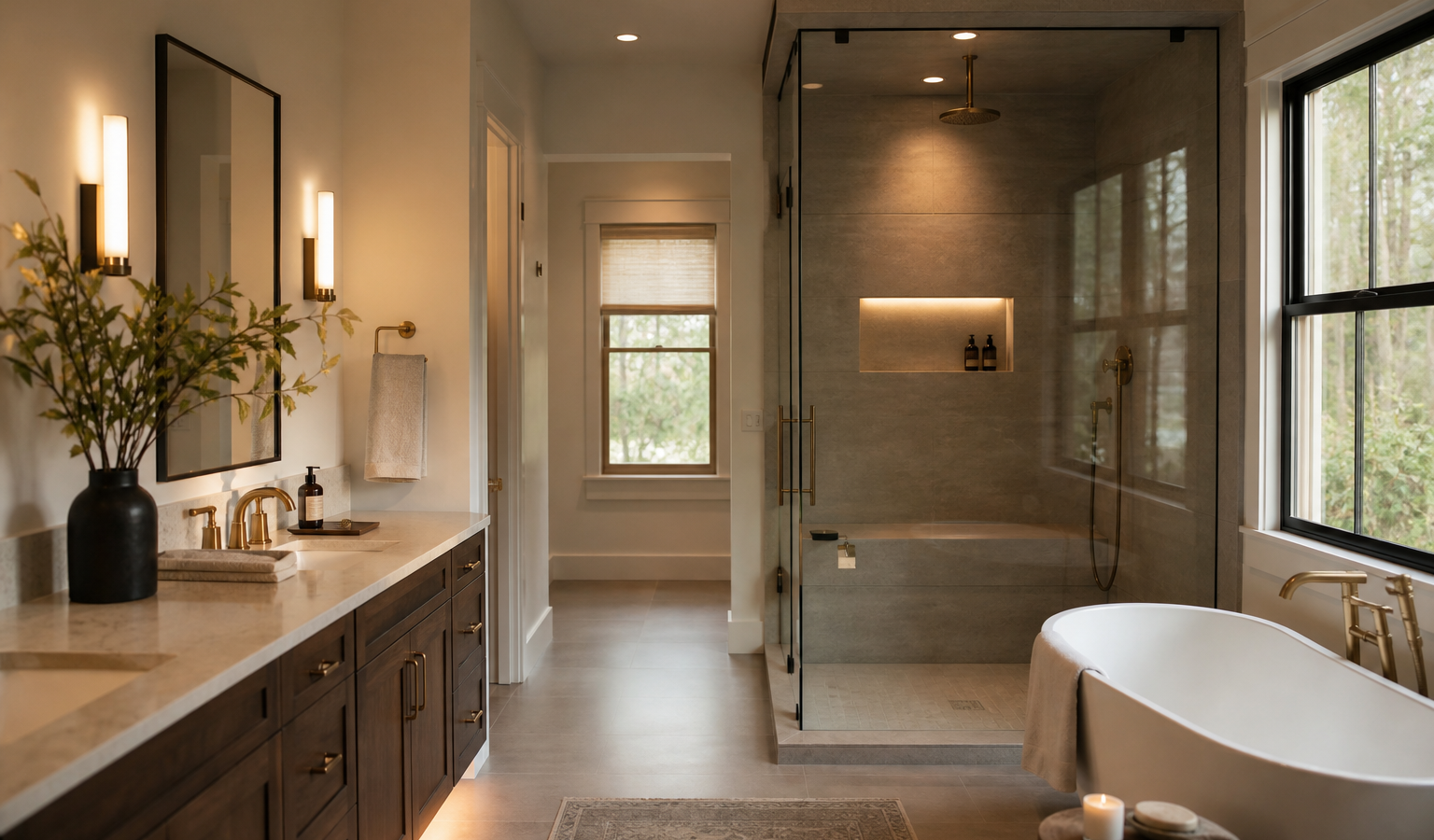
Great bathroom lighting ideas start with a plan, not a fixture. The best bathrooms in 2026 stack three or four layers of light so the room reads bright, flattering, and safe from the moment you flip the switch. This guide breaks down the layers, the real 2026 US costs, the fixtures worth buying, and the placement rules pros use so you never end up with harsh shadows or a dim, cave-like shower again.
Whether you are refreshing a powder room or wiring a full master bath, the same principles apply: light the face, not just the ceiling, choose the right color temperature, and match every fixture to its moisture zone. If you are budgeting a larger project, pair this with our bathroom remodel cost guide and bathroom remodel timeline so lighting lines up with the rest of the scope.
Key takeaways
- Layer four types of light: ambient, task, accent, and decorative, for a room that works day and night.
- Budget $300 to $2,000 for a lighting refresh, with a US average near $850 installed.
- Use 2700K to 3000K for warmth and a crisp 3000K to 4000K at the vanity, with a CRI of 90 or higher.
- Match fixtures to moisture zones: damp-rated on general ceilings, wet-rated inside showers and over tubs.
- Put every layer on its own dimmer so one room can shift from bright grooming to a calm soak.
What are the layers of bathroom lighting?
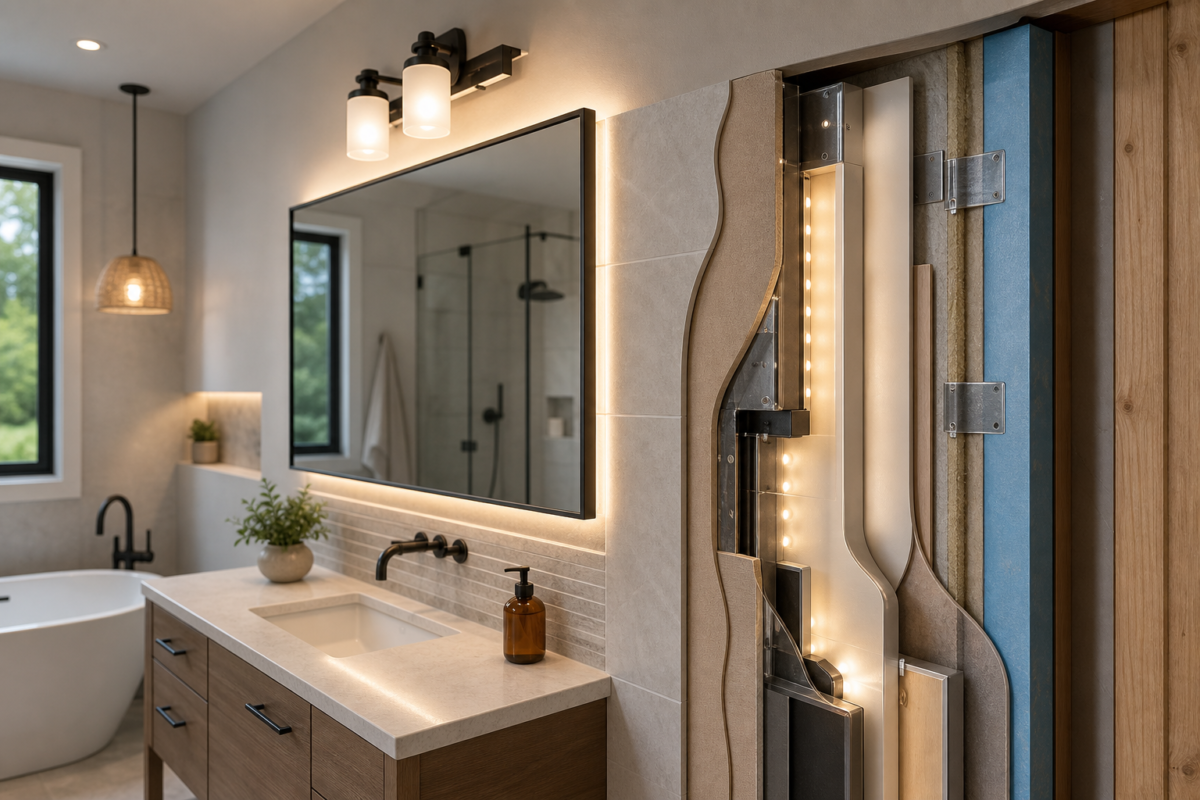
Bathroom lighting has four layers: ambient, task, accent, and decorative. Ambient fills the room, task lights the mirror and shower, accent highlights features, and decorative adds style. A well-lit bathroom uses at least three of the four, each on its own switch or dimmer so you control the mood without rewiring.
Ambient or general lighting
Ambient light is the base layer that lets you move safely and clean the room. In most bathrooms this comes from recessed downlights, a flush-mount ceiling fixture, or a central pendant. Aim for even coverage with no dark corners near the toilet or entry. For an 8-by-8 foot bath, three or four recessed cans on a dimmer usually deliver enough general light without glare.
Task lighting at the vanity and shower
Task light is the working layer at the mirror, the shower, and inside a water closet. Vanity task lighting matters most because it is where you shave, apply makeup, and check your reflection. The best approach is cross-illumination from both sides of the mirror, which erases the raccoon-eye shadows a single overhead fixture creates. Our full bathroom vanity lighting guide covers heights, sizing, and sconce spacing in detail.
Accent and decorative lighting
Accent light draws the eye to tile, niches, or artwork, while decorative fixtures such as a small chandelier or statement sconce add personality. LED strip lights tucked under a floating vanity or inside a shower niche create a soft glow and double as a nightlight. These layers are optional, but they separate a builder-grade bath from a designed one. A wet-rated recessed light aimed at a feature-tile bathroom tile wall is a low-cost way to add drama.
How much does bathroom lighting cost in 2026?
A typical bathroom lighting project runs $300 to $2,000, with a national average near $850 installed in 2026. Simple bulb-and-dimmer refreshes can land under $100, while a full layered plan with recessed cans, sconces, a lighted mirror, and smart switches can pass $2,500. Labor is the swing factor, especially when an electrician has to add a circuit or fish wire through finished walls.
| Item | Typical 2026 US price (installed) | Notes |
|---|---|---|
| Recessed downlight (per can) | $150 – $300 | Wet-rated trims cost more |
| Vanity light bar or sconce pair | $200 – $600 | Fixture plus wiring |
| Lighted or backlit LED mirror | $300 – $1,100 | Fixture $200-$800 plus install |
| Dimmer switch | $80 – $200 | Per switch, installed |
| Smart switch | $150 – $250 | Per switch, app or voice control |
| New dedicated circuit | $300 – $600 | Panel space and run length matter |
| Whole-room refresh | $300 – $2,000 | US average near $850 |
What drives bathroom lighting costs up
Three things push the number higher: adding circuits, cutting into finished drywall or tile, and premium fixtures. Moving or adding a switch leg on a tiled wall can cost more than the fixture itself because of patching. If you are already opening walls during a remodel, wiring extra lighting now is far cheaper than retrofitting later. Compare tradeoffs against the whole project in our bathroom remodel cost breakdown.
Best bathroom lighting ideas by fixture type
The best fixture depends on the layer it serves. Recessed cans handle ambient light, vanity bars and sconces handle task light, and pendants or mirrors add both function and style. Most designed bathrooms mix at least three fixture types so no single light has to do everything.
Recessed downlights
Recessed cans are the workhorse of ambient light. Use 4-inch or 6-inch LED wafer trims, space them roughly one-half of the ceiling height apart, so about 4 feet apart on a standard 8-foot ceiling, and keep them off the exact center so light falls where you stand. Choose airtight, insulation-contact rated housings to stop warm, moist air from leaking into the ceiling.
Vanity bars and mirror sconces
For the mirror, wall sconces mounted at eye level on both sides beat a single overhead bar because they light the face evenly. Where a pair of sconces will not fit, a horizontal vanity bar mounted above the mirror is the practical fallback. Size the bar to about three-quarters of the mirror width and never wider than the mirror itself.
Pendants and mini-chandeliers
A small pendant or chandelier over a freestanding tub or in the center of a larger bath adds a decorative anchor. Keep the bottom of any hanging fixture at least 7 feet above the floor, and a minimum of 8 feet above a tub deck unless the fixture is wet-rated and code allows otherwise. Take styling cues from our kitchen lighting layers guide, since the sizing math is the same.
Backlit and LED mirrors
Backlit LED mirrors and lighted medicine cabinets have become a 2026 default because they deliver even, shadow-free light and free up wall space in small rooms. Look for models with adjustable color temperature and a built-in defogger. They run $200 to $800 for the unit plus $100 to $300 to install on a switched, GFCI-protected circuit.
Bathroom lighting ideas for small bathrooms and powder rooms
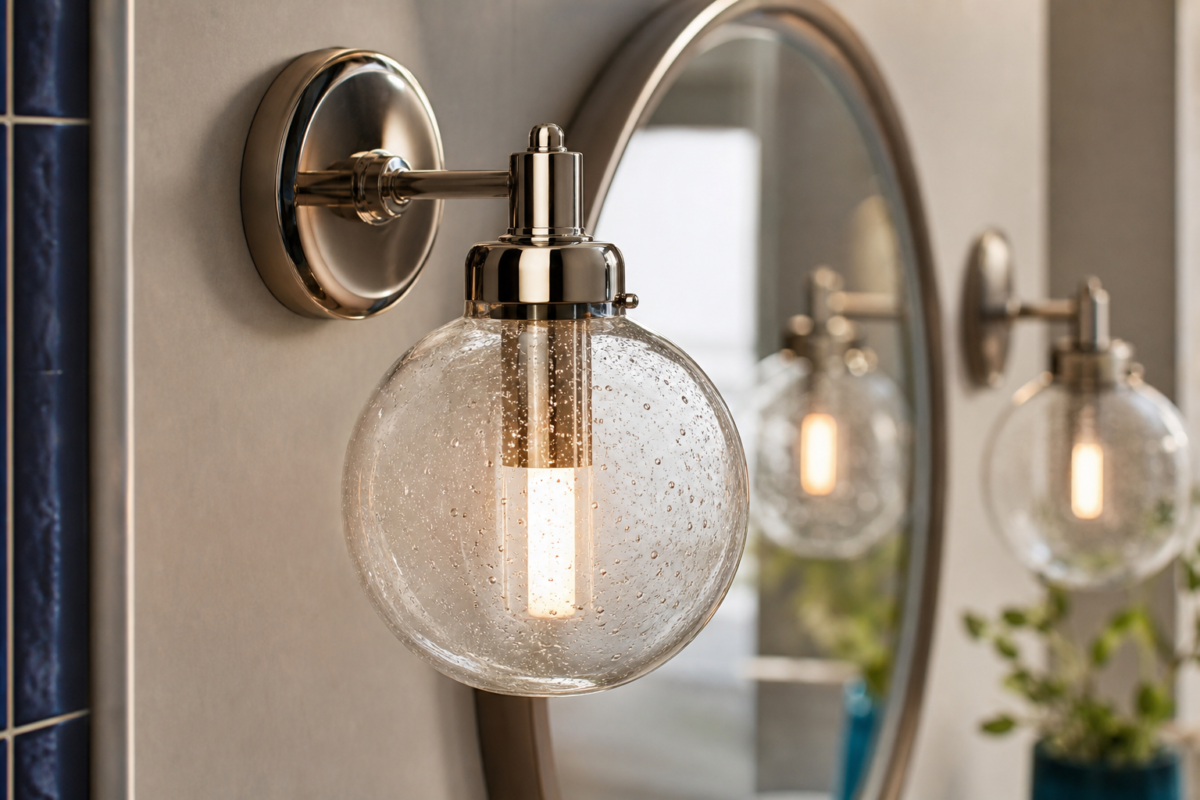
In a small bathroom, choose wall-mounted vanity light plus one ambient source rather than a single ceiling fixture, which throws shadows. A lighted mirror or a pair of slim sconces keeps sightlines clear, and a bright 3000K source makes a compact room feel larger. Reflective tile and a large mirror multiply whatever light you install.
Powder rooms can lean decorative because there is no shower or grooming task. A single statement sconce pair or a small pendant on a dimmer sets the mood, while still meeting the damp-location rules for the space. Coordinate finishes with your bathroom vanity so metals match across the room.
How do you light a shower and wet zones safely?
Inside a shower or directly over a tub you must use a wet-rated fixture; elsewhere on the ceiling a damp-rated fixture is acceptable. Wet-rated means the housing is sealed against direct water contact, while damp-rated only tolerates humidity and steam. All bathroom lighting circuits must also be GFCI protected under current code.
A single wet-rated recessed light in the shower on the same dimmer as the room keeps the enclosure from feeling like a dark box. If you have a steam shower, confirm the fixture is rated for steam, not just moisture. When in doubt, an electrician sizing the job against local code is money well spent, and the standards published by the National Kitchen and Bath Association are a useful sanity check for planning.
What color temperature and brightness should bathroom lighting be?
Use 2700K to 3000K for a warm, relaxing bathroom and step up to 3000K to 4000K at the vanity for crisp grooming light. Choose LED bulbs with a CRI of 90 or higher so skin tones and makeup read true. For brightness, plan for roughly 70 to 100 lumens per square foot of ambient light, then add dedicated task lumens at the mirror.
Kelvin, lumens, and CRI in plain terms
Kelvin is warmth: lower numbers look candle-warm, higher numbers look daylight-cool. Lumens are actual brightness, which matters more than watts on modern LEDs. CRI is color accuracy on a 100-point scale, and anything below 90 can make foundation and hair color look off. Tunable fixtures that shift from warm to cool let one bathroom serve a morning routine and an evening bath equally well.
Bathroom lighting layout and placement rules
The core placement rule is simple: put task light beside the mirror, ambient light overhead, and never rely on one fixture to do both. Sketch the room, mark where you stand, and place light so it falls on faces and work surfaces rather than the tops of heads. Then split the layers across separate switches.
- Flank the mirror with light at eye level, roughly 60 to 66 inches off the floor.
- Space recessed cans about half the ceiling height apart for even ambient fill.
- Keep hanging fixtures 7 feet above the floor and 8 feet above a tub.
- Put each layer, ambient, task, and accent, on its own dimmer or switch.
- Confirm every circuit is GFCI protected and every wet-zone fixture is wet-rated.
- Add a low-output LED strip or toe-kick light as a night path.
One overlooked idea is a dedicated night layer: a low-output LED strip along the toe kick or a single dim path light on a motion sensor. It lets anyone reach the toilet at 2 a.m. without triggering the harsh main lights and waking up fully. Set it to a warm 2200K to 2700K so it does not disrupt sleep, and it costs very little to add when a circuit is already in the wall.
Smart and energy-efficient bathroom lighting
Efficient bathroom lighting starts with LED sources and dimmers, then adds smart controls if you want scenes and scheduling. LEDs use a fraction of the energy of old incandescent bulbs and last far longer, which matters in a fixture you may run several hours a day. Look for products that carry the ENERGY STAR label for verified efficiency and lifespan.
Smart switches and tunable bulbs let you save a bright grooming scene and a dim late-night scene, and motion sensors are ideal for a shared or kids bathroom. Budget $150 to $250 per smart switch installed. Even without smart tech, a simple dimmer on every layer is the single highest-impact upgrade for both comfort and energy use.
Contractor’s take
The mistake I fix most often is one fixture over the mirror doing all the work. Add sconces or a lighted mirror for cross light, put everything on dimmers, and standardize on one color temperature across the room so it never looks patchy. If walls are already open, run an extra switch leg while it is cheap, you will want the flexibility later.
Your next move
You know the number. What are you deciding next?
Walk-in tub cost in 2026: $5,000 to $20,000 installed. Compare tub types, features, and the real Medicare coverage…
Continue →Bathroom remodel financing explained: compare home equity loans, HELOCs, cash-out refi, personal loans, and 0% cards with 2026…
Continue →Steam shower cost runs $3,000 to $10,000 installed in 2026. See prices by generator size, enclosure, and prefab…
Continue →Frequently asked
How many lights do I need in a bathroom?
Most full bathrooms need at least three: an ambient source such as recessed cans or a ceiling fixture, task light at the mirror, and a wet-rated light in the shower. Larger baths add accent or decorative layers. The goal is even coverage with no dark zones.
What is the best color temperature for a bathroom?
Use 2700K to 3000K for a warm, comfortable room and 3000K to 4000K at the vanity for crisp grooming light. Pair either with a CRI of 90 or higher so skin and makeup look accurate. Tunable fixtures let you have both.
Do bathroom lights need to be wet-rated?
Only fixtures inside the shower or directly over a tub must be wet-rated. General ceiling fixtures away from spray can be damp-rated. Every bathroom lighting circuit, regardless of fixture, must be GFCI protected under current code.
Can I install bathroom lighting myself?
Swapping a like-for-like fixture on an existing GFCI circuit is a common DIY job. Adding circuits, moving switches, or wiring in a tiled wall should go to a licensed electrician, both for safety and to keep the work code-compliant and inspection-ready.
How much does it cost to add recessed lighting to a bathroom?
Expect $150 to $300 per can installed in 2026, more for wet-rated shower trims or when wire must be fished through finished ceilings. A typical set of three to four cans lands between $500 and $1,200 depending on access and local labor rates.

Prices reflect 2026 US installed averages from remodeling and lighting cost data; heights and ratings follow common code and manufacturer guidance.