Bathroom Vanity Lighting: Height, Sizing, and Placement Guide
Sconces vs bars, how high to hang them, how to size them to your mirror, and what vanity lighting costs in 2026.

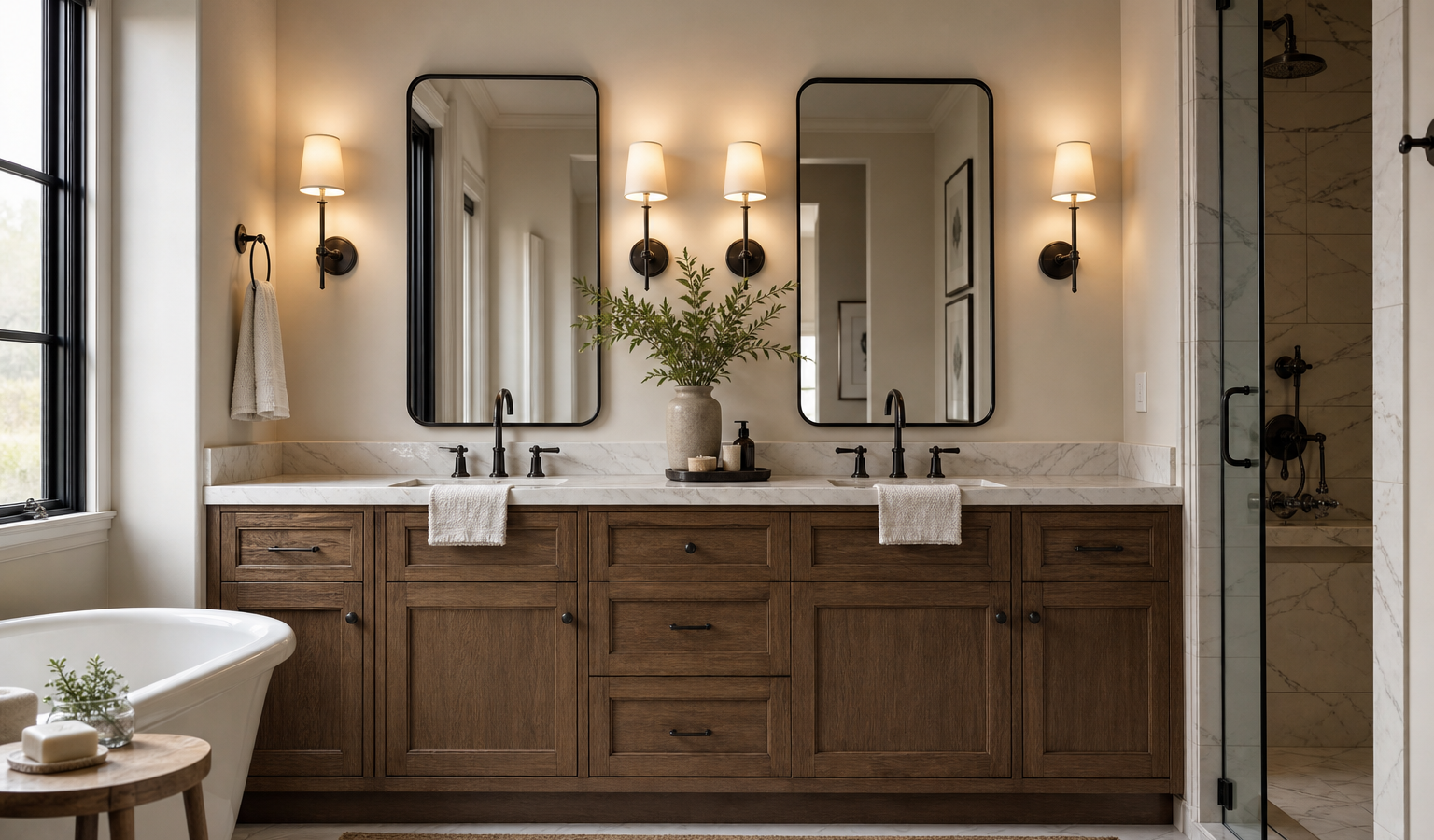
Getting bathroom vanity lighting right is the difference between a mirror that flatters and one that ages you ten years. The single biggest fix is lighting the face from both sides at eye level instead of blasting one fixture down from above. This guide covers exactly how high to hang fixtures, how to size them to your mirror, the color temperature and brightness that make grooming easy, and what it all costs in 2026.
The vanity is where you shave, apply makeup, and start your day, so it deserves the most deliberate lighting in the room. Below you will find the placement math pros use, plus how vanity light fits into the wider plan in our bathroom lighting ideas guide and bathroom remodel cost guide.
Key takeaways
- Light the face from both sides at eye level for shadow-free, flattering results.
- Hang an overhead vanity bar about 75 to 80 inches off the floor; set sconces near 60 to 66 inches.
- Size a vanity bar to roughly 75 percent of the mirror width and never wider than the mirror.
- Aim for 3000K to 4000K and a CRI of 90 or higher so makeup and skin tones read true.
- Budget $200 to $600 for a sconce pair installed and $300 to $1,100 for a lighted LED mirror.
What is the best lighting for a bathroom vanity?
The best bathroom vanity lighting comes from two sources flanking the mirror at eye level, which lights the face evenly and kills shadows. A single overhead bar is the common fallback when wall space is tight, and a backlit LED mirror is a strong modern option. Whatever the fixture, the goal is cross-illumination, light hitting your face from both sides rather than only from above.
Wall sconces flanking the mirror
Paired sconces are the gold standard. Mounted on each side of the mirror at eye level, they wrap light around the face and eliminate the under-eye and under-chin shadows that overhead-only setups create. Space them 28 to 40 inches apart depending on mirror width, and choose fixtures with a diffusing shade so the source is soft rather than glaring.
Overhead vanity light bars
A horizontal vanity bar above the mirror is the practical choice when sconces will not fit, such as over a wide mirror or in a rental-friendly swap. Bars with the bulbs facing down or diffused forward light the counter well; pick multi-bulb bars so light spreads rather than spotlighting. Pair a bar with recessed or ambient light so faces are not lit from a single high angle.
Backlit and lighted LED mirrors
Lighted mirrors have surged in 2026 because they deliver even, frontal light and save wall space, which is ideal in a small bath. Backlit models add a soft halo for ambiance, while front-lit or edge-lit models give stronger grooming light. Many now include tunable color temperature and an anti-fog pad. Coordinate the mirror with your bathroom vanity so proportions and finishes line up.
How high should you hang bathroom vanity lighting?
Hang an overhead vanity bar about 75 to 80 inches above the finished floor, and mount side sconces near 60 to 66 inches so the light source sits close to eye level. Always measure from the finished floor, not the countertop or mirror, so heights stay consistent even when counter heights differ. The table below sums up the working numbers.
| Fixture placement | Height above finished floor | Notes |
|---|---|---|
| Overhead vanity bar | 75 – 80 in | Above the mirror, standing user |
| Side sconces | 60 – 66 in | At or just above eye level |
| Sconce spacing (pair) | 28 – 40 in apart | Wider mirrors use the top of the range |
| Accessible or seated bar | 52 – 66 in | Lower for seated grooming |
| Above-mirror clearance | 6 in min to ceiling | Leave room above the fixture |
Overhead vanity bar height
For a standing user, center an overhead bar roughly 3 to 6 inches above the top of the mirror, which usually lands in the 75 to 80 inch range off the floor. Leave at least 6 inches of clearance to the ceiling. Too high and the light skims the top of the head; too low and it glares in the mirror.
Sconce height and spacing
Mount sconces so the center of the light sits near 60 to 66 inches off the floor, which puts the glow at eye level for most adults. Space a flanking pair 28 to 40 inches apart, using the wider end for large mirrors. When two people share a double vanity, treat each sink as its own zone with its own pair or bar.
Accessible and seated heights
For a seated makeup station or an accessible vanity, drop the overhead fixture to a 52 to 66 inch range so light reaches a seated face. Universal-design bathrooms benefit from tunable, dimmable fixtures that adapt to different users and tasks without rewiring.
How to size bathroom vanity lighting
Size an overhead vanity bar to about 75 percent of the mirror width, and never let it extend past the mirror edges. For a 42-inch mirror that means roughly a 31 to 32 inch fixture; for a 24-inch vanity, an 18-inch bar. Sconces are sized by height instead: about 12 inches tall for small baths, 18 inches for mid-size, and 19 inches or more for large rooms.
Single vanity sizing
With one mirror, apply the 75 percent rule to the mirror width and pick a bar that stays inside its edges. If you prefer sconces, one on each side is plenty for a standard 30 to 48 inch vanity. Match the fixture scale to the vanity so it neither overwhelms nor disappears against the wall and countertop.
Double vanity sizing
For a double vanity, light each sink separately rather than stretching one long bar across both. Use two bars, or three sconces spaced across the run so each person gets even light. If a single wide mirror spans both sinks, divide the width in half and size a fixture to 75 percent of each half.
What color temperature and CRI are best for a vanity?
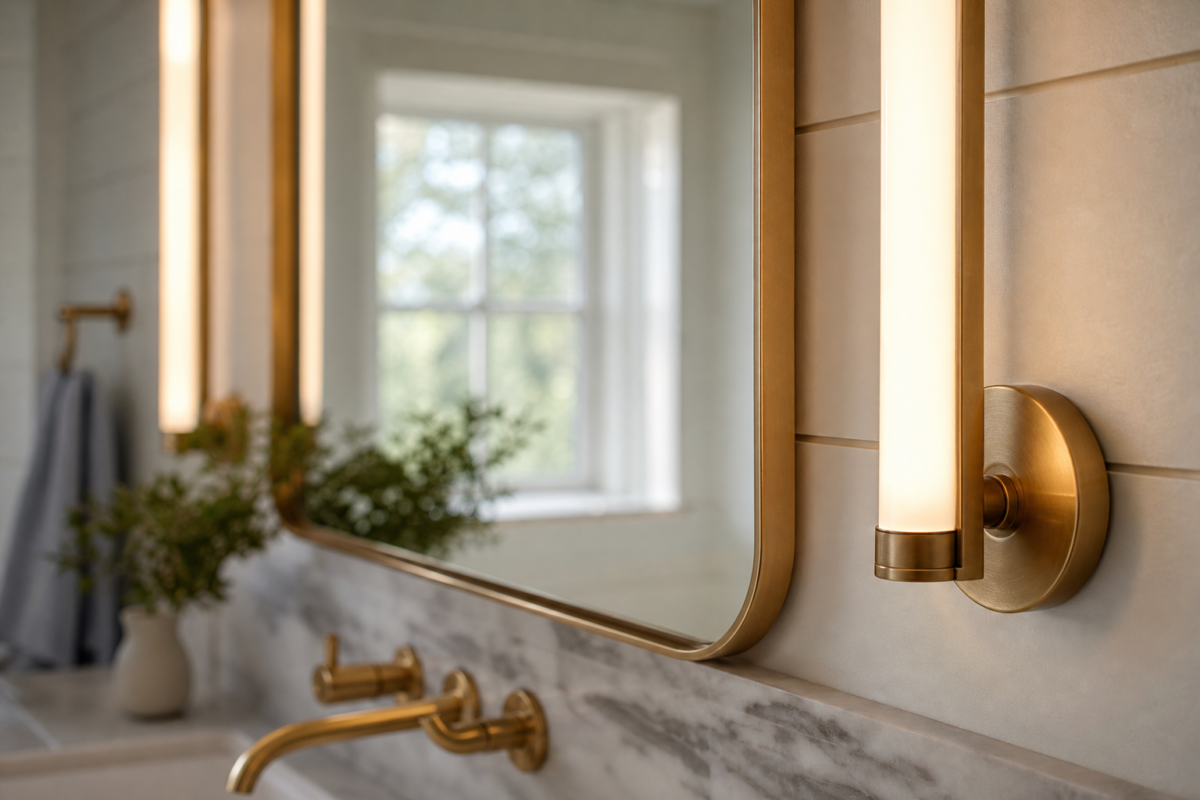
Use 3000K to 4000K at the vanity, warm enough to be comfortable but crisp enough for accurate grooming, and choose bulbs with a CRI of 90 or higher. Low-CRI light distorts skin tones and makeup, which is why a mirror that looks fine in the store can betray you at home. The factors below rank what matters most for vanity light quality.
Why CRI matters more than watts
CRI measures how faithfully a light renders color on a 100-point scale. At 90 or above, foundation, blush, and hair color look the way they will in daylight. Watts tell you energy use, not brightness or quality, so ignore them and read the lumens and CRI on the box. For efficient, high-quality LEDs, the ENERGY STAR label is a reliable shortcut.
How many lumens does a bathroom vanity need?
Plan for roughly 1,600 to 4,000 lumens at the vanity, scaling up with mirror width and room size. A good rule is about 70 to 100 lumens per square foot for the room, with the vanity as the brightest task zone. Two 800-lumen sconces or a multi-bulb bar totaling 2,000 to 2,500 lumens suits most single vanities.
Put the vanity on a dimmer so you can run it bright for grooming and low for a midnight trip. Dimming also extends bulb life and cuts energy use. If you are layering the whole room, see how task lumens interact with ambient light in our bathroom lighting ideas guide and the analogous task-lighting logic in our under-cabinet lighting guide.
If you are choosing between spending on the fixture or the bulbs, spend on the bulbs and the dimmer first. A modest sconce pair fitted with high-CRI, tunable LEDs on a quality dimmer will out-perform an expensive designer fixture running cheap, low-CRI bulbs. The light quality you see in the mirror comes from the source, not the shape of the housing around it.
What does bathroom vanity lighting cost in 2026?
A vanity lighting upgrade typically runs $200 to $1,100 installed in 2026, depending on fixture type. A sconce pair or vanity bar with wiring lands at $200 to $600, while a lighted LED mirror runs $300 to $1,100 including install. Adding a switch or dimmer adds $80 to $200, and a new circuit adds $300 to $600.
| Vanity lighting option | 2026 US installed price | Best for |
|---|---|---|
| Vanity bar (standard) | $120 – $450 | Wide mirrors, quick swaps |
| Sconce pair | $200 – $600 | Flattering, shadow-free light |
| Lighted LED mirror | $300 – $1,100 | Small baths, modern look |
| Dimmer switch | $80 – $200 | Every vanity should have one |
| New circuit or switch leg | $300 – $600 | Rewires and additions |
Fixture finish is where you can safely economize or splurge to taste. Matte black, brushed nickel, and warm brass all remain popular in 2026, and the choice is purely aesthetic as long as the fixture is rated for a bathroom. What is not optional is that the finish should match the other metals in the room, faucet, hardware, and mirror frame, so the vanity reads as one intentional composition rather than a collection of parts.
Common bathroom vanity lighting mistakes to avoid
The most common mistake is relying on a single overhead fixture, which casts shadows on the face. Others include buying a fixture wider than the mirror, ignoring CRI, skipping a dimmer, and mounting sconces too high. Run through this checklist before you buy.
- Do not light the face from above only; add side light for cross-illumination.
- Do not oversize the bar; keep it to about 75 percent of the mirror width.
- Do not ignore CRI; insist on 90 or higher for accurate grooming.
- Do not forget a dimmer on the vanity circuit.
- Do not mount sconces above eye level; keep centers near 60 to 66 inches.
- Do not mix color temperatures; standardize across the room.
Wiring, dimmers, and vanity light safety
Every bathroom vanity light must be on a GFCI-protected circuit, and any fixture near the shower zone should be damp- or wet-rated as the location requires. A dimmer is strongly recommended, and smart switches let you save grooming and night scenes. Like-for-like fixture swaps are DIY-friendly, but new circuits and tiled-wall wiring belong with a licensed electrician.
If you are coordinating tile and fixtures, plan switch and sconce locations before the bathroom tile goes up so boxes land where you want them. Following recognized planning standards, such as those published by the National Kitchen and Bath Association, keeps clearances and spacing sensible and inspection-ready.
Contractor’s take
If you do one thing, add light on both sides of the mirror at eye level and put it on a dimmer. I have swapped countless single overhead bars for a sconce pair or a lighted mirror, and clients always say the same thing: they finally look right in their own bathroom. Spend on CRI and dimming before you spend on a fancy finish.
Your next move
You know the number. What are you deciding next?
Walk-in tub cost in 2026: $5,000 to $20,000 installed. Compare tub types, features, and the real Medicare coverage…
Continue →Bathroom remodel financing explained: compare home equity loans, HELOCs, cash-out refi, personal loans, and 0% cards with 2026…
Continue →Steam shower cost runs $3,000 to $10,000 installed in 2026. See prices by generator size, enclosure, and prefab…
Continue →Frequently asked
Are sconces or a vanity bar better?
Sconces on both sides of the mirror are better because they light the face evenly and remove shadows. A vanity bar above the mirror is a fine fallback when wall space is tight, especially if you pair it with ambient light so the face is not lit from a single high angle.
How high should a vanity light be?
Mount an overhead vanity bar about 75 to 80 inches above the finished floor and set side sconces near 60 to 66 inches so the light sits at eye level. For seated or accessible vanities, drop the fixture into the 52 to 66 inch range.
What size vanity light do I need?
Size an overhead bar to roughly 75 percent of the mirror width and keep it inside the mirror edges. A 42-inch mirror pairs with a 31 to 32 inch fixture, while a 24-inch vanity suits an 18-inch bar. Size sconces by height instead, about 12 to 19 inches tall by room size.
What color temperature is best for a bathroom vanity?
Aim for 3000K to 4000K, warm enough to feel comfortable but crisp enough for accurate grooming, with a CRI of 90 or higher. Tunable fixtures let you shift warmer for evenings and cooler for detailed tasks like makeup.
How much does it cost to install a vanity light?
In 2026, a sconce pair or vanity bar runs $200 to $600 installed, and a lighted LED mirror runs $300 to $1,100. Adding a dimmer is $80 to $200, and a new circuit adds $300 to $600 depending on access and local labor rates.

Heights and sizing reflect common lighting-manufacturer and NKBA-style guidance; prices are 2026 US installed averages.