Bathroom Vanity Countertops: Materials, Costs, and How to Choose (2026)
Every vanity countertop material compared on real 2026 US prices, durability, and maintenance, so you can match the right surface to your bathroom and budget.

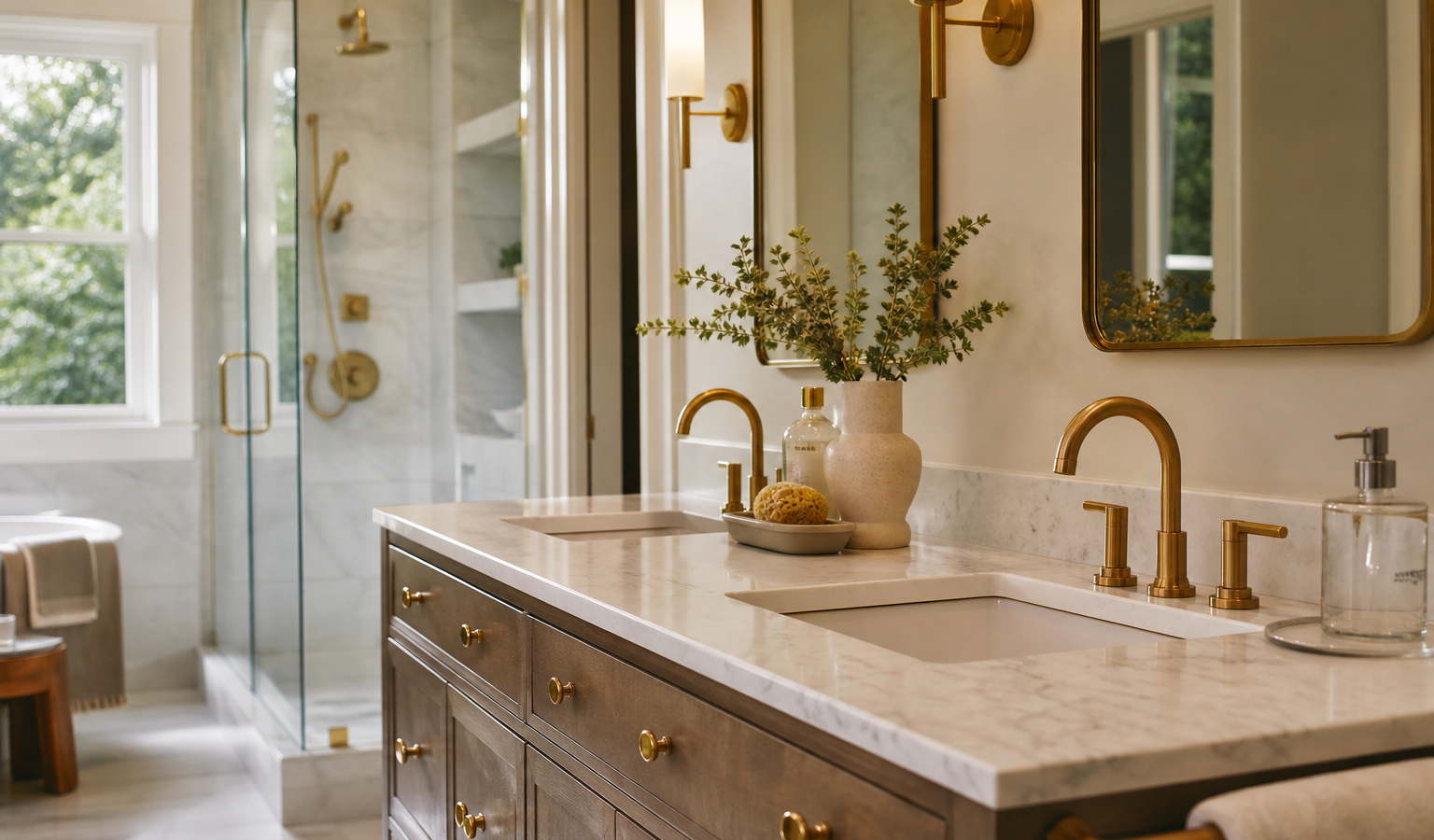
Choosing bathroom vanity countertops is one of the highest-impact decisions in any bathroom remodel: the surface sits at eye level, gets touched every single day, and takes a beating from water, toothpaste, makeup, hot styling tools, and harsh cleaners. Unlike a kitchen counter, a vanity top is small, which means premium materials that would blow a kitchen budget are often affordable here. In 2026, a single 30-inch vanity top runs anywhere from about $150 for a laminate slab to $850 or more for high-end quartz or natural stone, installed. This guide breaks down every material by real US price, durability, and best use so you can match the right surface to your budget, your bathroom, and how hard you plan to use it.
We will compare quartz, granite, quartzite, marble, cultured marble, solid surface, porcelain slab, concrete, wood, and laminate, then walk through edges, sink styles, backsplashes, and installation so nothing on your quote catches you off guard.
Key takeaways
- Small vanity tops let you afford premium stone: a full quartz or granite vanity top usually lands between $300 and $850 installed.
- Quartz is the low-maintenance default; cultured marble and solid surface win on price and seamless integrated sinks.
- Marble looks stunning but etches and stains without diligent sealing, making it a high-maintenance choice for busy bathrooms.
- Expect material to be 40 to 55 percent of the cost, fabrication 25 to 35 percent, and installation 15 to 25 percent.
- Edge profile, sink cutouts, and backsplashes can add $100 to $500 to a single-vanity project.
How much do bathroom vanity countertops cost in 2026?
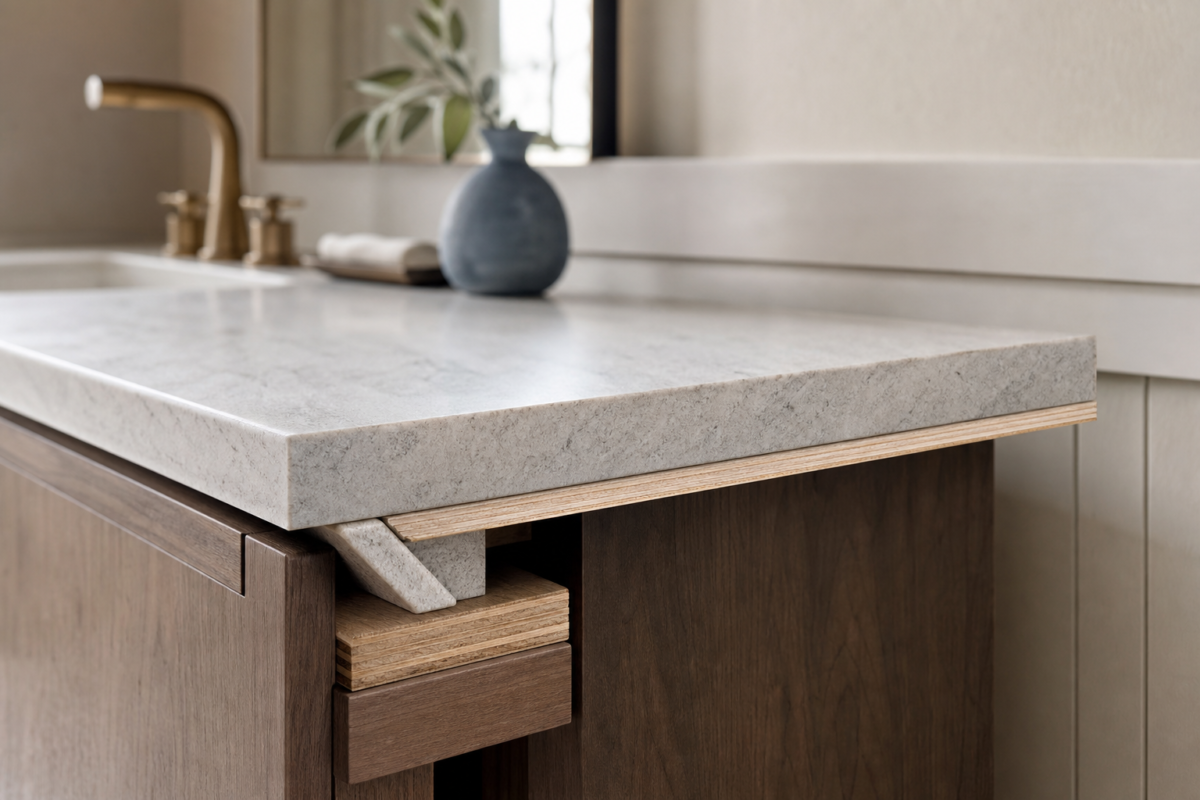
Bathroom vanity countertops cost roughly $10 to $200 per square foot installed in 2026, with most homeowners spending $300 to $850 on a standard single vanity and $700 to $1,700 on a double vanity. Because vanity tops are small (a 36-inch top is only about 5.5 square feet), the price gap between budget and premium materials is far narrower than in a kitchen, so upgrading to stone often adds only a few hundred dollars.
The table below shows installed price ranges by material. Actual quotes swing with slab quality, edge profile, sink cutouts, and your local labor market. For a full remodel budget picture, see our bathroom remodel cost guide, and if you are cross-shopping with your kitchen, the kitchen countertop cost breakdown uses the same fabrication math.
| Material | Installed cost per sq ft | Typical single 30 in top | Best for |
|---|---|---|---|
| Laminate | $10 – $30 | $150 – $350 | Tight budgets, rentals |
| Cultured marble | $30 – $100 | $250 – $600 | Integrated sinks, value |
| Butcher block / wood | $30 – $60 | $200 – $450 | Warm, powder rooms |
| Solid surface (Corian) | $40 – $80 | $300 – $650 | Seamless, kid baths |
| Porcelain slab | $50 – $100 | $350 – $750 | Thin, modern looks |
| Granite | $50 – $120 | $350 – $850 | Durability, resale |
| Quartz | $55 – $130 | $400 – $900 | Low maintenance |
| Concrete | $65 – $135 | $450 – $950 | Custom, industrial |
| Marble | $75 – $200 | $500 – $1,200 | Luxury, low-use baths |
| Quartzite | $80 – $200 | $550 – $1,200 | Natural look, hardness |
What drives the price up or down
Material is 40 to 55 percent of your total, but the rest hides in the details. Fabrication (25 to 35 percent) covers templating at $100 to $250, cutting and polishing at $150 to $400, sink cutouts at $100 to $300 each, and edge profiling at $5 to $30 per linear foot. Installation (15 to 25 percent) runs $150 to $500 and includes removing the old top. Exotic granite and rare marble can exceed $250 per square foot for the slab alone, while remnant pieces, which are ideal for small vanities, sell at 30 to 50 percent off standard pricing. If granite radon questions come up, the EPA radon resources put the negligible risk in context.
Prefab tops vs custom slabs
Prefabricated vanity tops come in standard sizes (24, 30, 36, 48, and 60 inches) with the sink hole and backsplash already formed, and they are available immediately or within three to five days. Custom slab fabrication lets you pick the exact stone, edge, and sink but takes five to fifteen business days and costs more. For a standard-size vanity, a prefab quartz or cultured marble top is usually the smart-money move; save custom fabrication for oversized or furniture-style vanities.
Quartz vanity tops: the low-maintenance default
Quartz is the best all-around bathroom vanity countertop for most homeowners because it is non-porous, never needs sealing, and shrugs off water, makeup, and mild cleaners. Engineered from roughly 90 percent ground natural quartz bound with resin, it delivers consistent color and pattern, including convincing marble look-alikes, without the maintenance of real stone. Expect $55 to $130 per square foot installed.
The trade-offs are modest. Quartz can scorch under a flat iron or curling wand left directly on the surface, so use a heat pad. Direct, prolonged sunlight can fade some resins over years, which rarely matters in an interior bath. For a family bathroom that sees heavy daily use, quartz is hard to beat. If you are weighing engineered stone against natural granite, our quartz vs granite comparison covers the durability and appearance differences in depth.
Granite and quartzite: natural stone that lasts
Granite and quartzite are the most durable natural stones for a vanity, resisting scratches and heat better than marble while offering one-of-a-kind veining. Granite runs $50 to $120 per square foot installed; quartzite, which is harder and increasingly fashionable, runs $80 to $200. Both are porous and need sealing once or twice a year to prevent staining from oils, dyes, and standing water.
Granite vs quartzite for bathrooms
Granite offers the widest color range and the best value in natural stone, making it a resale-friendly pick. Quartzite (a metamorphic sandstone, not to be confused with engineered quartz) is harder than granite and often mimics marble, so it is popular for homeowners who want the marble aesthetic without the etching risk. Quartzite still etches slightly from acids and needs sealing, so it lands between marble and quartz on the maintenance scale.
Marble vanity tops: beauty with a maintenance tax
Marble delivers unmatched luxury and timeless veining, but it is the highest-maintenance vanity surface you can buy, so reserve it for low-traffic or powder-room use. Carrara and other marbles run $75 to $200 per square foot installed. Because a vanity is small, a marble top can be surprisingly attainable, but the daily reality is what stops most families.
Sealing and etching realities
Marble is calcium carbonate, so any acid, including toothpaste, lemon, wine, or many cleaners, chemically etches the surface into a dull spot that sealing cannot prevent. Sealer slows staining, not etching (the Natural Stone Institute publishes care guidelines worth reading before you buy). In a guest bath used a few times a week, marble ages gracefully; in a shared family bath with kids and hair products, it will show wear within months. Choose a honed (matte) finish over polished to disguise etching, and keep a stone-safe cleaner on hand.
Cultured marble and solid surface: the budget-friendly integrated option
Cultured marble and solid surface are the value champions of bathroom vanity countertops because they can be molded with the sink and backsplash as one seamless, non-porous piece that never needs sealing. Cultured marble runs $30 to $100 per square foot installed; solid surface such as Corian runs $40 to $80. Both wipe clean easily and resist stains, which is why builders and parents love them.
Integrated sinks and seamless backsplashes
The integrated sink is the killer feature: with no rim or caulk line where the bowl meets the counter, there is nowhere for grime and mildew to collect, and cleaning is a single wipe. Solid surface has an edge on repairability, since scratches and minor burns can be sanded out, and it feels warmer and more matte than glossy cultured marble. The knock on cultured marble is aesthetic: lower-grade versions can look plasticky and can dull or yellow over many years, and both materials can scorch under hot styling tools.
Porcelain slab, concrete, wood, and laminate: the alternatives
Beyond the mainstream, four materials fill specific niches. Porcelain slab ($50 to $100 installed) is ultra-thin, heat-proof, UV-stable, and comes in large-format stone looks, making it a favorite for modern, minimalist vanities. Concrete ($65 to $135) is fully custom in shape and color with an industrial vibe, but it is porous and can hairline-crack. Wood or butcher block ($30 to $60) brings warmth to a powder room but must be sealed obsessively against water. Laminate ($10 to $30) is the rental and flip favorite, now available in surprisingly convincing stone prints, though seams and edges remain its weak points.
How to choose the right bathroom vanity countertop
Choose your vanity countertop by weighing four factors in order: how much daily abuse the bathroom takes, your total budget, the maintenance you will realistically do, and the look you want. The chart below shows how the leading materials stack up on the factors that matter most for a bathroom.
Match the material to your bathroom type
For a primary or family bath, prioritize quartz, granite, or solid surface. For a rarely used powder room, marble or wood can shine because abuse is minimal. For a kids bath, an integrated solid-surface or cultured-marble top removes the grimy caulk line and survives splashes. Use this quick checklist before you commit.
- Confirm the material is rated for wet, everyday use and easy to clean.
- Match maintenance to reality: skip anything that needs sealing if you will not do it.
- Order a physical sample and view it under your bathroom lighting, not showroom light.
- Ask whether an integrated sink or undermount fits your chosen material.
- Get the fabrication timeline in writing so it aligns with your remodel schedule.
Edges, sinks, and backsplashes that change the price
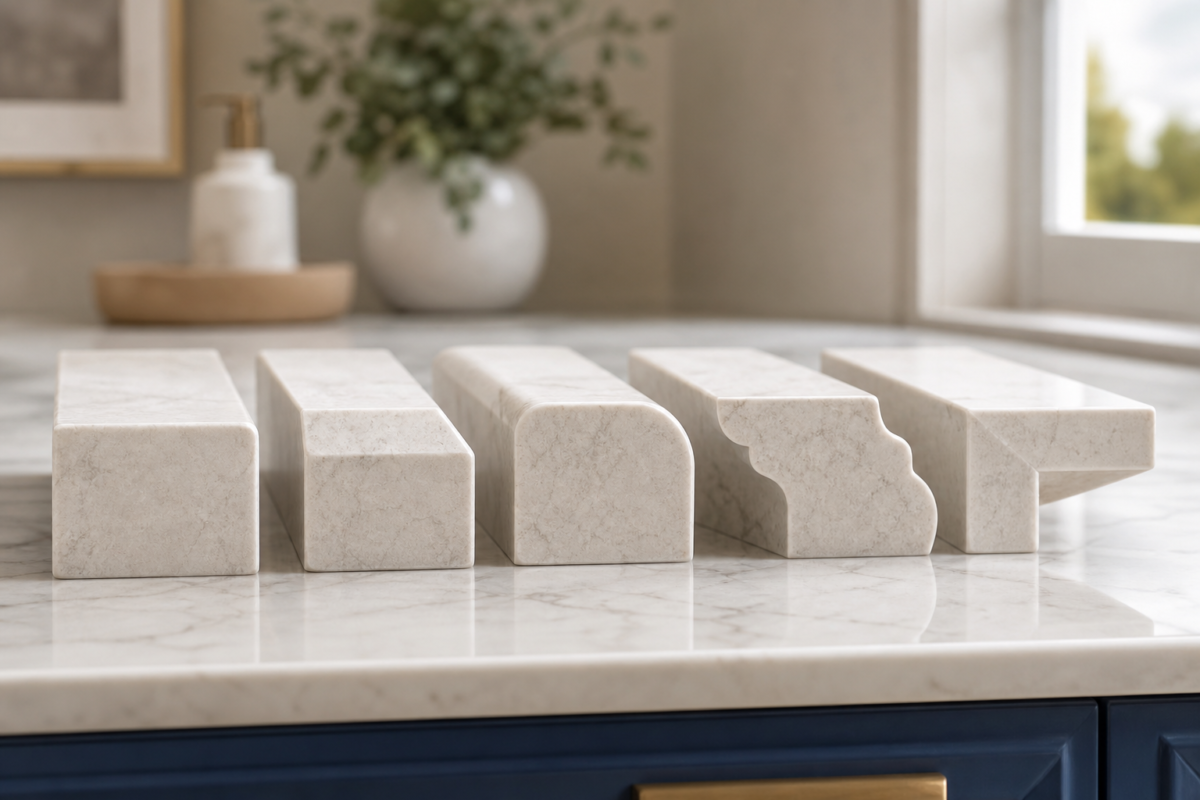
The extras on your quote (edge profile, sink style, and backsplash) can add $100 to $500 to a single vanity, so decide them early. A simple eased edge costs $5 to $8 per linear foot, while an ogee or mitered waterfall edge runs $15 to $30. An integrated backsplash adds a 15 to 25 percent markup over a plain top.
Undermount vs vessel vs integrated sinks
An undermount sink mounts below the counter for a clean, wipe-friendly line and pairs with quartz, granite, and solid surface; the cutout adds $100 to $300. A vessel sink sits on top like a bowl for a spa look but needs a taller faucet and collects water at the base. An integrated sink, molded into cultured marble or solid surface, is the easiest to clean and the most seamless. Coordinate your sink and faucet together; our team walks through pairings in the complete bathroom vanity guide.
Installation, fabrication, and timeline
Plan on five to fifteen business days for custom slab fabrication and a half-day for installation, or near-immediate availability for prefab tops. Professional installation is strongly recommended for stone: slabs are heavy, cutouts are unforgiving, and a cracked corner means starting over. Installers template your vanity, fabricate off-site, then set, level, and seal the top and caulk the joints. Coordinate countertop install after the vanity cabinet is set but before the mirror and vanity lighting go in, and confirm your backsplash tile plan so heights line up.
Contractor’s take
On a small vanity, buy a remnant. Fabricators keep offcuts from big kitchen jobs, and a 5-square-foot vanity top often fits a piece they will sell at 30 to 50 percent off premium stone. I have put $150-per-square-foot quartzite on a client vanity for the price of mid-grade granite just by asking to see the remnant rack. And always spec a honed finish on marble; polished shows every etch, honed hides them, and both feel equally luxurious.
Bathroom vanity countertop FAQ
Bathroom vanity countertops reward a little strategy: because the surface is small, spending a bit more on quartz, quartzite, or a stone remnant costs far less than it would in a kitchen while dramatically upgrading the room. Match the material to how hard the bathroom is used, be honest about the maintenance you will do, and coordinate the sink, edge, and backsplash before you sign the quote.
Your next move
You know the number. What are you deciding next?
Compare bathroom vanity countertop materials, real 2026 US costs, and how to choose the right surface for your…
Continue →Compare bathroom sink types, vessel, undermount, pedestal, and wall-hung, with pros, cons, materials, and 2026 installed costs.
Continue →Freestanding tub cost runs $1,300 to $8,000 installed in 2026. See prices by material, full installation breakdown, and…
Continue →Frequently asked
What is the most low-maintenance bathroom vanity countertop?
Quartz and solid surface are the lowest maintenance because both are non-porous and never need sealing. Solid surface adds the bonus of repairable scratches, while quartz offers the widest range of stone looks. Either will handle daily bathroom use with only routine wiping.
Is marble a bad idea for a bathroom vanity?
Marble is not bad, but it is high maintenance. It etches from acids like toothpaste and stains without regular sealing. It works beautifully in a low-use powder room or guest bath, but a busy family bathroom will wear it quickly. Choose a honed finish to hide etching.
How much does a standard vanity top cost installed in 2026?
A standard single 30-inch vanity top runs about $300 to $850 installed for quartz or granite, $250 to $600 for cultured marble, and $150 to $350 for laminate. Double vanities of 60 to 72 inches run roughly $700 to $1,700 in stone.
Should I choose an undermount or integrated sink?
Choose an undermount for stone tops and a cleaner look, budgeting $100 to $300 for the cutout. Choose an integrated sink with cultured marble or solid surface if you want the easiest possible cleaning, since there is no seam or caulk line where grime collects.
Can I put a kitchen-grade countertop in my bathroom?
Yes. Any kitchen countertop material works in a bathroom, and because vanity tops are small you can often afford a premium slab for a few hundred dollars. Buying a kitchen-job remnant is one of the cheapest ways to get high-end stone on a vanity.

Installed 2026 US price ranges compiled from national fabricator and remodeling cost data; verify with local quotes.