Freestanding Tub Cost in 2026: Price and Installation Guide
What a freestanding tub really costs once plumbing, filler, and floor work are included, with a full installed-price breakdown for 2026.

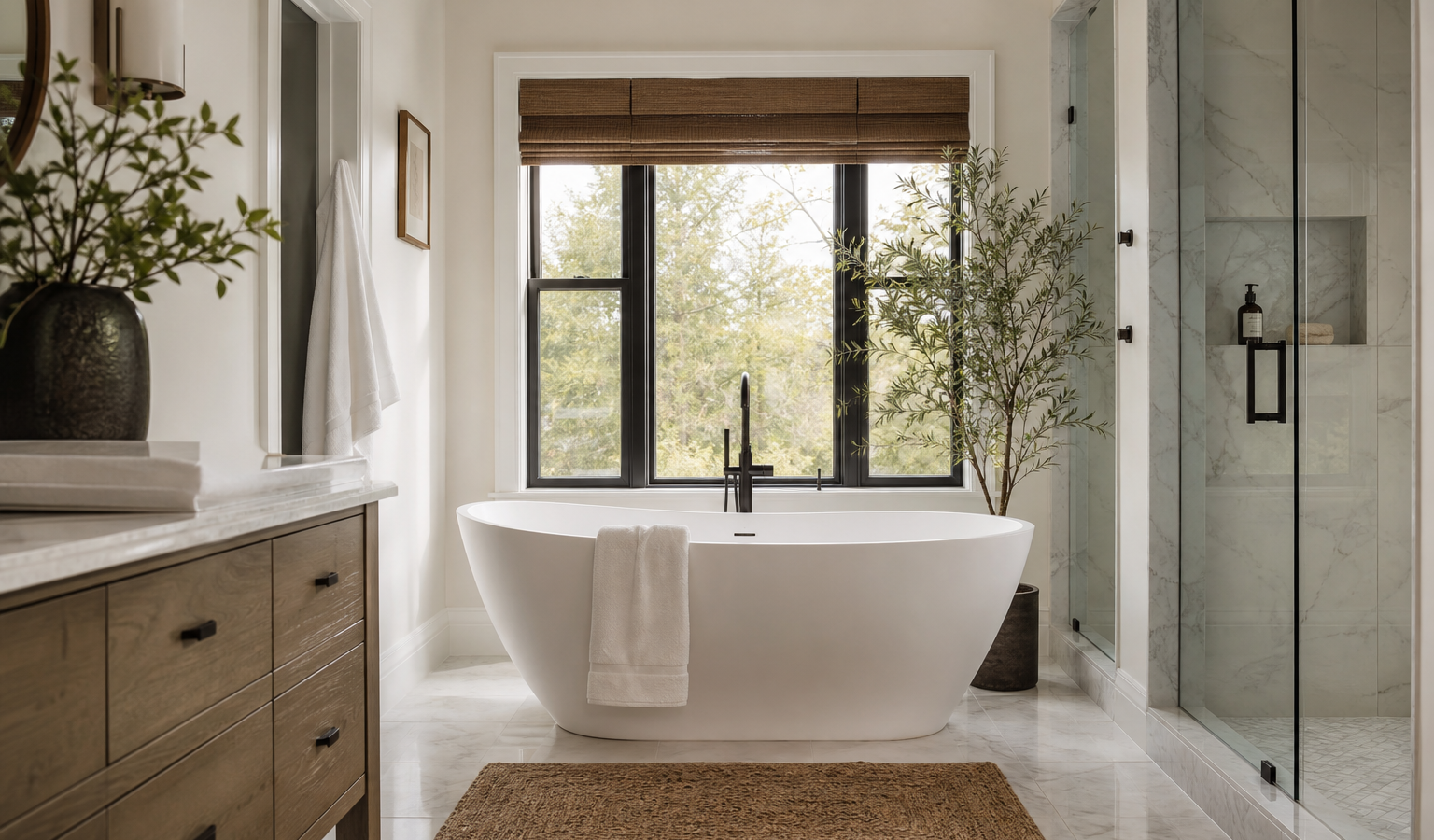
The freestanding tub cost in 2026 runs $1,300 to $8,000 installed, with most homeowners spending around $3,500. The tub itself is $500 to $10,000+ depending on material, and installation adds $800 to $3,000 once you account for plumbing, the floor-mounted filler, and any floor work. What surprises most people is that the tub is often the cheaper half of the project; the plumbing, filler, and structural prep behind it drive the real number.
This guide breaks down the full installed freestanding tub cost, material by material and line by line, including the hidden costs most quotes leave out, so you can budget for the whole job rather than just the showroom price tag.
Key takeaways
- Expect $1,300 to $8,000 installed, averaging about $3,500 for a freestanding tub in 2026.
- The tub alone runs $500 (acrylic) to $10,000+ (copper); material is the biggest price driver.
- Installation adds $800 to $3,000, plus plumbing, filler, and any floor reinforcement.
- A floor-mounted filler adds $300 to $2,000+ and its own rough-in labor.
- Heavy cast iron or stone tubs on upper floors may need $300 to $1,200 in joist reinforcement.
How much does a freestanding tub cost?
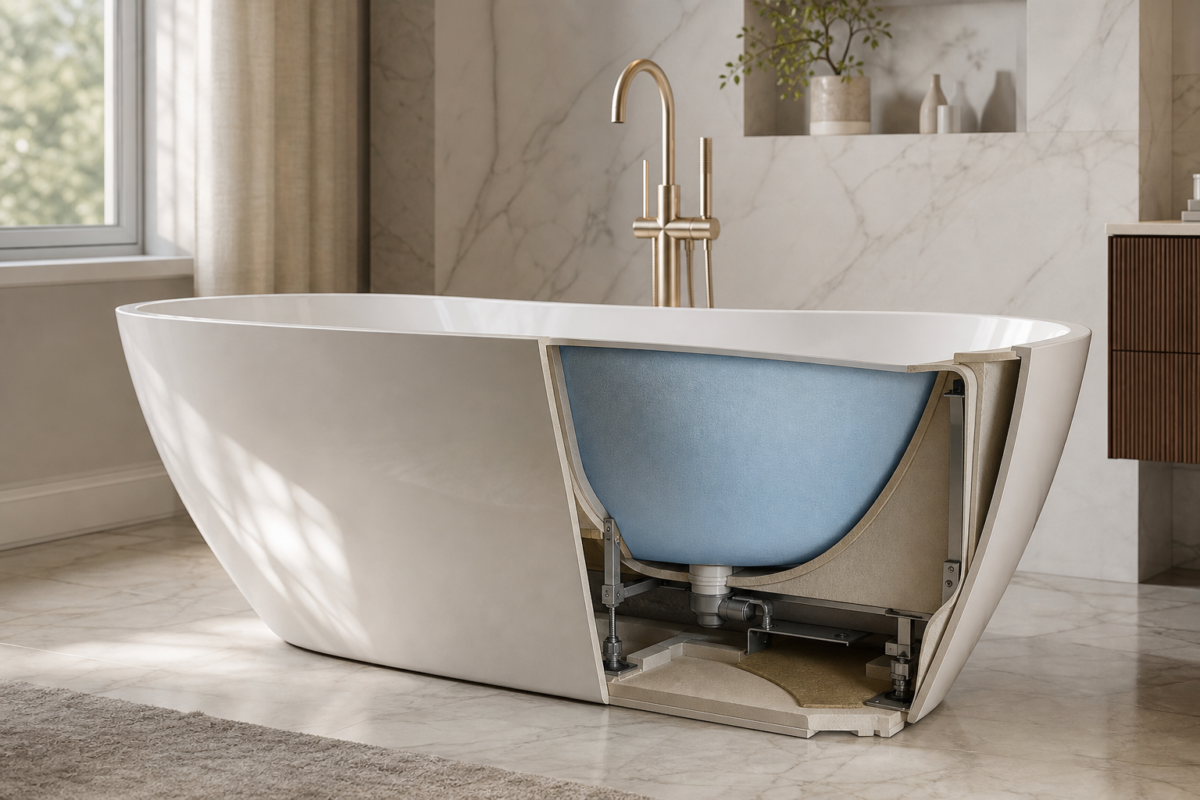
A freestanding tub cost averages $3,500 installed in 2026, with a typical range of $1,300 to $8,000. A budget acrylic tub with a simple drain swap can land near $1,300; a mid-range acrylic or solid-surface tub with a floor-mounted filler runs $3,000 to $5,000; a premium cast iron, stone resin, or copper tub with new plumbing and floor work can exceed $8,000.
The spread is wide because three separate budgets stack up: the tub, the filler and plumbing, and the construction prep. A freestanding tub is usually the centerpiece of a larger project, so it helps to see it in context of our primary bathroom remodel cost guide, where the tub is one line among many.
Freestanding tub cost by material
Material is the single biggest driver of freestanding tub cost, ranging from $400 for fiberglass to $10,000+ for copper. Acrylic is the value leader and the most common choice; cast iron and stone resin cost more but hold heat far longer for deep soaks.
| Material | Tub price | Heat retention | Weight |
|---|---|---|---|
| Fiberglass | $400 – $1,500 | Fair | Lightest |
| Acrylic | $500 – $2,500 | Good | Light |
| Cast iron | $1,500 – $5,000 | Excellent | Very heavy |
| Stone resin | $2,000 – $8,000 | Excellent | Heavy |
| Solid surface | $2,500 – $7,000 | Very good | Heavy |
| Copper | $3,000 – $10,000+ | Excellent | Moderate |
For a fuller comparison of how these materials behave in daily use, and how freestanding stacks up against alcove and drop-in styles, see our bathtub types guide.
Freestanding tub installation cost breakdown
Installation runs $800 to $3,000 for a straightforward job, but the true figure depends on plumbing, the filler type, and your floor. The table below shows typical 2026 line items so you can see where the installed cost actually goes.
| Line item | Typical cost |
|---|---|
| Old tub removal and disposal | $100 – $500 |
| Basic installation labor | $200 – $1,000 |
| Full installation (typical) | $800 – $3,000 |
| Floor supply line rough-in | $400 – $900 |
| Floor-mounted filler fixture | $300 – $2,000+ |
| Drain relocation (wood floor) | $500 – $1,500 |
| Drain relocation (concrete slab) | $1,000 – $3,000+ |
| Subfloor or joist reinforcement | $300 – $1,200 |
| Tile patching around base | $200 – $600 |
Why installation can cost more than the tub
Unlike an alcove tub that hides its plumbing in a wall, a freestanding tub exposes the drain and supply lines, so they must be routed precisely through the floor and finished cleanly. That demands more plumbing labor, a dedicated filler, and often floor repair where the old tub sat. On a slab foundation, relocating the drain means cutting and patching concrete, which alone can run $1,000 to $3,000.
Faucet and filler options for a freestanding tub
Freestanding tubs use one of three filler styles, and the choice affects both cost and rough-in. A floor-mounted filler is the most popular and most expensive, a wall-mounted spout is the cheapest when a wall is close, and a deck-mounted filler works only on tubs with a rim wide enough to hold it.
Floor-mounted vs wall-mounted fillers
A floor-mounted filler stands beside the tub and costs $300 to $2,000+ for the fixture plus $400 to $900 in supply rough-in, since the plumbing must come up through the floor exactly where the filler lands. A wall-mounted filler is far cheaper to rough in when the tub sits near a wall, but it limits placement. Decide on the filler before plumbing rough-in, because changing your mind afterward means reopening the floor. Our bathroom faucets guide covers finishes and valve quality worth prioritizing.
Hidden costs of installing a freestanding tub
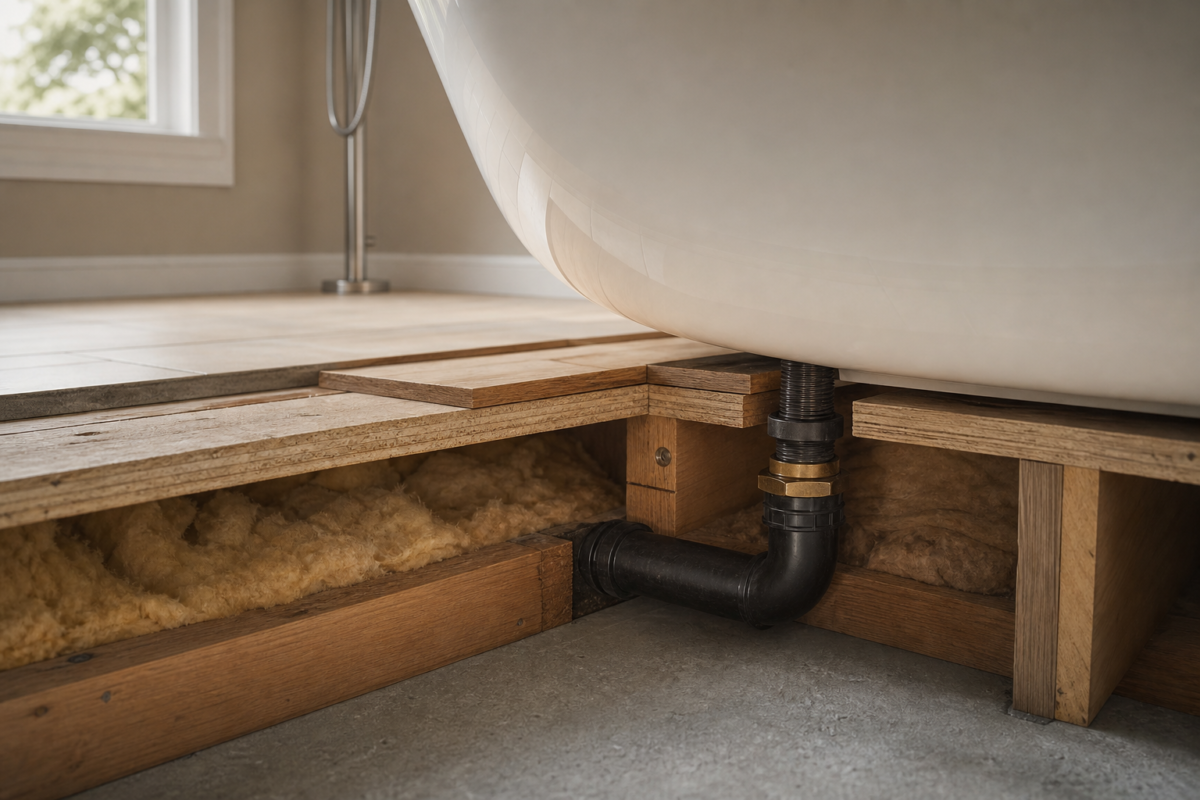
The costs most quotes omit are floor reinforcement, water-heater capacity, and flooring repair. Together these can add $1,000 to $4,000, so build them into your budget before you commit to a heavy or deep tub.
- Floor reinforcement: $300 to $1,200 for heavy cast iron or stone tubs, especially on upper floors.
- Water heater upgrade: $800 to $2,500 if a deep soaker outstrips your current tank.
- Flooring repair: $200 to $600 to patch, or $800 to $3,500+ to replace the floor around the old tub footprint.
- Drain relocation: $500 to $3,000 depending on wood versus concrete.
- Delivery and maneuvering: extra labor for oversized or very heavy tubs through tight spaces.
A deep soaker is only relaxing if you can fill it with hot water. A standard 40-gallon tank often cannot fill a 60-to-80-gallon tub to the shoulders at temperature, which is why a tankless or larger tank upgrade frequently rides along with a freestanding tub. Pairing a water-efficient filler helps; look for EPA WaterSense labeled fittings to balance flow and performance.
Freestanding tub cost vs a built-in tub
A freestanding tub typically costs $1,000 to $3,000 more installed than a comparable alcove or drop-in tub, mostly because of exposed plumbing and the floor-mounted filler. A basic alcove tub-and-surround can be installed for $800 to $2,500 total, while an equivalent-quality freestanding setup with a floor filler usually starts around $3,000 once plumbing is finished.
The premium buys looks and flexibility, not better bathing. If your goal is a nightly soak on a tight budget, a deep alcove tub delivers the same hot water for less. If you want the sculptural centerpiece that reads as a spa and photographs well for resale, the freestanding premium is usually worth it, provided the room is large enough to give the tub the clearance it needs. The National Kitchen and Bath Association recommends clear space around a freestanding tub for comfortable access and cleaning, which is a real constraint in medium-size bathrooms.
When a freestanding tub is the wrong call
Skip the freestanding tub if your bathroom is under about 80 square feet, if you need the tub to double as a shower, or if moving plumbing across a slab is the only way to make it fit. In those cases the cost climbs while daily usefulness drops. A well-chosen alcove or drop-in tub, or a larger walk-in shower, will serve the space better and leave thousands in the budget for finishes that get used every day.
What drives freestanding tub cost up or down
Material, filler type, and floor conditions move the budget more than anything else. The bars below rank the factors that most often change the installed total.
Where to save on a freestanding tub
Save by choosing acrylic, keeping the drain where it is, and placing the tub near existing plumbing. Splurge only on the filler valve and, if you soak often, a tub material that holds heat. These choices can cut $2,000 or more off a typical installed cost without hurting the result.
Acrylic delivers 90 percent of the freestanding look at a fraction of cast iron or stone pricing, and it is light enough to avoid floor reinforcement. If you can position the new tub over or near the old drain, you skip the single most expensive hidden line item. For broader savings strategies across the whole room, see our bathroom remodel cost guide and small bathroom remodel cost guide if space is tight.
Contractor’s take
The number one way homeowners blow the budget on a freestanding tub is moving the drain. If you place the tub so the drain lines up with the existing rough-in, a straightforward install can stay near $2,000 all in. Shift it four feet across a concrete slab for aesthetics, and you have just added $2,000 to $3,000 in concrete cutting and patching. Design the layout around the plumbing, not the other way around.
DIY versus professional installation
A freestanding tub install is not a typical DIY job because it combines plumbing, floor penetrations, and heavy, fragile fixtures. A skilled DIYer can save $200 to $600 on the old-tub removal and some prep, but the drain, supply rough-in, and filler connection should go to a licensed plumber to avoid leaks under a finished floor.
The riskiest part is the hidden connection: a drain or supply leak beneath a freestanding tub can soak subfloor and ceiling before you notice it. Many homeowners handle demo, painting, and sourcing the tub themselves, then hire out the plumbing and final set. Always confirm permits are pulled; unpermitted plumbing can complicate a future sale and void coverage after a water loss.
Is a freestanding tub worth the cost?
Yes, in the right bathroom. A freestanding tub is a strong resale and lifestyle feature in a primary suite with space for it, often cited by buyers as a spa-like draw. In a small or tub-only bathroom, however, a freestanding tub can cost more and function worse than an alcove tub or a large shower.
Before committing, weigh how often you actually take baths. If the answer is rarely, the money may deliver more joy in a premium walk-in shower, compared in our shower vs bathtub guide. If you love a long soak and have the room, a freestanding tub is one of the highest-impact features you can add.
For resale, appraisers and buyers respond to a freestanding tub as a signal of a thoughtfully updated primary bath, but the return is tied to the rest of the room. A striking tub beside a dated vanity and worn tile looks out of place and recovers little. The tub pays off best as part of a cohesive update where lighting, tile, and vanity all read at the same level, so budget it as one element of a complete suite rather than a standalone splurge. Spend to the standard of your neighborhood, not above it, and the tub becomes an asset at sale rather than an over-improvement.
Your next move
You know the number. What are you deciding next?
Walk-in tub cost in 2026: $5,000 to $20,000 installed. Compare tub types, features, and the real Medicare coverage…
Continue →Compare bathroom vanity countertop materials, real 2026 US costs, and how to choose the right surface for your…
Continue →Compare bathtub types, alcove, drop-in, freestanding, corner, and undermount, with sizes, materials, and 2026 costs to pick the…
Continue →Frequently asked
How much does it cost to install a freestanding tub?
Installation alone runs $800 to $3,000 for a typical job, on top of the $500 to $10,000+ tub. Adding plumbing, a floor-mounted filler, and any floor work brings most projects to $1,300 to $8,000 installed.
Why are freestanding tubs so expensive to install?
Their drain and supply lines run through the floor and must be finished cleanly, which takes more plumbing labor than a wall-hidden alcove tub. Floor-mounted fillers, drain relocation, and floor reinforcement add further cost.
Do I need to reinforce my floor for a freestanding tub?
Often yes for heavy cast iron or stone tubs, especially on upper floors, at a cost of $300 to $1,200. Lightweight acrylic tubs usually need no reinforcement. Have a pro verify the joists before ordering a heavy tub.
What is the cheapest freestanding tub option?
A fiberglass or acrylic tub placed over the existing drain with a wall-mounted filler is the cheapest route, often totaling $1,300 to $2,000 installed. Avoiding drain relocation is the single biggest saver.
Will a standard water heater fill a freestanding soaking tub?
Not always. A 40-gallon tank may not fill a deep 60-to-80-gallon soaker to the shoulders at full temperature, so a larger tank or tankless upgrade ($800 to $2,500) is a common add-on with deep tubs.

Figures reflect 2026 US retail and installed pricing from manufacturers, suppliers, and contractor bids; labor varies by region.