Bathroom Vanity Countertops: Materials, Costs, and How to Choose (2026)
Every bathroom vanity countertop material compared, with 2026 installed prices and a clear way to choose.

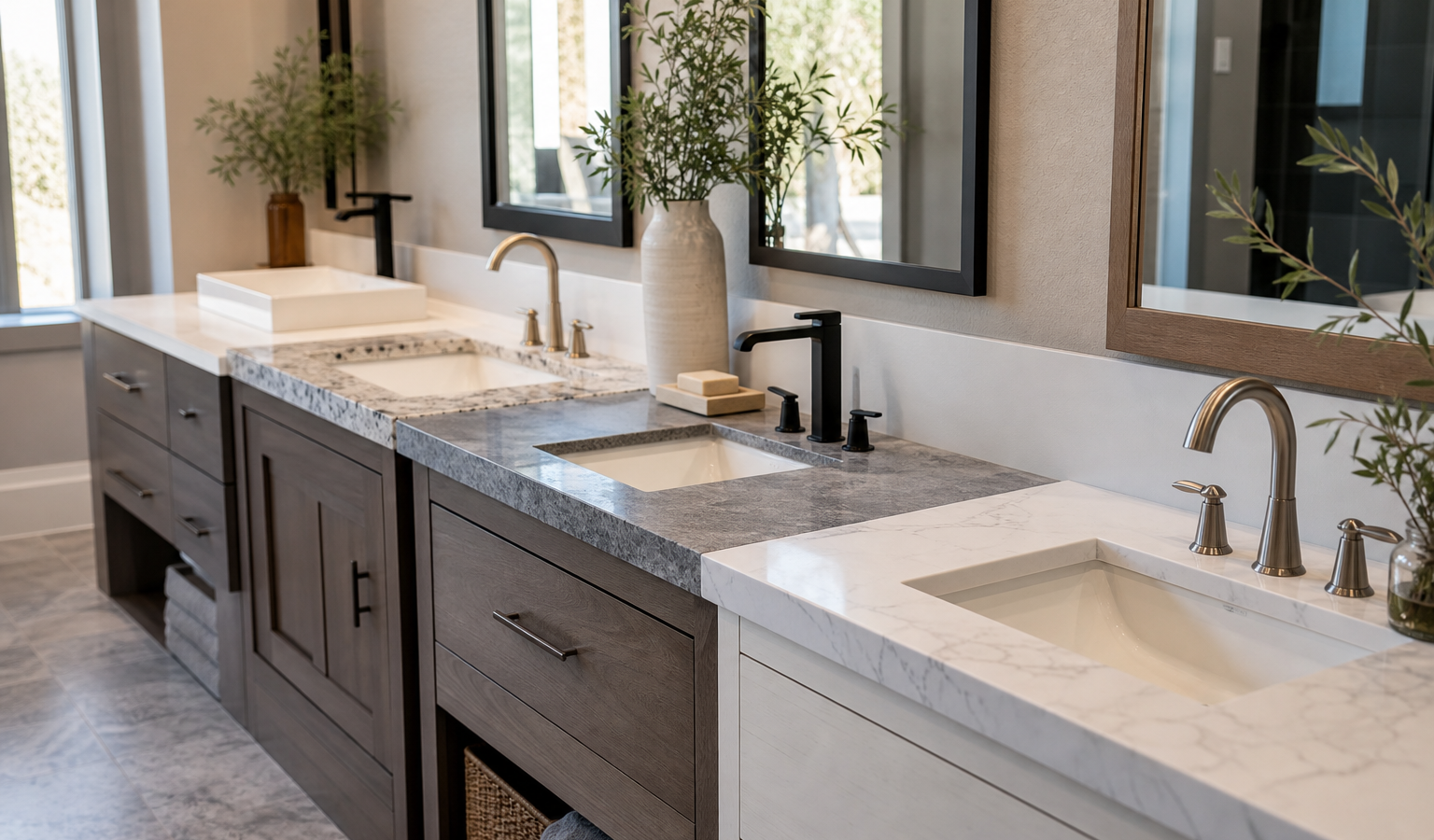
Choosing the right bathroom vanity countertop is one of the highest-impact decisions in any bathroom remodel, because the surface anchors the room visually and takes daily abuse from water, toothpaste, cosmetics, and heat from styling tools. The good news is that a bathroom top uses far less material than a kitchen, so premium stone that would blow a kitchen budget becomes affordable here. In 2026, a bathroom vanity countertop runs roughly $40 to $200 per square foot installed, and most single vanities land between $400 and $850 all-in. This guide breaks down every material, real US prices, sizing, edge profiles, and how to match a surface to how your household actually uses the room.
Key takeaways
- A single-sink vanity top typically costs $400 to $850 installed; double vanities run $700 to $1,700.
- Quartz is the best all-around choice for busy baths: non-porous, no sealing, stain and bacteria resistant.
- Because bathroom tops are small (3 to 11 sq ft), splurging on marble or quartzite is realistic here.
- Natural stone (granite, marble, quartzite) needs periodic sealing; quartz, solid surface, and laminate do not.
- Fabrication turnaround is usually 1 to 2 weeks after templating, so order early in your project.
What is the best bathroom vanity countertop material?
For most homeowners, quartz is the best bathroom vanity countertop because it is non-porous, requires no sealing, resists stains and bacteria, and comes in hundreds of colors including convincing marble looks. If you want natural stone, granite and quartzite offer superior heat and scratch resistance, while marble delivers unmatched elegance at the cost of higher maintenance. Your ideal surface depends on three things: your budget, how much upkeep you tolerate, and the look you are chasing.
Because a vanity uses so little material, the calculus differs from a kitchen. A 36-inch top is roughly 5.5 square feet, so even a $120-per-square-foot quartz slab only adds a few hundred dollars over a budget laminate. That is why designers frequently recommend spending up on the bathroom surface even when a client is watching the overall remodel budget elsewhere. The material choice you make here will outlast most other finishes in the room.
Bathroom vanity countertop cost by material in 2026
Expect to pay between $10 and $200 per square foot installed depending on material, with laminate at the low end and marble and quartzite at the top. The table below reflects current 2026 US installed pricing, which bundles material, fabrication, and standard installation. Regional labor, slab availability, edge profile, and cutouts all move the final number.
| Material | Installed cost per sq ft | Sealing | Best for |
|---|---|---|---|
| Laminate | $10 – $30 | No | Rentals, tight budgets |
| Cultured marble | $25 – $60 | No | Integrated sink, value |
| Butcher block / wood | $30 – $60 | Yes (oil) | Warm, rustic baths |
| Solid surface (Corian) | $40 – $80 | No | Seamless integrated sinks |
| Porcelain slab | $50 – $100 | No | Ultra-thin modern looks |
| Granite | $50 – $120 | Yes | Durability, resale value |
| Quartz | $55 – $130 | No | Low-maintenance workhorse |
| Concrete | $65 – $135 | Yes | Custom shapes, industrial |
| Marble | $75 – $200 | Yes | Timeless luxury, low-traffic |
| Quartzite | $80 – $200 | Yes | Marble look, stone strength |
Total installed cost by size is easier to picture: a 24-inch top runs $300 to $600, a 30-inch runs $400 to $750, a 36-inch runs $450 to $850, and a 48-inch single runs $550 to $1,100. Double vanities at 60 and 72 inches run $700 to $1,400 and $850 to $1,700 respectively. Material typically accounts for 40 to 55 percent of the total, fabrication 25 to 35 percent, and installation 15 to 25 percent.
Quartz bathroom countertops: the low-maintenance workhorse
Quartz is engineered stone made from roughly 90 percent ground quartz bound with resin, which makes it non-porous and the easiest surface to live with. It never needs sealing, wipes clean with soap and water, and resists the toothpaste stains and cosmetic dyes that plague natural stone. For families and shared baths, it is the safest pick.
Quartz pros and cons for bathrooms
The upsides are consistency and hygiene: because it is non-porous, quartz will not harbor bacteria or mold in a humid room, and color and pattern are uniform slab to slab so your top matches the sample. The trade-offs are heat sensitivity, since the resin can scorch under a hot flat iron or curling wand, and a higher upfront price than granite in some markets. Keep a heat pad under styling tools and quartz will look new for decades.
Granite and quartzite: natural stone that lasts
Granite and quartzite are the most durable natural stones for a vanity, both resisting heat and scratches far better than marble. Granite delivers dramatic natural patterns and adds resale value, while quartzite mimics the soft veining of marble but with the hardness of quartz. Both are porous and need sealing once or twice a year.
When to choose granite vs quartzite
Choose granite if you want maximum durability and unique movement at a mid-range price, and you do not mind a busier, more speckled look. Choose quartzite if you love the white, marble-like aesthetic but need it to survive a real household. Quartzite commands a premium and requires a fabricator experienced with harder stone. If you are weighing engineered versus natural stone more broadly, our quartz vs granite comparison walks through the durability and maintenance trade-offs in detail.
Marble and luxury natural stone
Marble is the most elegant bathroom countertop, prized for its soft veining and timeless appeal, but it is porous, etches from acids like perfume and cleaning products, and scratches more easily than quartz or granite. In a low-traffic powder room or primary bath used by careful adults, marble is a defensible splurge; in a kids bathroom it will show wear fast.
Carrara vs Calacatta and sealing
Carrara marble is the most affordable at roughly $75 to $100 per square foot and shows fine gray veining, while Calacatta features bolder, more dramatic veins and can exceed $200 per square foot. Both require sealing at installation and periodic resealing, plus prompt cleanup of anything acidic. Many homeowners embrace the natural patina marble develops rather than fighting every etch. The Natural Stone Institute publishes care guidelines that are worth reading before you commit; you can find them at naturalstoneinstitute.org.
Budget-friendly countertop options
If cost is the priority, laminate, cultured marble, and solid surface deliver a finished look for a fraction of stone pricing. Laminate has improved dramatically, with realistic stone-look patterns and seamless edges available for $10 to $30 per square foot installed. Cultured marble molds the sink and top as one piece with no seams to scrub, running $25 to $60 per square foot.
Solid surface and porcelain
Solid surface such as Corian is non-porous, repairable by sanding out scratches, and supports fully integrated sinks for a seamless, easy-to-clean look at $40 to $80 per square foot. Porcelain slab is the newest option: at 6 to 12 millimeters thick it enables an ultra-slim modern profile, resists UV fading and heat, and runs $50 to $100 per square foot, though it requires a specialized fabricator. Any of these can free up budget for other priorities without looking cheap.
How to choose the right bathroom countertop
Match the material to how the room is actually used: prioritize non-porous, low-maintenance surfaces in shared and kids baths, and reserve high-maintenance stone for low-traffic spaces. Weigh five factors before you decide, shown below by how much they typically drive the decision.
Use this quick checklist to narrow your shortlist before you visit a slab yard or showroom.
- Confirm your vanity top size in square feet (width x depth divided by 144).
- Decide sealed vs sealed-free: natural stone needs it, quartz and solid surface do not.
- Match sink type: undermount for stone, integrated for solid surface or cultured marble.
- Pick an edge profile and confirm its per-linear-foot upcharge.
- Ask your fabricator about remnants, which can cut cost 30 to 50 percent on small tops.
Vanity top sizes, thickness, and edge profiles
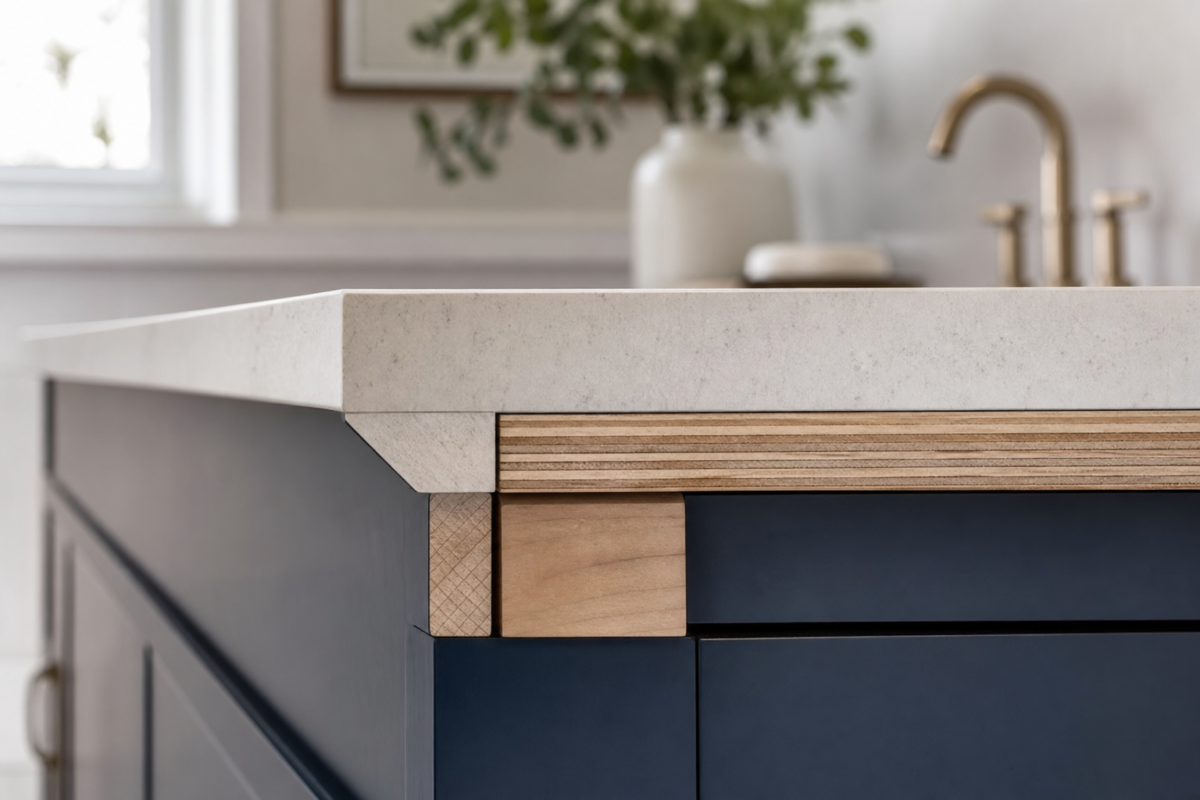
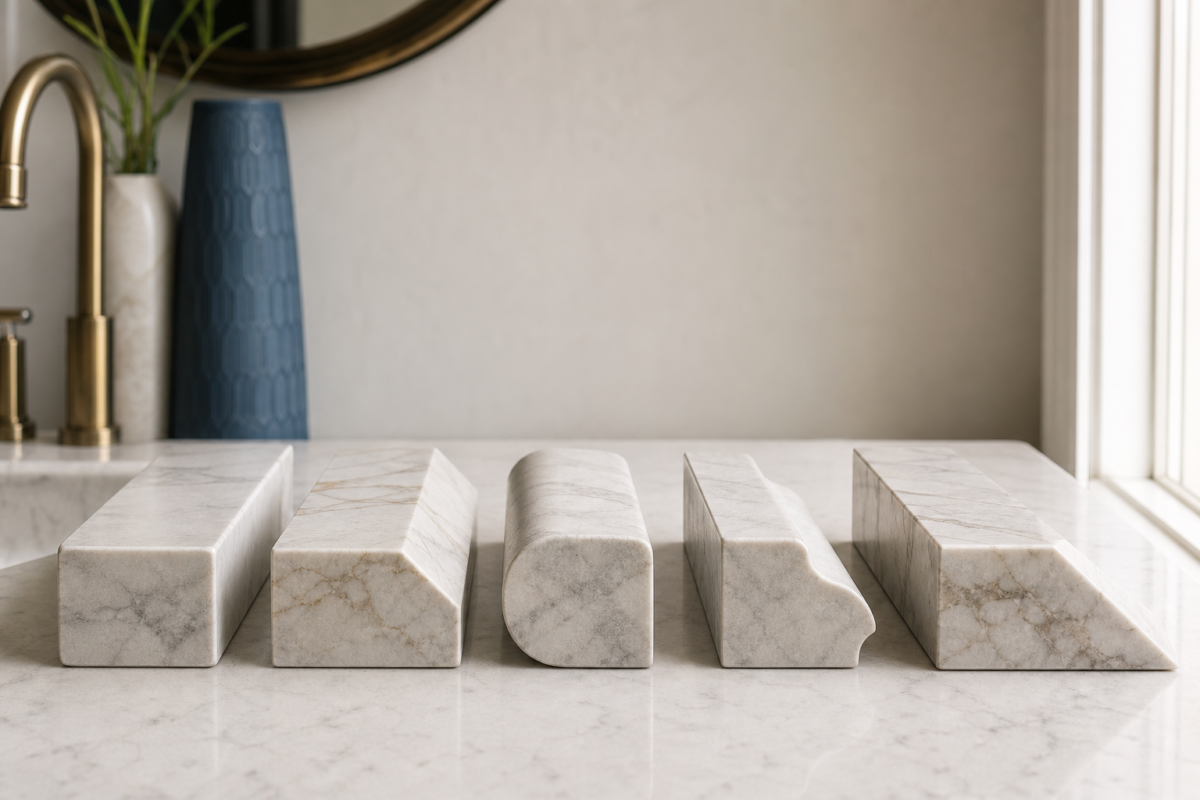
Standard vanity tops match cabinet widths of 24, 30, 36, 48, 60, and 72 inches at a 22-inch depth, and slab thickness is typically 2 centimeters or 3 centimeters. The 3-centimeter option looks more substantial and often skips a plywood buildup, while 2-centimeter is lighter and cheaper. Edge profiles are where personality and small upcharges live.
| Edge profile | Cost per linear ft | Look |
|---|---|---|
| Eased | $5 – $8 | Simple square, modern |
| Half bullnose | $8 – $12 | Softly rounded |
| Beveled | $8 – $14 | Angled, crisp |
| Ogee | $15 – $25 | Ornate, traditional |
| Waterfall (mitered) | $20 – $30 | Slab runs to floor |
Also budget $100 to $300 per sink cutout and $50 to $150 for removing an old top. Pairing the right faucet and fixtures with your edge and finish keeps the vanity looking intentional rather than assembled from parts.
Installation, sealing, and long-term maintenance
Professional installation is standard for stone because slabs are heavy and cutouts must be precise, and fabrication turnaround is usually 5 to 15 business days after templating. Plan the countertop order early so it does not stall the rest of your project schedule. On install day the top is set, seamed, and the sink and faucet are connected.
Keeping your countertop looking new
For natural stone, seal at installation and test annually by dripping water; if it darkens, reseal. Wipe acidic spills immediately, use pH-neutral cleaners, and never use abrasive pads. For quartz and solid surface, daily wiping is all it needs, but keep hot tools off the surface. With basic care, any of these materials will outlast the vanity cabinet beneath it.
Contractor’s take
On a bathroom this small, ask your fabricator about remnant slabs before you price a full slab. I regularly find leftover pieces of $150-per-square-foot quartzite or Calacatta from kitchen jobs that are more than big enough for a 36-inch vanity, and clients walk away with a luxury stone for the price of mid-grade quartz. Bring your exact dimensions and be flexible on the exact slab and you can save 30 to 50 percent.
Bathroom countertop ROI and where to save
Upgraded bathroom surfaces reliably help resale, and because the material spend is small, the return on a stone vanity top is among the best dollar-for-dollar upgrades in the room. A mid-range bathroom remodel returns a solid share of its cost at sale, in line with the broader remodel ROI patterns buyers reward. Spend where hands and eyes land daily, and trim elsewhere.
The smartest savings move is choosing an integrated or undermount sink that matches your material and skipping ornate edges you will not notice. If the cabinet is sound, you can even keep it and just replace the top, similar to how homeowners weigh refinishing versus replacing; our guide to refinishing cabinetry shows how far a surface-only update can go. And once the top is set, plan the right vanity lighting so the material actually reads true in the mirror.
Your next move
You know the number. What are you deciding next?
Compare bathroom sink types, vessel, undermount, pedestal, and wall-hung, with pros, cons, materials, and 2026 installed costs.
Continue →Freestanding tub cost runs $1,300 to $8,000 installed in 2026. See prices by material, full installation breakdown, and…
Continue →Walk-in tub cost in 2026: $5,000 to $20,000 installed. Compare tub types, features, and the real Medicare coverage…
Continue →Frequently asked
What is the most low-maintenance bathroom countertop?
Quartz is the most low-maintenance option because it is non-porous and never needs sealing. Solid surface and laminate are also maintenance-light. Wipe with soap and water and keep hot styling tools off the surface.
How much does a bathroom vanity countertop cost in 2026?
Most single-sink tops cost $400 to $850 installed, and double vanities run $700 to $1,700. Per square foot, expect $10 to $30 for laminate and $80 to $200 for marble or quartzite.
Can I put marble in a bathroom?
Yes, and a bathroom is actually a better place for marble than a kitchen because it sees less acidic exposure. Expect etching over time and seal it regularly. Reserve marble for lower-traffic baths.
Do I need to seal a bathroom countertop?
Only natural stone (granite, marble, quartzite, travertine, concrete) needs sealing, typically once or twice a year. Quartz, solid surface, cultured marble, and laminate never require sealing.
Should the countertop match my kitchen counters?
It does not have to. Because a vanity uses far less material, many homeowners choose a more luxurious stone for the bathroom than they used in the kitchen while keeping a complementary color family.

Installed prices reflect 2026 US fabricator and remodeling data; regional labor and slab availability vary.