Bathroom Lighting Guide: Layers, Placement, and Cost (2026)
How to light a bathroom the right way, from vanity placement and lumens to color temperature, code, and cost.

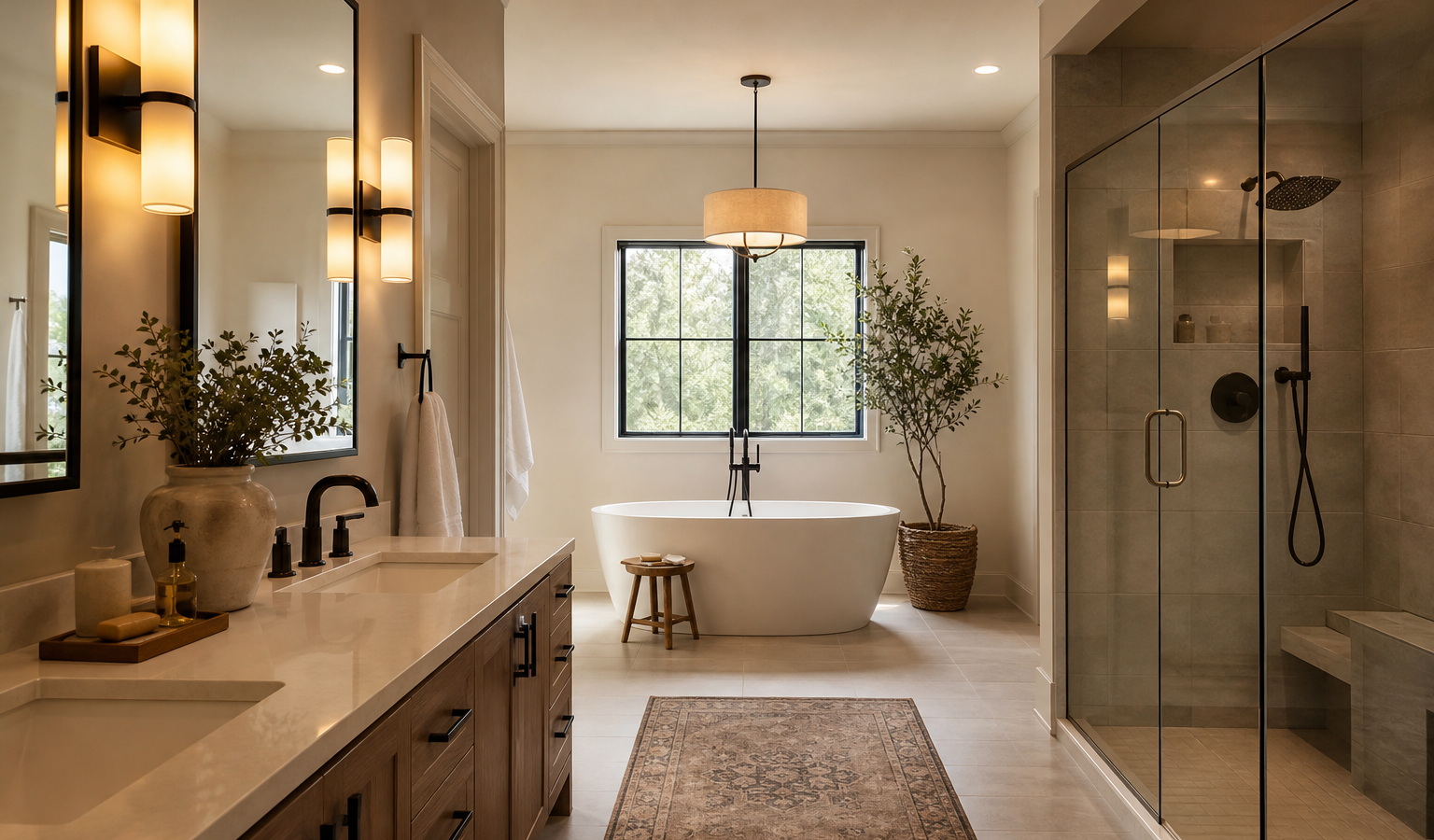
Good bathroom lighting is the difference between a spa-like retreat and a dim, unflattering room where you cannot see to shave or apply makeup. Yet lighting is the step most homeowners underplan, defaulting to a single ceiling fixture that casts harsh shadows on the face. The fix is layered lighting: combining ambient, task, accent, and decorative light so the room is both functional and inviting. In 2026, a bathroom lighting upgrade averages about $850 and ranges from $300 for a simple swap to $3,500 for a full multi-fixture overhaul. This guide covers placement, brightness, color temperature, code, and cost so you get it right the first time.
Key takeaways
- Layer four types of light: ambient, task (vanity), accent, and decorative.
- Aim for 50 to 75 lumens per square foot, plus 1,500 to 3,000 lumens at the vanity.
- Use 2700K-3000K for ambient warmth and 3500K-4000K at the vanity, with 90+ CRI.
- Fixtures near water must be damp or wet rated; all receptacles need GFCI protection.
- A full 4-to-6 fixture upgrade runs $1,500 to $3,500 installed.
How should you light a bathroom?
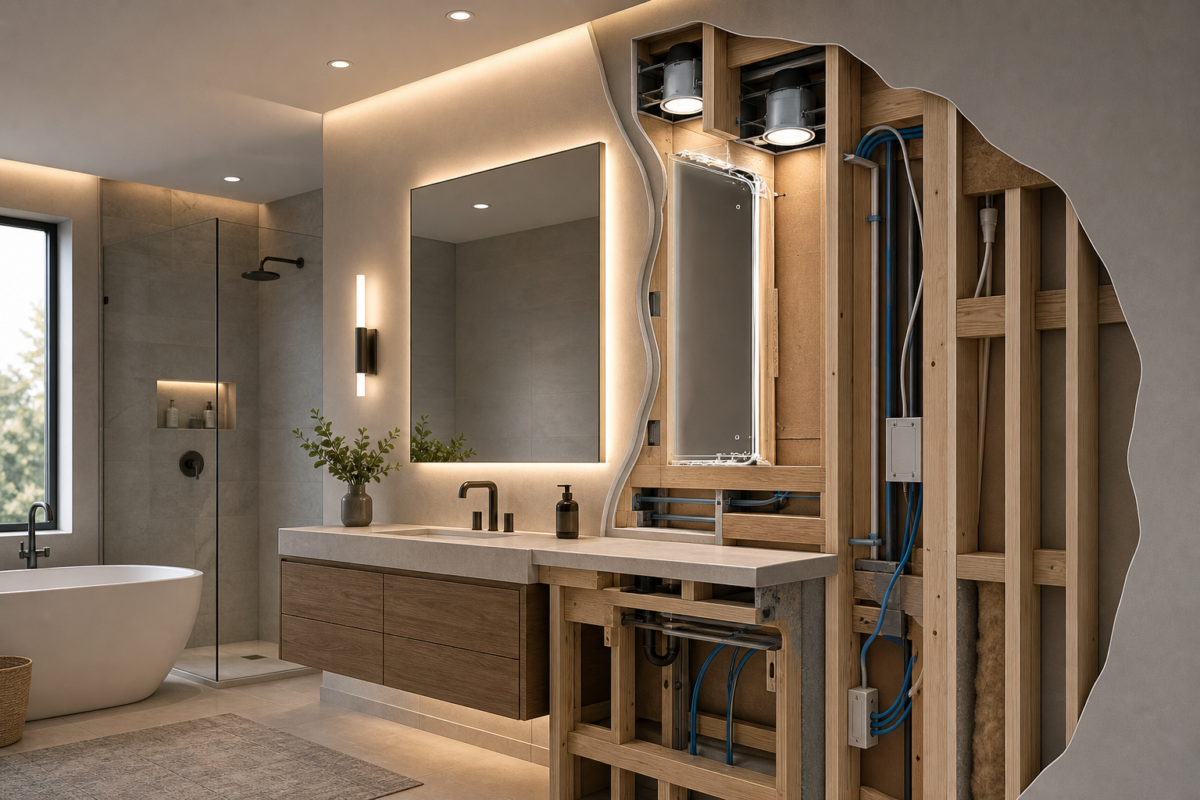
You should light a bathroom in layers rather than relying on one overhead fixture. Combine ambient light for overall illumination, task light at the vanity for grooming, accent light to highlight features, and decorative fixtures for style. A single ceiling can casts shadows directly onto the face, which is exactly the opposite of what you want at the mirror. Layering solves both function and mood.
The most common mistake is treating a recessed can over the sink as vanity lighting. Overhead light drops shadows into eye sockets and under the chin; the fix is light beside or around the face. As with a well-lit kitchen, the goal is to eliminate shadows on work surfaces, and at the vanity your face is the work surface. Get the layers right and everything else follows.
The four layers of bathroom lighting
Every well-lit bathroom uses four layers that each do a specific job. Ambient provides baseline brightness, task lights the mirror, accent adds depth, and decorative supplies personality. You do not always need all four, but skipping task light is where most bathrooms fail.
Ambient, task, accent, and decorative
Ambient light usually comes from recessed cans or a flush-mount ceiling fixture and fills the room evenly. Task light means vanity sconces or a light bar sized to the mirror, dedicated to grooming. Accent light highlights architecture such as a niche, tub, or textured wall and adds a sense of depth. Decorative fixtures like a small chandelier or statement pendant set the style, much like island pendants anchor a kitchen. The best bathrooms blend at least three of these on separate switches.
Vanity lighting: placement, height, and brightness
The best vanity lighting comes from fixtures mounted on either side of the mirror at roughly 60 to 66 inches from the floor, which puts light at face level and eliminates shadows. A single pair of sconces flanking the mirror does more for grooming quality than four recessed cans. If you must use a fixture above the mirror, choose a bar 75 to 100 percent of the mirror width mounted 75 to 80 inches from the floor.
Sconce placement and shadow-free light
Space side sconces 36 to 40 inches apart so they bracket the face evenly. The reason side lighting wins is simple physics: light coming from beside you fills in the shadows under brows, nose, and chin that overhead light creates. For a shared vanity or a wide double vanity, treat each sink as its own zone with its own pair of fixtures. This is the single highest-value lighting decision in the room.
How many lumens does a bathroom need?
A bathroom needs roughly 50 to 75 lumens per square foot of ambient light plus 1,500 to 3,000 lumens of dedicated task light at the vanity. A typical 50-square-foot bathroom therefore wants around 3,000 total lumens, with a portion of that concentrated at the mirror. The table below translates lumens into fixtures by zone.
| Zone | Target lumens | Typical fixtures |
|---|---|---|
| Overall ambient (50 sq ft) | 2,500 – 3,750 | 2 – 4 recessed or 1 flush mount |
| Vanity task | 1,500 – 3,000 | Pair of sconces or a light bar |
| Shower | 400 – 800 | 1 wet-rated recessed |
| Water closet | 400 – 600 | 1 recessed or small flush |
| Accent / tub | 200 – 500 | LED strip or wall wash |
These are guidelines, not ceilings. Larger primary baths, higher ceilings, and dark finishes all push the numbers up, which is why dimmers matter so much: they let you dial one fixture set from bright grooming light down to a relaxing soak.
Color temperature and CRI for bathrooms
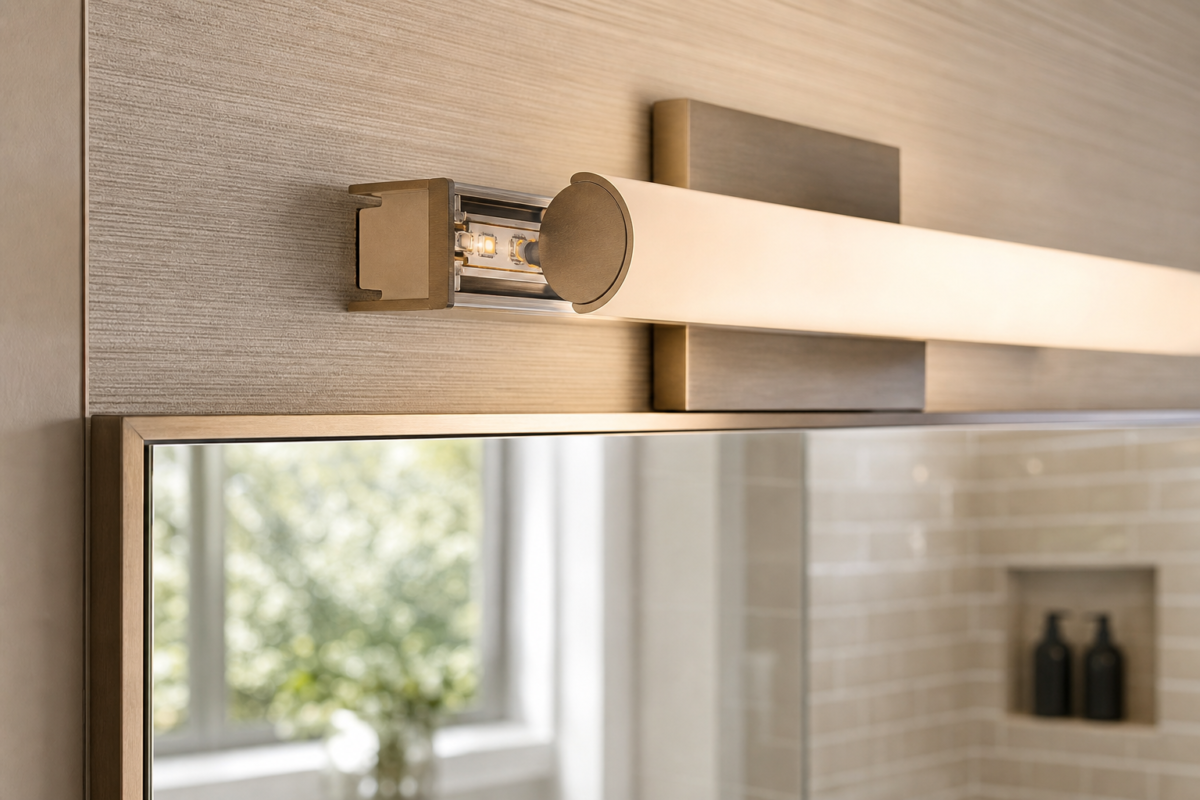
Use warm-to-neutral color temperatures of 2700K to 4000K in a bathroom, and never go cooler than 4000K in a residential space. Warm 2700K-3000K light feels spa-like for ambient and tub areas, while a slightly cooler 3500K-4000K at the vanity renders skin tones and makeup accurately. Just as important is a high Color Rendering Index.
Why CRI 90+ matters at the mirror
CRI measures how truly a light source shows colors compared to daylight, on a scale to 100. At the vanity, insist on 90 or above so foundation, concealer, and hair color look the same in the bathroom as they will outside. A low-CRI bulb can make makeup that looks perfect at home appear wrong in daylight. Look for ENERGY STAR certified LED fixtures, which meet efficiency and quality standards you can verify at energystar.gov. Matching bulb color across every fixture keeps the room from looking patchy.
Damp vs wet rated fixtures and code requirements
Fixtures near water must carry the correct UL listing: damp rated for humid areas away from direct spray, and wet rated for direct water exposure such as inside a shower or above a tub. Installing a standard fixture where a wet-rated one is required is both a safety hazard and a code violation. Bathroom electrical is governed by the National Electrical Code and local amendments.
GFCI, safety zones, and circuits
All bathroom receptacles must have GFCI protection regardless of distance from water, and bathrooms require at least one 20-amp circuit for receptacles. Code restricts fixtures and outlets within 3 feet horizontally and 8 feet vertically of a tub or shower, where wet or damp ratings apply. Any fixture over a tub or in a shower must be wet rated and, if within reach, protected. When in doubt, hire a licensed electrician; industry groups such as the National Kitchen and Bath Association at nkba.org publish planning standards that reflect these rules. Do not treat code as optional in a wet room.
Recessed, shower, and ceiling lighting
For general ceiling light, space recessed fixtures using a simple rule: divide the ceiling height by two to get the spacing between cans. In an 8-foot ceiling that means roughly 4 feet apart, kept about 12 inches off the walls. Showers need their own dedicated wet-rated fixture.
Shower and niche lighting
A single wet-rated recessed light of 400 to 800 lumens is enough for most showers, and a small LED strip inside a niche adds both function and a high-end glow. In enclosed or windowless showers, that dedicated light is not a luxury but a necessity. IC-rated housings are required where insulation contacts the fixture. Under-mirror or under-vanity LED strips, similar in principle to under-cabinet lighting in a kitchen, add a soft nightlight layer that is welcome at 2 a.m.
Bathroom lighting cost by fixture in 2026
A bathroom lighting upgrade averages about $850, with most projects between $300 and $2,000 and full overhauls of four to six fixtures reaching $1,500 to $3,500. Cost depends on fixture count, whether new wiring or circuits are needed, and fixture quality. The table shows installed prices by fixture.
| Fixture / work | Installed cost | Notes |
|---|---|---|
| Vanity light bar | $100 – $300 | Simple mirror-top upgrade |
| Sconces (pair) | $200 – $600 | Best grooming light |
| Recessed can | $150 – $300 each | Ambient ceiling light |
| Backlit LED mirror | $300 – $1,100 | Task plus decorative |
| New dimmer switch | $80 – $200 | Per switch |
| New circuit | $300 – $600 | If capacity is short |
| New wiring run | $200 – $500 | Per run to a new location |
If you are budgeting a full renovation, fold lighting into your overall project cost plan and schedule early, because moving a fixture location means opening walls before tile goes up. Rewiring after finishes are in is far more expensive.
Choosing fixtures, finishes, and controls
Pick fixtures that balance brightness, code compliance, finish, and dimmability rather than looks alone. The factors below rank how much each typically matters when selecting bathroom lighting.
Use this checklist before you buy so a good-looking fixture does not turn into a code problem or a shadow factory.
- Confirm the fixture rating matches its location (damp near sink, wet in shower).
- Add up lumens per zone and compare to the 50 to 75 per sq ft target.
- Match color temperature and CRI across every fixture in the room.
- Put ambient, task, and accent on separate dimmable switches.
- Verify all outlets are GFCI protected before closing walls.
Dimmers, smart controls, and energy efficiency
Adding dimmers is the cheapest upgrade with the biggest quality-of-life payoff, letting one fixture serve both bright grooming and a low evening glow. LED fixtures use a fraction of the energy of incandescent, last 15,000 to 50,000 hours, and now come in every warm tone, so there is no efficiency penalty for good light. Smart switches add scheduling and app control.
Choosing ENERGY STAR certified LEDs and putting each layer on its own dimmable circuit is the formula for a bathroom that is efficient, flattering, and flexible. Modern smart switches also let you set scenes, so a single tap can shift the room from bright morning grooming light to a warm, dimmed glow for an evening soak without touching individual fixtures. Once your fixtures are set, make sure your vanity countertop and mirror finish complement the color temperature so the whole room reads as one considered design. Good light makes every other finish look more expensive; skimping on it undoes the rest of a careful remodel.
Contractor’s take
Wire your vanity sconces and your ceiling light to separate dimmers, not one switch. Nine times out of ten a client tells me the bathroom feels harsh, and the fix is not more light but the ability to bring it down. I also run a small wet-rated LED under the floating vanity or inside a niche on its own low-output circuit as a nightlight. It costs almost nothing during rough-in and clients say it is their favorite feature.
Your next move
You know the number. What are you deciding next?
Walk-in tub cost in 2026: $5,000 to $20,000 installed. Compare tub types, features, and the real Medicare coverage…
Continue →Bathroom remodel financing explained: compare home equity loans, HELOCs, cash-out refi, personal loans, and 0% cards with 2026…
Continue →Steam shower cost runs $3,000 to $10,000 installed in 2026. See prices by generator size, enclosure, and prefab…
Continue →Frequently asked
Where should bathroom vanity lights be placed?
Ideally on both sides of the mirror at 60 to 66 inches from the floor, spaced 36 to 40 inches apart. Side lighting fills in facial shadows that overhead fixtures create. A light bar above the mirror is a second-best option.
What color temperature is best for a bathroom?
Use 2700K to 3000K for warm ambient light and 3500K to 4000K at the vanity for accurate grooming. Avoid anything above 4000K in a home bathroom, and choose bulbs with a CRI of 90 or higher.
How many lumens do I need in a bathroom?
Aim for 50 to 75 lumens per square foot of ambient light, so about 3,000 lumens for a 50-square-foot bath, plus 1,500 to 3,000 lumens of dedicated task light at the vanity.
Do bathroom lights need to be wet rated?
Fixtures in a shower or directly above a tub must be wet rated. Fixtures elsewhere in the humid room should be at least damp rated. All receptacles require GFCI protection regardless of location.
How much does it cost to upgrade bathroom lighting?
A typical upgrade averages about $850 and ranges from $300 for a simple fixture swap to $3,500 for a full four-to-six fixture overhaul, with more if new circuits or wiring runs are required.

Lumen, placement, and code figures reflect 2026 US lighting and NEC guidance; costs are national installed averages.