Laminate Countertops in 2026: A Complete Buying Guide
Today's laminate looks nothing like the rolled-edge tops you remember. Here is what it costs, which brands to trust, and when it is the smart budget pick.

RenHive may earn a commission when you buy through links on this page. It never affects which products we recommend or how we rank them, and we do not accept product samples. How we review →
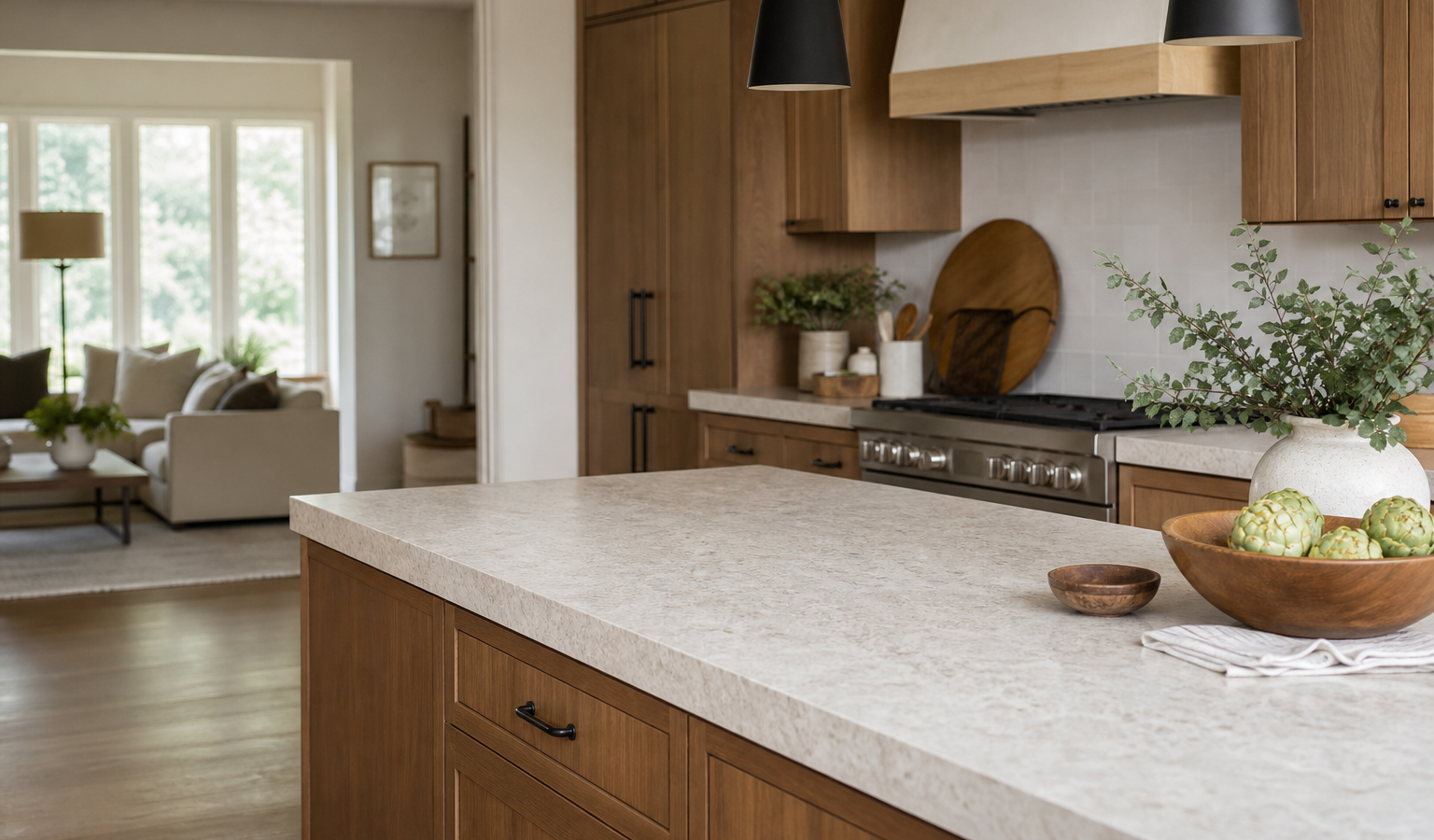
Laminate countertops have quietly become one of the smartest budget buys in the American kitchen. If you last saw laminate in a 1990s rental with a rolled front edge and a fake wood grain, the material you can order in 2026 will surprise you. Today’s laminate countertops mimic honed marble, concrete, and linen-textured stone convincingly, install fast, and cost a fraction of what a stone slab runs. For a laundry room, a rental refresh, or a first kitchen on a tight budget, they are often the most sensible choice on the shelf.
This guide walks through what laminate is made of, how far the looks have come, which brands to trust, what you should actually pay per square foot installed in 2026, and where laminate wins or loses against quartz and granite. By the end you will know whether it belongs in your project or whether one more tier up makes better sense.
What Laminate Countertops Actually Are
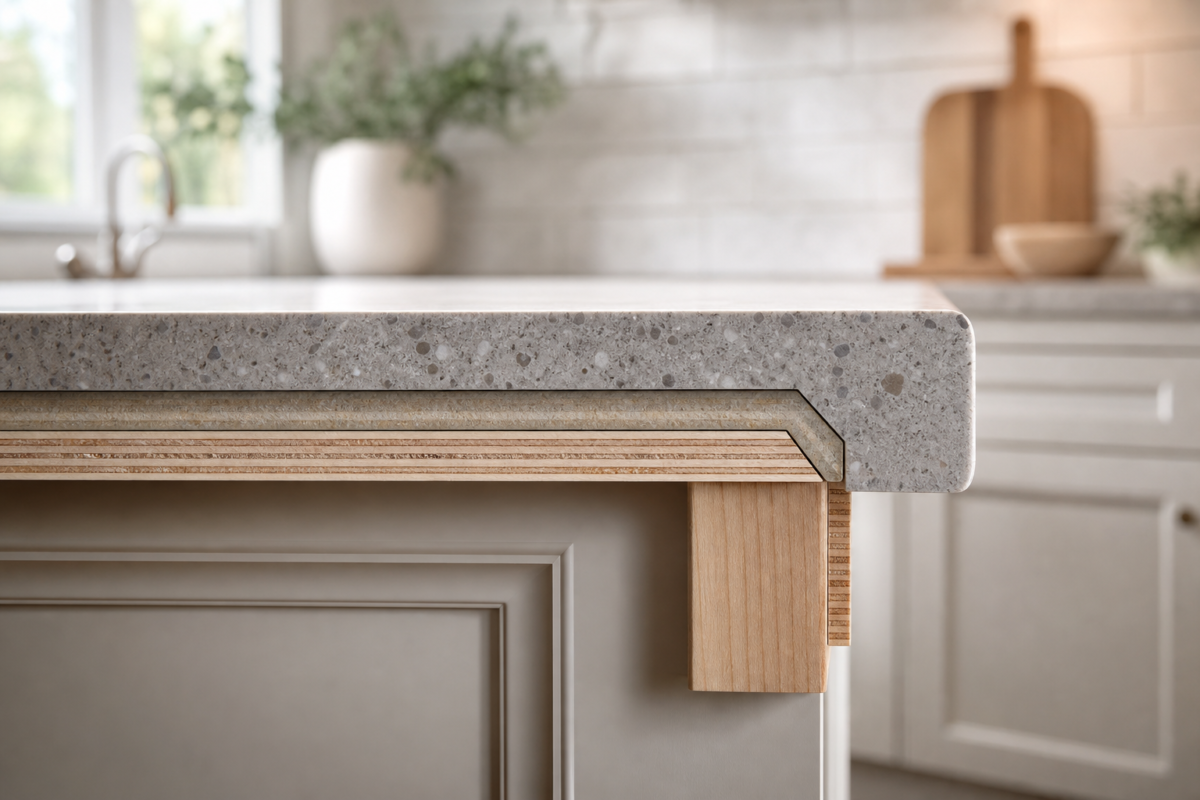
A laminate countertop is not solid plastic. It is a thin decorative surface, called high-pressure laminate or HPL, bonded to a wood-based core. The HPL is the wear layer you touch and see; the substrate underneath gives the counter its bulk and rigidity. Understanding this two-part construction explains almost every strength and weakness the material has.
HPL, the Wear Layer, and the Substrate
High-pressure laminate is built by fusing several sheets of resin-saturated kraft paper together under heat and roughly 1,000 pounds of pressure per square inch. A printed decorative sheet sits near the top, and a clear protective wear layer caps it. That wear layer is what resists everyday scratches, moisture, and stains. Below the HPL sits the substrate, almost always particleboard or medium-density fiberboard (MDF). The particleboard substrate is dense, flat, and cheap, which is a big reason laminate stays affordable. The downside is that the pattern lives only on the surface: chip through the wear layer and you expose the brown core, which cannot be sanded out or refinished.
Postform Versus Custom Fabrication
Laminate reaches your kitchen two ways. Postform tops are mass-produced in standard lengths with the laminate already curved over the front edge and up into an integrated backsplash in one continuous piece. They are the cheapest, fastest option and sit at every home center. Custom fabrication starts with flat sheet laminate a shop glues to a cut-to-size substrate, which lets you pick specific edges, thicknesses, and shapes. Postform is ideal for straight galley runs; custom is worth it for islands, angles, and premium edge details.
How Good Modern Laminate Looks in 2026
The single biggest change in laminate is visual quality. High-resolution printing and embossing now let manufacturers register the texture to the pattern, so a marble-look top actually feels like the veining sits slightly below the polished field. In showrooms, buyers routinely mistake current premium laminate for the real stone it copies.
Realistic Stone Looks, Matte, and Textured Finishes
The 2026 catalogs lean hard into matte and low-sheen finishes because they read as more natural and hide fingerprints and light scratches better than the old glossy tops. Textured surfaces that mimic honed marble, leathered granite, raw concrete, and even soft linen weaves are standard across the major lines. Warm neutrals, greige, soft white marble with gray veining, and matte black are the volume sellers. The result is a counter that photographs and lives like stone at a fraction of the price, which is exactly why designers no longer flinch at specifying it for the right project.
The Laminate Brands Worth Knowing
Laminate is close to a commodity, but a handful of established brands set the standard for pattern quality, wear-layer durability, and color matching between the top and any matching edge or backsplash pieces.
Formica, Wilsonart, and Pionite
Formica is the name most homeowners recognize and effectively invented the category; its current lines include convincing stone and woodgrain patterns with matte and textured finishes. Wilsonart is the other heavyweight, widely praised by fabricators for deep, realistic patterns and a broad premium palette, and it usually sits at the top of the price band. Pionite (part of Panolam) is a strong value player favored in commercial and multifamily work for durability at a lower cost. Arborite and Nevamar round out the field. For most residential kitchens, choosing between Formica and Wilsonart comes down to the exact pattern you love rather than any real quality gap.
Laminate Countertop Cost in 2026
Here is the headline most people came for. In 2026, laminate countertops run roughly $20 to $50 per square foot installed for the vast majority of kitchen projects. Basic postform tops in a standard color can land near $20 to $30 per square foot, while custom-fabricated tops in premium patterns with upgraded edges push toward $50, and elaborate jobs with a lot of edge work can reach $60 to $80. Material alone is roughly $10 to $50 per square foot, with labor adding another $10 to $30. For a typical 30 to 40 square foot kitchen, expect a total in the low four figures rather than the $4,000-plus a comparable quartz job commands.
What Drives the Price, and How It Compares
Pattern tier, edge profile, custom cutouts, and whether you go postform or custom all move the number. Even at the top of its range, laminate undercuts every stone option. The table below shows 2026 installed ranges so you can see where laminate sits against the alternatives. For a full breakdown across every surface, our kitchen countertop cost guide goes deeper and compares the whole field.
| Material | Installed cost per sq ft (2026) | Typical lifespan | Resale impact |
|---|---|---|---|
| Laminate | $20 – $50 | 10 – 20 years | Neutral to low |
| Quartz | $50 – $150 | 30+ years | Strong |
| Granite | $40 – $175 | 30+ years | Strong |
| Butcher block | $35 – $120 | 20+ years (resealed) | Moderate |
Contractor’s take
When a client is torn between low-end quartz and top-tier laminate, I ask how long they plan to stay. Under five years, or in a rental, premium laminate is the better dollar. Ten-plus years in a forever home, spend the extra and go quartz. The regret I hear most is people paying near the top of the laminate range for heavy custom edge work when a step up to a stone remnant would have been smarter.
Edge Profiles and Finish Options
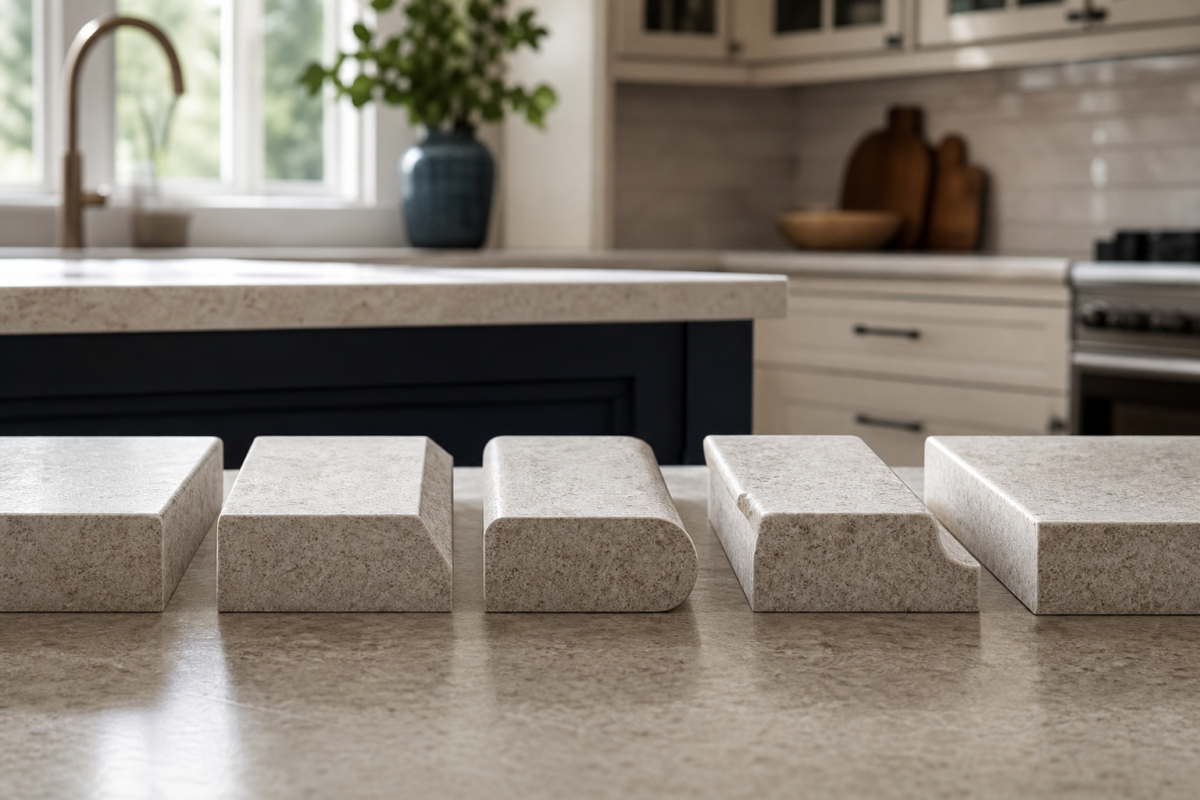
The rolled, bullnose-only front edge that dated old laminate is no longer your only choice. Modern fabrication lets laminate mimic the crisp, squared edges people associate with stone, which does more than anything else to make a top read as an upgrade.
From Rolled Postform to Square and Eased
Postform tops still offer the classic waterfall roll and a matching integrated backsplash molded in one piece, which eliminates a seam where the counter meets the wall. But custom shops now build square edges, gently eased edges, beveled edges, and even ogee profiles using edge-banding techniques. A square or eased edge in a matte stone pattern is the single best trick for making laminate look current. The table below lays out the common choices and roughly what each adds.
| Edge or finish option | Best for | Relative cost |
|---|---|---|
| Postform rolled edge | Budget straight runs | Included / lowest |
| Square or eased edge | Modern stone look | $5 – $15 per linear ft |
| Beveled or ogee edge | Premium detailing | $15 – $30 per linear ft |
| Matte or textured finish | Hiding scratches, natural look | Small upcharge |
| Integrated backsplash | Seam-free wall transition | Included on postform |
The Pros and Cons of Laminate
No surface is perfect. Laminate makes real trade-offs to hit its price, and knowing them up front keeps expectations honest.
Where Laminate Wins
The upsides are the reason laminate has survived every design trend for decades. It is genuinely cheap, forgiving to install, and offered in more colors and patterns than any stone.
- Lowest upfront cost of any mainstream countertop
- DIY-friendly: postform tops can be cut and set with common tools
- Enormous range of patterns, colors, and realistic stone looks
- Low maintenance with no sealing ever required
- Nonporous wear layer resists everyday stains
- Lightweight, so standard cabinets need no reinforcement
The Trade-Offs to Accept
The cons all trace back to the thin surface and wood core. Laminate can chip at edges if struck hard, and it will scorch or blister under a hot pan, so trivets are mandatory. Seams on longer runs or L-shaped layouts are visible on close inspection, unlike a stone miter. Because the pattern is surface-deep, a deep gouge or burn is not repairable; you replace the section. And if water works into a bad seam or an unsealed cutout, the particleboard substrate can swell. None of these are dealbreakers for the right project, but they are why laminate is not a lifetime surface.
Lifespan and Durability
With reasonable care, laminate countertops last about 10 to 20 years, and a well-treated top in a low-traffic room can stretch beyond that. The limiting factor is usually cumulative wear and edge damage rather than a single failure.
What Actually Ends a Laminate Top
Three things retire most laminate: a scorch or melt from a hot pan set directly on the surface, a chipped or delaminating edge in a high-use corner, and moisture swelling the core around a sink or seam. Because the surface cannot be refinished, once the wear layer dulls or the edge lifts, replacement is the only fix. The good news is that replacement is cheap and fast compared with stone, so a laminate top that reaches the end of its life is not an expensive problem to solve.
Sinks, Seams, and Backsplash Details
The details around water are where laminate demands the most attention, because the wood substrate does not tolerate standing moisture. Getting the sink and backsplash right is what separates a top that lasts 20 years from one that swells in five.
The Undermount Question and Integrated Backsplash
Traditionally laminate takes a drop-in sink, whose rim covers and protects the cut edge of the substrate. Undermount sinks were long considered off-limits because they expose that raw core to water. In 2026 a few fabricators do offer sealed systems and specialty edge treatments that allow an undermount on laminate, but it remains the exception, adds cost, and depends on flawless sealing. For most homeowners a quality drop-in sink is the right, worry-free call. On the wall side, a postform integrated backsplash is a real advantage, since the seam-free curve where counter meets wall gives water nowhere to hide. If you want a tile backsplash instead, our kitchen backsplash cost guide covers what that adds.
When Laminate Is the Right Choice
Laminate is not a compromise everywhere; in the right room it is the correct answer, not the cheap one. The trick is matching it to projects where its strengths matter and its weaknesses do not.
Best Uses: Rentals, Budgets, and Laundry Rooms
Laminate shines in rental units and flips, where durability per dollar beats resale prestige, and in laundry rooms, mudrooms, and secondary kitchens that see light use. It is the anchor of most budget-focused kitchens, letting you put money into cabinets, lighting, or appliances instead. Homeowners who love a natural material on a budget sometimes pair a laminate perimeter with a wood island for warmth.
How It Compares and What It Does for Resale
Against stone, laminate trades longevity and resale draw for a much lower entry price. Buyers in higher-end markets increasingly expect quartz or granite, so laminate is roughly neutral to slightly negative on resale in those homes; if you are deciding between the two premium stones, our quartz versus granite comparison helps. In starter homes, rentals, and value-focused markets, a fresh, modern laminate top in a matte stone look reads clean and move-in ready, which is all the resale lift most of those buyers need.
Frequently asked questions
Your next move
You know the number. What are you deciding next?
Compare the 9 best kitchen countertop materials for 2026, with real installed prices per square foot, durability, and…
Continue →Everything you need to plan a kitchen remodel in 2026 - budget, layout, cabinets, countertops, appliances, timeline, hiring,…
Continue →A kitchen remodel costs $18,000 to $120,000 in 2026, with a national average near $42,000. Here's the full…
Continue →Frequently asked
Are laminate countertops good in 2026?
Yes, for the right project. Modern laminate mimics stone convincingly, costs a fraction of quartz, and needs no sealing. It is an excellent budget, rental, or secondary-room surface, though it is not a lifetime top like stone.
How much do laminate countertops cost installed?
In 2026, expect roughly $20 to $50 per square foot installed for most kitchens. Basic postform tops start near $20 to $30, while custom patterns and premium edges push toward $50 or a bit beyond.
Can you put a hot pan on laminate?
No. Laminate can scorch, blister, or melt under direct heat because of its resin and wood construction. Always use trivets or hot pads; this is the single most common way laminate gets damaged.
Can laminate countertops be repaired?
Not really. Because the pattern is a thin surface layer, deep gouges, burns, and chips cannot be sanded or refinished out. Minor edge lifts can be re-glued, but significant damage means replacing the affected section.
Can you use an undermount sink with laminate?
Traditionally no, and a drop-in sink remains the standard, worry-free choice. A few 2026 fabricators offer sealed systems that allow undermount sinks on laminate, but it costs more and relies on flawless sealing to protect the core.

Pricing and product details compiled from 2026 US cost data (HomeGuide, Angi, HomeAdvisor, SlabWise) and manufacturer catalogs (Formica, Wilsonart, Pionite).