Kitchen Cabinet Materials: Plywood vs. MDF vs. Particleboard vs. Solid Wood
The material behind your doors decides whether cabinets last 10 years or 30. Here is where plywood, MDF, particleboard, and solid wood each belong, and what they cost.

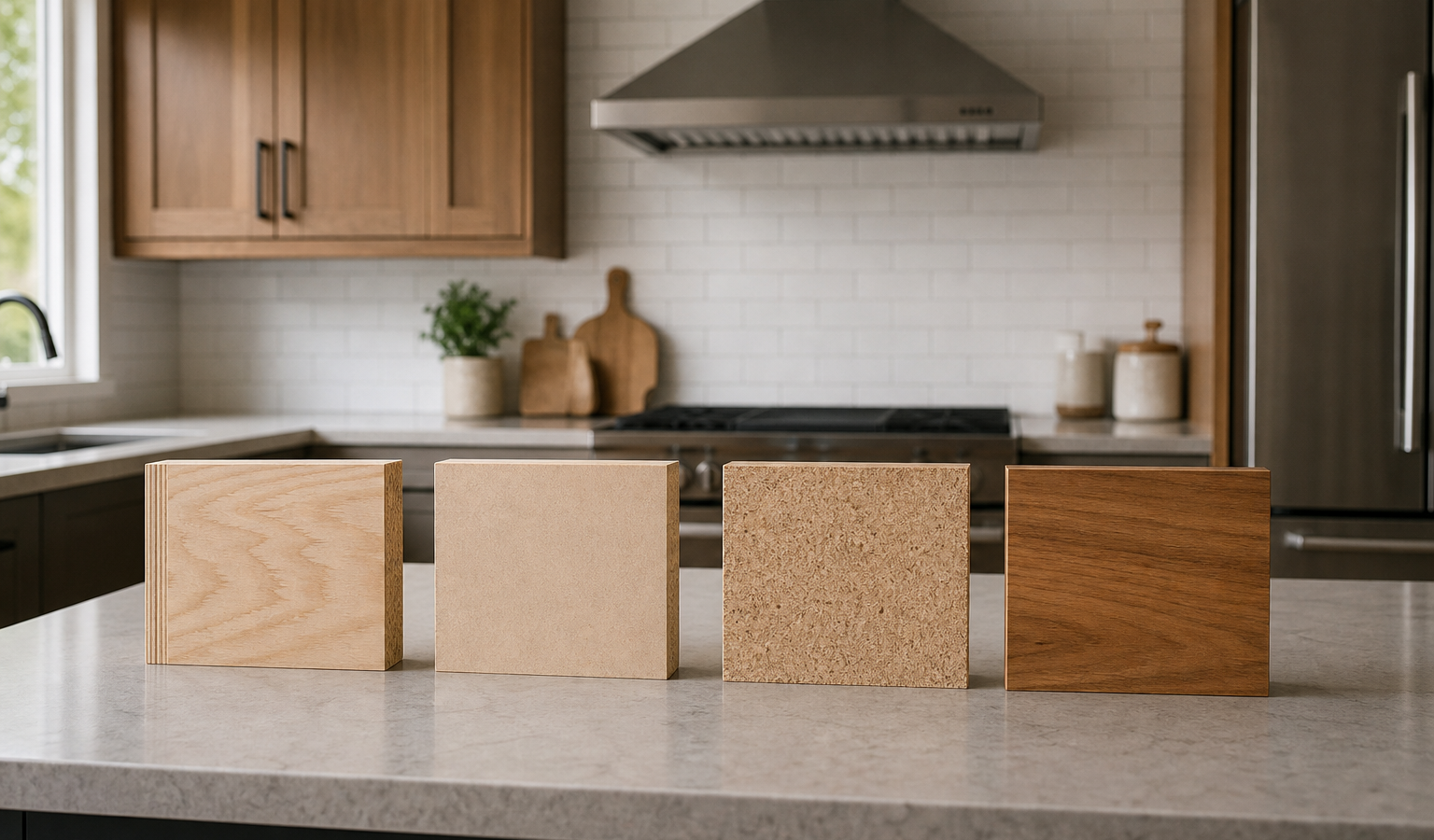
Your kitchen cabinet materials quietly decide whether your cabinets feel solid a decade from now or start sagging and swelling within a few years. The doors get the attention on a showroom floor, but the box behind them, the shelves inside, and how the two are joined are what you actually live with. This guide breaks down the four materials on almost every quote in 2026: plywood, MDF, particleboard, and solid wood, where each belongs, what it costs, and how it handles moisture.
Here is the frustrating part: two identical-looking kitchens can be built from completely different materials at wildly different prices. A painted shaker door can sit on a $70 particleboard box or a $250 plywood box, and from three feet away you cannot tell the difference until a hinge screw strips or a leak turns a base cabinet into oatmeal.
Cabinet Boxes vs. Doors and Face Frames
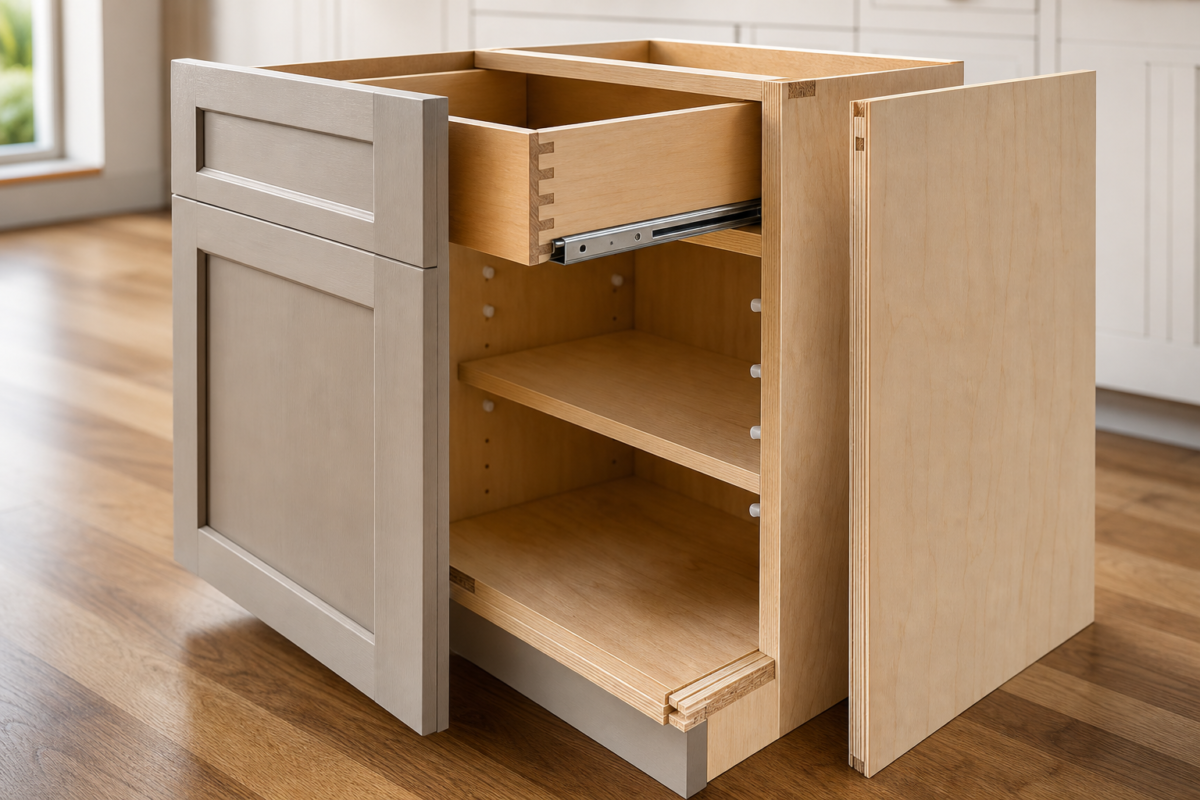
Separate the two jobs a cabinet material does. The cabinet box, or carcass, is the structural shell: sides, top, bottom, back, and shelves. It carries weight, holds screws for hinges and slides, and takes the brunt of any moisture under your sink. The doors, fronts, and face frame are what you see and touch; they need to look good and hold a finish but carry far less load.
Why the split matters for your budget
Good cabinet lines mix materials on purpose. A well-built cabinet might pair a plywood box with an MDF painted door and a solid wood face frame, because each material does what it does best. When a salesperson says solid wood, ask what the box, shelves, and drawer boxes are made of. Those three answers tell you more than any brochure.
Plywood: The Premium Cabinet Box
Plywood is thin wood veneers stacked with the grain rotated ninety degrees on each layer, then glued under heat and pressure. That cross-laminated, veneer core construction is why plywood is strong in every direction, resists warping, and holds screws better than any engineered panel. For cabinet boxes in a kitchen, it is what contractors reach for when durability is the priority.
Grades, ply count, and veneer core
Cabinet plywood is graded by face veneer quality (A is smoothest, down through B, C, and D) and by ply count. A 3/4-inch panel might be 5-ply, 7-ply, or 9-ply; more plies means a flatter, stiffer panel with fewer voids. Look for a veneer core, solid wood plies all the way through, rather than an MDF or particleboard core wrapped in a wood face that some makers pass off as plywood. Birch and maple are the common species, and the spec to look for is ANSI/HPVA HP-1.
1/2-inch vs. 3/4-inch: where thickness matters
Thickness is where quality shows. Premium boxes use 3/4-inch plywood for sides, bottoms, and shelves, which resists deflection and gives screws a full bite. Budget boxes drop to 1/2-inch sides and a thin 1/8-inch back, acceptable for uppers but flexier in wide base cabinets. A 3/4-inch shelf 30 inches wide holds a stack of plates without sag; a 1/2-inch shelf at that span will bow over time. Plywood is also the lightest engineered option at roughly 2.1 to 2.3 pounds per square foot. For how box material drives the total, see our guide to kitchen cabinet costs.
Contractor’s take
If you splurge on one upgrade, make it 3/4-inch plywood boxes and shelves. It is the difference between cabinets that feel like furniture and ones that feel like they came in a flat box, and it barely changes the door style or color you get.
MDF: The Painted-Door Champion
Medium-density fiberboard is wood fibers broken down almost to a pulp, combined with resin, and pressed into a dense, uniform panel with no grain and no voids. That dead-flat surface makes MDF the best paint substrate available, which is why most quality painted cabinet doors and drawer fronts in 2026 are MDF, not solid wood.
Why painted doors belong on MDF
Paint telegraphs everything underneath it. On solid wood, seasonal movement opens hairline cracks at a painted door’s joints, and grain can show through a thin finish. MDF has no grain to telegraph and does not move like solid wood, so a painted MDF door stays crisp for years. For any white, gray, green, or painted shaker, MDF doors are usually the smarter pick. Our walkthrough on how to paint kitchen cabinets explains why the substrate matters so much.
The weight and moisture tradeoff
MDF is heavy, roughly 3 pounds per square foot, and thirsty. A raw, unsealed edge wicks water fast, and once the fibers swell the damage is permanent. That is why MDF is excellent for sealed doors and fronts but a poor choice for the box under a sink. If your kitchen runs humid, ask whether moisture-resistant MDF, labeled MR MDF and usually green-tinted, is available for exposed areas.
Particleboard and Furniture Board: The Budget Workhorse
Particleboard is wood chips and sawmill shavings bonded with resin and pressed into sheets. Wrapped in a tough melamine laminate, makers call it furniture board, and it forms the box of most stock cabinets. It is 30 to 50 percent cheaper than plywood, which is why it dominates the budget tier.
Melamine, laminate, and the flat-surface advantage
Particleboard has one genuine strength: it is dead flat and void-free, an ideal substrate for melamine and laminate. A melamine-wrapped interior is smooth, wipeable, and scratch-resistant, and many good semi-custom lines use it on purpose. The problems are structural, not cosmetic.
Sagging, moisture, and lifespan
Particleboard is heavier than plywood at around 2.8 to 3.0 pounds per square foot, yet weaker. Its edge screw retention is poor, so hinge and slide screws strip over time, and wide shelves sag under load. Moisture is the real enemy: once water gets into unsealed particleboard, the swell is permanent and a soaked base cabinet crumbles rather than dries. Expect 10 to 15 years versus 20 to 30 for plywood. It is reasonable for a rental, a flip, or a tight cabinet budget, with clear expectations.
Contractor’s take
Particleboard is not automatically junk. A quality furniture-board box with confirmat screws and a melamine wrap can serve a family fine for a decade. What kills it is water and cheap fasteners. Under the sink, I always want plywood, no exceptions.
Solid Wood: Where It Actually Belongs
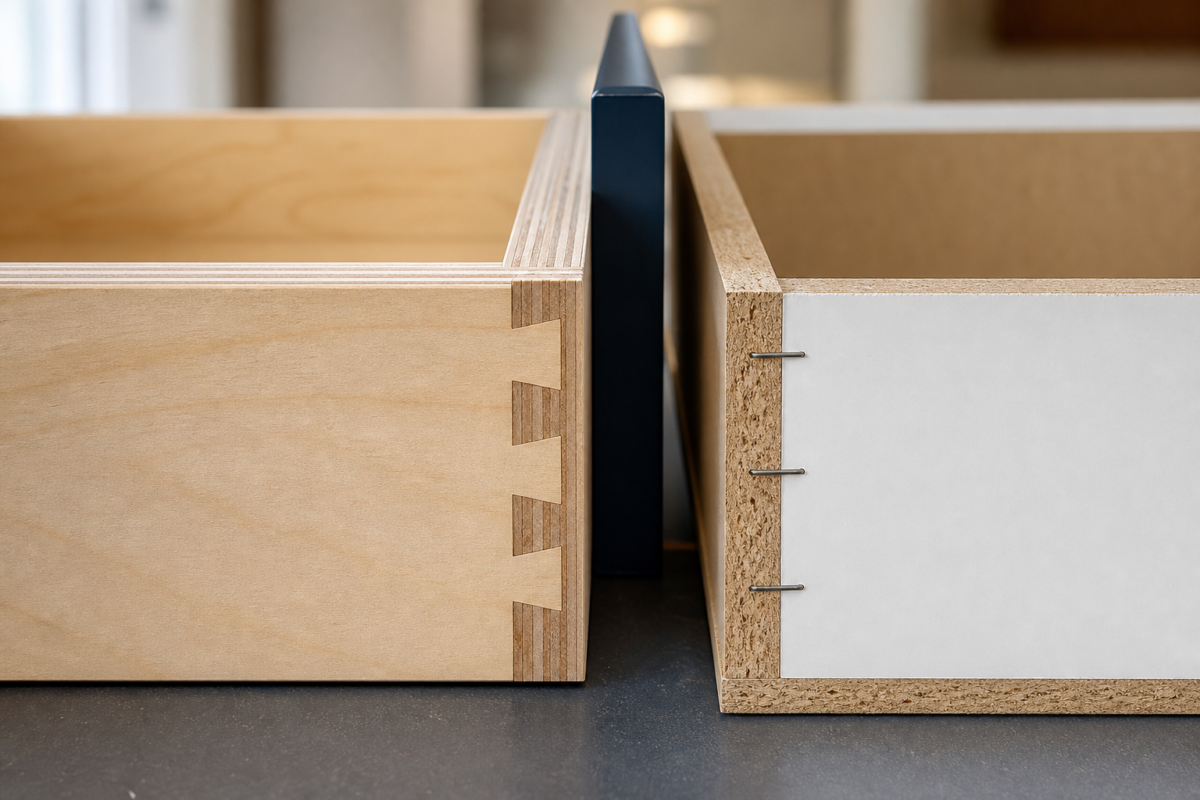
Solid wood is the material everyone assumes they want, but it is rarely right for the entire cabinet. Real hardwood expands and contracts with humidity, and a large panel will cup, crack, or split as the seasons change. That movement is why you almost never see a solid wood cabinet box or flat door panel in a well-engineered kitchen.
Doors, face frames, and dovetail drawer boxes
Solid wood shines in the parts designed to handle movement: face frames, the rails and stiles of a five-piece door, and drawer boxes. A quality drawer box is solid maple or birch with dovetail joints, which outlast stapled corners by decades. If you love a stained look, solid wood door frames with a veneer-core plywood center panel give you real grain that moves as a unit without splitting.
The cost and movement reality
Solid wood is the most expensive material and the most demanding to keep stable, so it lives at the semi-custom and custom end. Paying for solid wood everywhere usually buys a problem, not a feature. Spend it on the drawer boxes and door frames you touch daily, and let engineered panels do the flat, structural work.
Thermofoil, Melamine, and Laminate Finishes
Not every smooth painted-looking door is actually painted. Several popular finishes are wraps or laminates bonded to an engineered core, and the difference affects durability and repair.
How thermofoil doors are made
Thermofoil is a vinyl or PVC film heat-pressed and vacuum-formed over a shaped MDF door. It gives a seamless, easy-to-clean surface for less than a painted door and resists everyday moisture. Its weakness is heat: near an oven, self-cleaning range, or unvented dishwasher it can peel at the edges, and unlike paint it cannot be touched up. Smart value in low-heat zones, a risk right beside heat sources.
Laminate and melamine surfaces
High-pressure laminate and melamine are both applied over particleboard or MDF. Melamine is thinner and common on interiors and budget doors; high-pressure laminate is thicker, tougher, and used for durable modern slab fronts. Both resist scratches and stains well, but chipped edges cannot be repaired invisibly. For contemporary flat-front kitchens, a quality laminate slab is a durable, affordable alternative to painted MDF.
Moisture and Humidity Performance
Kitchens are wet rooms. Steam, spills, a dripping supply line, and a slow dishwasher leak all test your cabinet materials, and this category has the widest spread between them. If your kitchen runs humid, weight this factor heavily.
How each material handles water
Plywood swells if it stays wet, but the swelling is largely reversible: the veneers spring back as it dries. Particleboard and standard MDF both swell permanently once saturated because their compressed fibers cannot recompress, and MDF wicks water through any unsealed edge fast. This is the strongest argument for plywood boxes in base cabinets and near plumbing.
Contractor’s take
Whatever box you choose, seal the sink base and put a leak tray or puck alarm under the plumbing. Most destroyed cabinets I replace failed at one spot: the sink base, after a slow leak no one caught for a week.
Screw Holding, Hinges, and Shelf Sag
A cabinet is only as good as its ability to hold the hardware that makes it work. Hinges, drawer slides, and wall-mount screws all depend on the material gripping a fastener through years of daily use.
Why plywood keeps hinges tight
Plywood has the best edge screw retention because a screw threads through multiple cross-grain layers that resist pulling out. That is why hinges hold and doors stay aligned long after budget boxes sag at the top screw. MDF has the weakest edge screw holding, with particleboard close behind; both benefit from confirmat screws that spread the load. Shelf sag follows the same logic: a 3/4-inch plywood shelf beats a 1/2-inch particleboard shelf at any meaningful width.
A quick material inspection checklist
Use this list when you are standing in a showroom or opening a sample cabinet at home. It cuts through the marketing fast:
- Confirm the box is 3/4-inch veneer-core plywood, not an MDF core wrapped in wood veneer.
- Check shelves; 3/4-inch shelves under 32 inches wide resist sag best.
- Open a door hard a few times and watch the top hinge screw for wobble.
- Pull a drawer fully out; look for a solid wood dovetail box, not stapled particleboard.
- Feel the cabinet back; thin 1/8-inch panels flex and signal a budget build.
- Ask whether the sink base is plywood and whether MR MDF is used in wet zones.
2026 Costs and the Material Comparison
Material is the biggest lever on cabinet price after size and layout. In 2026, budget particleboard or MDF boxes with a melamine coating run roughly $70 to $150 per linear foot, while premium Grade-A plywood pushes the same cabinet to about $150 to $300 per linear foot and up. Across a typical 20-linear-foot kitchen, upgrading to plywood boxes often adds a few thousand dollars, meaningful but modest against a full remodel.
The at-a-glance comparison
| Material | Relative cost | Durability | Moisture | Weight (3/4 in.) | Best use |
|---|---|---|---|---|---|
| Plywood | $$$ (highest) | 20-30 yrs | Best, recovers | 2.1-2.3 lb/sq ft | Boxes, shelves, sink base |
| MDF | $$ (mid) | 15-20 yrs | Poor, seals well | ~3.0 lb/sq ft | Painted doors and fronts |
| Particleboard | $ (lowest) | 10-15 yrs | Weakest | 2.8-3.0 lb/sq ft | Budget boxes, interiors |
| Solid wood | $$$$ (premium) | 30+ yrs | Moves with humidity | Varies by species | Face frames, drawer boxes |
Remember these are material costs, not the installed price; hardware, finish, and installation stack on top. For the full picture, compare our kitchen remodel cost breakdown and think about where to splurge versus save so your money lasts.
Formaldehyde, CARB2, and How Materials Map to Cabinet Lines
Two things separate a smart buyer from an average one: understanding what the materials off-gas, and knowing which materials appear at which price tier.
CARB2 and off-gassing
Engineered panels are bonded with resins, and some older or cheaper particleboard and MDF use urea-formaldehyde resin that can off-gas formaldehyde into your home. Look for CARB2 compliance, now folded into the federal TSCA Title VI rule, which caps emissions. Reputable makers state it right on the spec sheet, and no-added-formaldehyde options exist if air quality is a priority. If a quote is silent, ask.
Stock, semi-custom, and custom
Material maps neatly onto cabinet lines. Stock and ready-to-assemble cabinets ($100 to $400 per linear foot) usually mean particleboard or MDF boxes with melamine interiors and thermofoil or laminate doors. Semi-custom ($200 to $800) upgrades to plywood box options, MDF or solid wood doors, and dovetail drawer boxes. Full custom ($500 to $1,200 and up) gives plywood everywhere and any combination you specify. To decide which tier fits, read our comparison of stock vs. custom cabinets and the broader complete kitchen remodeling guide before you commit.
Contractor’s take
My rule of thumb: buy the best box you can afford and stay flexible on the door. You can reface a door in ten years cheaply, but you cannot reface a box that has swelled or lost its screws without tearing the kitchen out.
Frequently Asked Questions
Your next move
You know the number. What are you deciding next?
Everything you need to plan a kitchen remodel in 2026 - budget, layout, cabinets, countertops, appliances, timeline, hiring,…
Continue →A kitchen remodel costs $18,000 to $120,000 in 2026, with a national average near $42,000. Here's the full…
Continue →Kitchen cabinets cost $80-$800 per linear foot installed in 2026. Here's what stock, semi-custom, and custom really cost,…
Continue →Frequently asked
Are plywood cabinets really worth the extra cost?
For the box, shelves, and especially the sink base, yes. Plywood holds screws better, sags less, and recovers from moisture instead of crumbling, typically 20 to 30 years of service versus 10 to 15 for particleboard.
Is MDF better than plywood for cabinet doors?
For painted doors, usually yes. MDF has no grain to telegraph through paint and does not move with humidity, so painted MDF doors stay crisp. Plywood or solid wood win where you want visible grain under a stain.
What is the difference between particleboard and furniture board?
They are essentially the same core. Furniture board is particleboard wrapped in a durable melamine laminate for a smooth, wipeable surface. The underlying strength and moisture limits are identical.
Which cabinet material handles moisture best under the sink?
Plywood, clearly. It swells only temporarily and recovers as it dries, while particleboard and standard MDF swell permanently when saturated. Insist on plywood for the sink base and add a leak alarm.
Should I worry about formaldehyde in cabinets?
It is worth checking. Some engineered panels use urea-formaldehyde resin that can off-gas. Look for CARB2 or TSCA Title VI compliance on the spec sheet, and ask about no-added-formaldehyde options if air quality is a concern.

Based on 2026 US cabinet manufacturer spec sheets, industry pricing guides, and ANSI/CARB2 material standards.