Kitchen Flooring Cost in 2026: Price by Material
Kitchen floors take more abuse than any in the house, and the cost swings widely by material. Here's what new kitchen flooring costs per square foot installed in 2026, what a whole kitchen runs, and how to keep the number down.

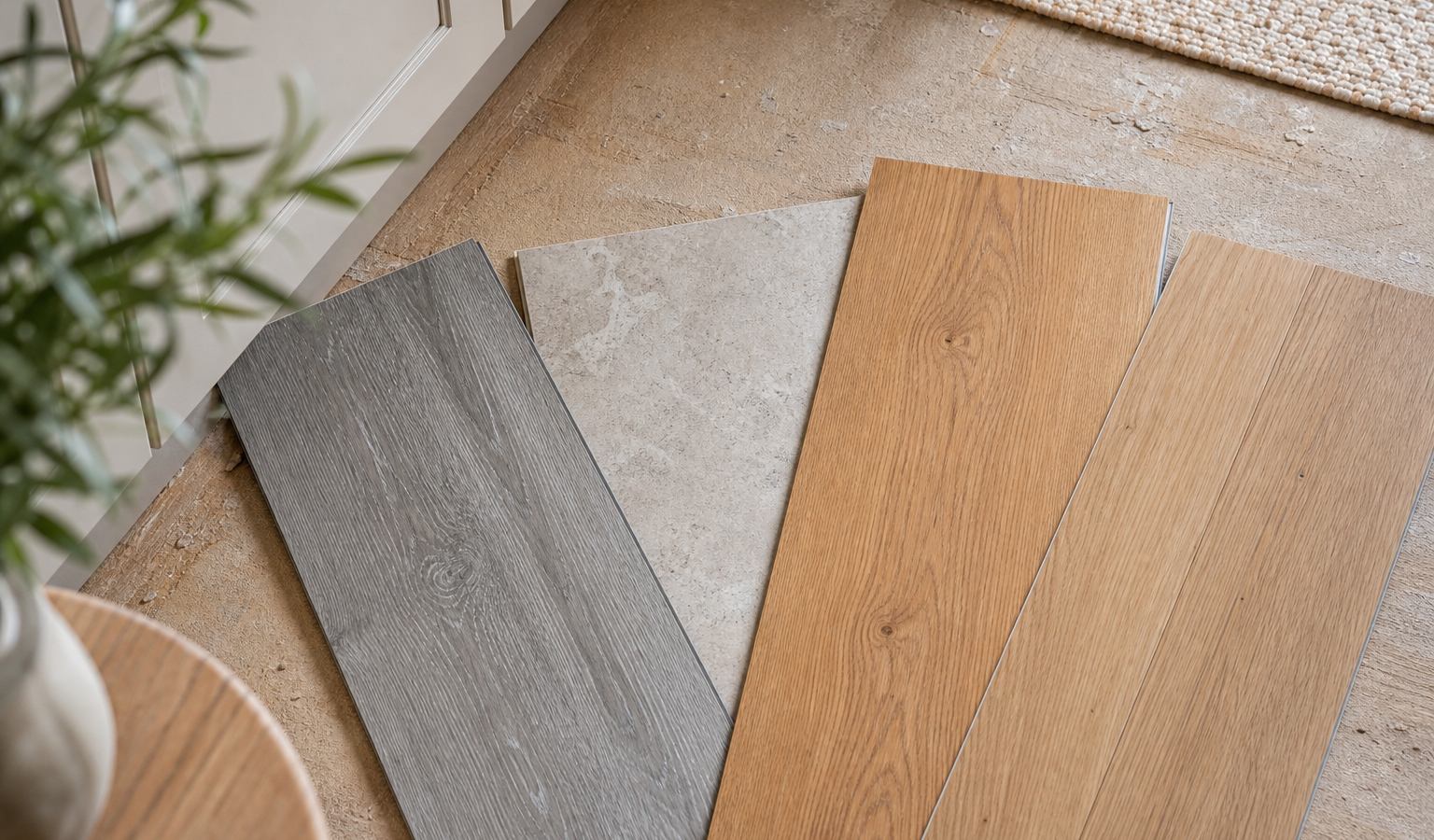
New flooring is one of the highest-impact changes you can make in a kitchen, and the kitchen flooring cost depends almost entirely on the material you pick and the size of your floor. In 2026, a typical kitchen floor runs between $800 and $5,000 installed, or roughly $4 to $50 per square foot, depending on whether you choose budget vinyl or premium tile or stone. This guide breaks the number apart: installed price by material with material and labor split out, what subfloor prep, tear-out, and underlayment add on top, how install method changes the bill, and how much a DIY install actually saves. For help picking which material fits your household, see the best kitchen flooring guide; this one is about pricing it out.
Kitchen flooring cost per square foot in 2026
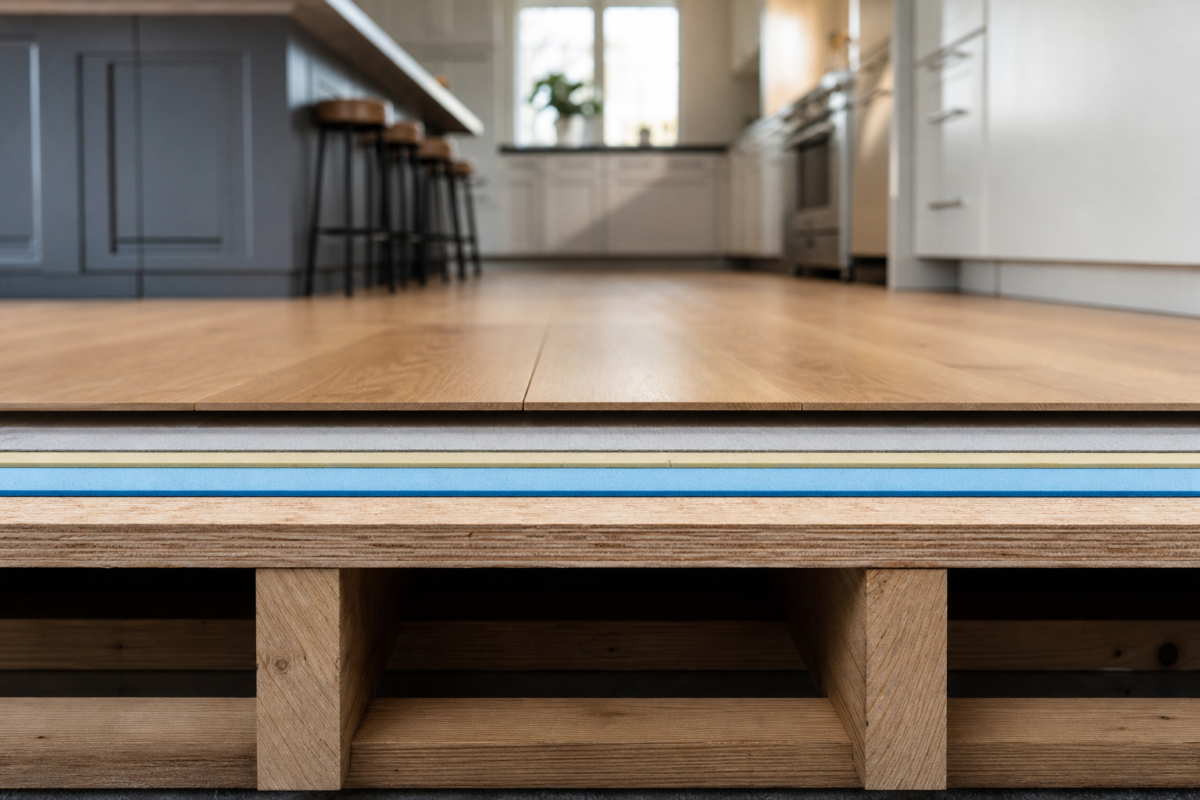
Flooring is quoted per square foot installed, which bundles two separate numbers: the material itself and the labor to fit it. Splitting them out shows why some cheap materials still carry a big labor bill, and why others are worth doing yourself.
| Material | Material cost / sq ft | Labor cost / sq ft | Installed total / sq ft |
|---|---|---|---|
| Sheet vinyl | $1-$3 | $2-$4 | $3-$7 |
| Laminate | $2-$5 | $2-$9 | $4-$14 |
| Luxury vinyl plank (LVP) | $2-$7 | $2-$9 | $4-$16 |
| Engineered hardwood | $3-$8 | $3-$10 | $6-$18 |
| Ceramic / porcelain tile | $3-$8 | $7-$22 | $10-$30 |
| Solid hardwood | $5-$12 | $6-$13 | $11-$25 |
| Natural stone (granite, slate, travertine) | $5-$15 | $10-$35 | $15-$50 |
Notice that labor, not material, is what pushes tile and stone to the top of the range – both need a mortar bed, precise setting, and grout. LVP and laminate sit at the bottom of the labor column because they click together and float over most existing floors. A premium LVP and an entry-level engineered hardwood can land at the same installed price, so the real decision is usually water resistance and feel underfoot, not the number on the quote.
Kitchen flooring cost by size
Because flooring is priced per square foot, your kitchen’s actual floor area sets the base number before material even enters the picture. Measure the walkable floor – not the room’s full footprint, but the area not covered by cabinet boxes or the island base – since that’s what actually gets material and labor. Most kitchens run 100 to 200 square feet once cabinets are subtracted; a small kitchen can be well under 100. Here’s what three common sizes cost, installed, across the most popular materials:
| Floor area | LVP | Laminate | Tile | Hardwood |
|---|---|---|---|---|
| 100 sq ft | $400-$1,600 | $400-$1,400 | $1,000-$3,000 | $1,100-$2,500 |
| 160 sq ft (typical) | $640-$2,560 | $640-$2,240 | $1,600-$4,800 | $1,760-$4,000 |
| 200 sq ft | $800-$3,200 | $800-$2,800 | $2,000-$6,000 | $2,200-$5,000 |
For most homeowners, a mid-market 160-square-foot kitchen floor lands around $1,500-$3,000 installed. Flooring typically makes up 7-10% of a full kitchen remodel budget – see how it stacks against cabinets and counters in the complete kitchen remodel cost guide.
Contractor’s take
“The line people forget is the subfloor. If the floor under the old material is uneven, rotted around the dishwasher, or has to be built up to match the next room, that prep gets billed on top of the flooring line – and on an older home it’s where the surprise cost hides. Always ask your installer to inspect the subfloor before they quote a firm number, not after demo starts.” – Marcus Hale, licensed GC
Cost by material: what you’re paying for
Luxury vinyl plank – $4-$16 / sq ft
The value champion and the most-installed kitchen floor today. LVP is fully waterproof, warm and soft underfoot, and often floats right over the existing floor, which keeps labor down. It’s also the most DIY-friendly option here. The trade-off: deep gouges can’t be sanded out – you replace the plank.
Tile and natural stone – $10-$50 / sq ft
Porcelain and ceramic tile are the toughest, most water- and heat-proof kitchen floors, and they last for decades; expect $10-$30 per square foot installed. Natural stone – granite, slate, or travertine – runs $15-$50 because the material itself costs more, it’s heavier to handle, harder to cut, and most stone needs periodic sealing to resist staining. Both are labor-intensive to install, and larger-format tiles or intricate patterns push the labor line higher still.
Hardwood and engineered hardwood – $6-$25 / sq ft
Solid hardwood is the warmest underfoot and the best for resale, and it can be refinished for decades – but standing water is its enemy, so it suits homeowners who wipe up spills promptly. Engineered hardwood gives a similar real-wood look with better moisture stability, often at a lower installed cost since the veneer construction needs less finishing labor.
Laminate and sheet vinyl – $3-$14 / sq ft
The budget tier. Modern laminate mimics wood convincingly and installs fast, though it’s not fully waterproof at the seams. Sheet vinyl is the cheapest floor you can buy and is completely waterproof – the practical pick for a rental or a quick refresh before resale.
Waterproof vs. water-resistant: what a kitchen floor needs
A kitchen is a wet room in disguise – dishwasher leaks, spills, and mopping are constant – which makes water resistance the property most worth paying for after budget. Sheet vinyl, LVP, and porcelain tile are fully waterproof. Laminate is water-resistant at best: fine for splashes, but standing water can swell the seams and void the warranty. Solid hardwood is the most vulnerable of the group and asks for prompt cleanup. If your household is hard on floors, a waterproof material now beats replacing a swollen laminate floor later.
Subfloor prep, tear-out, and underlayment costs
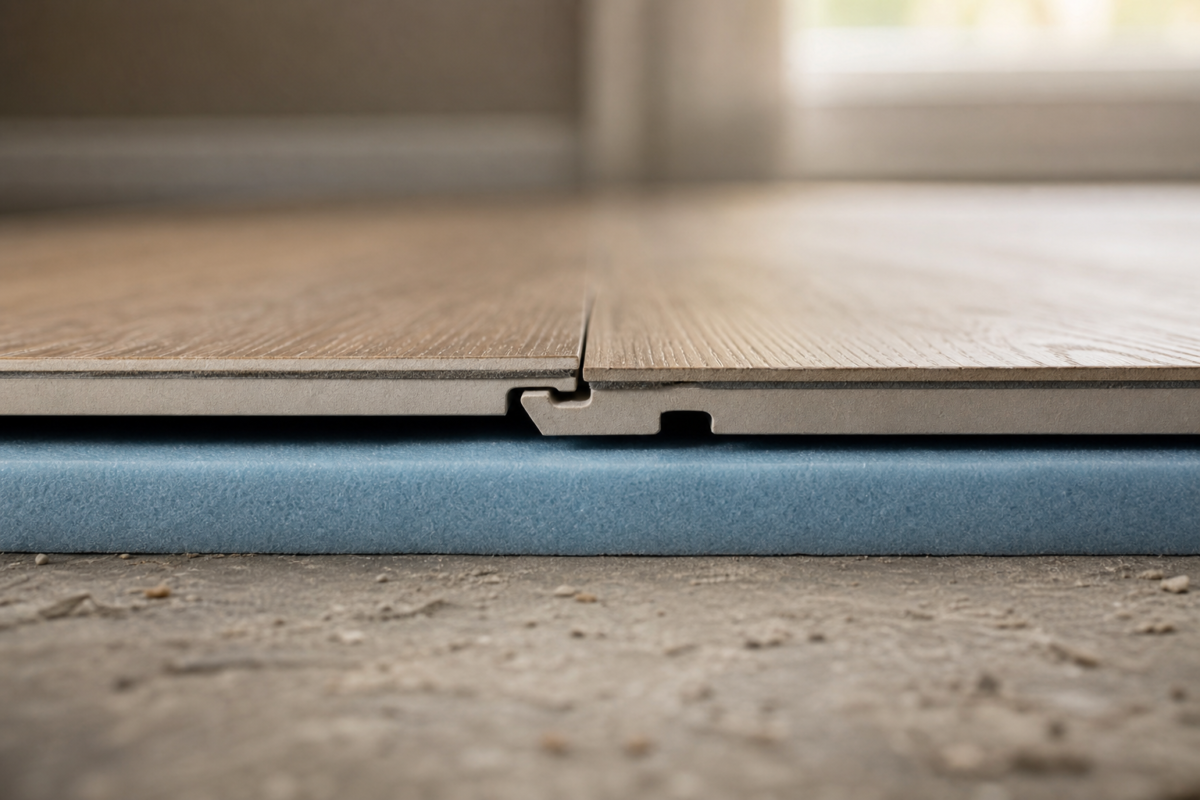
The material price on the box is never the whole story. Three add-on costs show up on almost every kitchen flooring quote, and together they can add 10-30% to the job.
Subfloor leveling and repair
Self-leveling underlayment compound runs $2-$5 per square foot installed, or about $50-$100 per 50-pound bag that covers roughly 40-50 square feet at a 1/8-inch pour. If a section of plywood subfloor is water-damaged or delaminating – common around the sink and dishwasher – patching it costs $2-$8 per square foot, and a full plywood subfloor replacement for a 160-square-foot kitchen runs $700-$2,000. Tile and stone are the least forgiving of an uneven subfloor, so budget for leveling first if you’re going that route.
Removing and disposing of the old floor
Tear-out is priced separately from installation. Pulling up vinyl, laminate, or LVP runs $1-$4 per square foot, since it’s largely fastener-free. Tile and stone removal costs $3-$7 per square foot because the material is bonded to the subfloor and often has to be chipped out, damaging the plywood underneath. For a 160-square-foot kitchen, that’s roughly $160-$640 to remove resilient flooring versus $480-$1,120 for tile, plus a $75-$400 disposal or dumpster fee.
Underlayment by floor type
Underlayment cushions and protects the new floor and is usually billed per square foot on top of the material: foam or felt underlayment for laminate and some LVP runs $0.50-$1.50 per square foot; a moisture or vapor barrier for vinyl or laminate over concrete adds $0.50-$1.50 per square foot; and cement backer board underneath tile or stone, required for a durable bond, costs $1.50-$3 per square foot installed. Some premium LVP products include an attached underlayment pad, which trims this line to zero.
Installation methods: floating, glue-down, nail-down, and mortar
How a floor attaches to the subfloor changes the labor bill and the timeline. Budget 2 to 5 days for a kitchen floor, tile and hardwood at the longer end for set and cure time; see the kitchen remodel timeline for how that fits around cabinets and counters.
Floating: LVP, laminate, click-lock engineered
Planks click together and rest on top of a foam or pad underlayment without glue or nails, which makes this the fastest, cheapest-to-install, and most DIY-friendly method here. A floating floor can often go directly over a sound existing floor, skipping tear-out entirely.
Glue-down: LVP tile, sheet vinyl, some engineered hardwood
Adhesive bonds the flooring directly to the subfloor, adding roughly $0.50-$1.50 per square foot in material for the glue itself. Glue-down is more stable underfoot and is typically required over radiant heat systems or on concrete slabs, but a clean glue-down job is harder to DIY than a floating one.
Nail-down or staple-down: solid hardwood
Boards are fastened through the tongue into a wood subfloor, which is the standard method for solid hardwood and some engineered planks. It requires a wood subfloor – not bare concrete without sleepers first – and is labor-intensive, which is part of why solid hardwood’s labor cost runs high.
Mortar and thin-set: tile and natural stone
Tile and stone are set into a troweled mortar bed over cement backer board, then grouted once the mortar cures. This is the slowest method – often 24 to 72 hours before foot traffic and longer before heavy use – and the least DIY-friendly, which is the main reason tile carries the highest labor cost of any kitchen floor.
What changes the flooring price
Two kitchens the same size can differ by thousands of dollars. Ranked by impact:
A few specifics worth flagging when you compare quotes: tile and stone carry the highest installation labor of any kitchen floor; LVP and laminate the lowest. An intricate tile pattern, a herringbone hardwood layout, or large-format tile that needs extra cutting and leveling all add labor hours without changing the material cost at all – so two quotes for the same tile can differ by 30% purely on layout.
DIY vs. pro: how much you can actually save
Because labor is roughly half of an installed LVP or laminate floor, a clean DIY install can save real money – but only on the materials built for it. On a 160-square-foot kitchen, skipping the labor line on either one saves roughly $320-$1,440. Tile, stone, and hardwood are a different calculation: a botched tile job can cost $10-$20 per square foot to rip out and redo, erasing any savings.
- DIY-friendly and worth trying: floating LVP or laminate over a flat, sound existing floor.
- DIY with caution: glue-down LVP tile, if the subfloor is already level and clean.
- Hire a pro: any tile or stone install, since a mortar bed and grout lines are unforgiving of small errors.
- Hire a pro: solid hardwood nail-down, which needs a flooring nailer and experience reading board movement.
- Always hire out subfloor leveling and structural repair, even if you plan to lay the finish floor yourself.
- Get at least three quotes – installed labor for the same material commonly varies 20-30% by contractor.
Durability and resale value
How long each kitchen floor lasts
Durability tracks closely with cost. Tile and stone lead by a wide margin – 50 years or more – and shrug off water and heat. Solid hardwood lasts 30-plus years and can be refinished several times over that span. LVP runs 15-25 years, engineered hardwood 20-30, and laminate 10-20. Sheet vinyl is the shortest-lived at around 10-15 years. If you’re staying in the home for decades, tile and hardwood spread their higher upfront cost over a much longer life, which narrows the real cost gap.
Does new flooring add resale value
Flooring is one of the first things buyers notice, and a fresh, cohesive floor helps a kitchen show and sell without a specific value tied to the material alone. Durable, neutral choices – LVP or tile in a warm, current tone – are a safe bet for resale, and continuing hardwood from an adjacent living space reads as high-end. See our breakdown of kitchen remodel ROI for how flooring compares to cabinets and counters as a value-add.
The bottom line
Budget $3-$7 per square foot for sheet vinyl, $4-$16 for luxury vinyl plank, $10-$30 for ceramic or porcelain tile, and $11-$25 for solid hardwood, installed. For a typical 160-square-foot kitchen, that’s $800 to $5,000, with mid-market LVP landing most homeowners near $1,500-$2,500 – and remember to add subfloor prep and tear-out if your quote doesn’t already include them. Once you have a target material and budget, price your whole project against the two other biggest lines, kitchen cabinet cost and kitchen countertop cost, to see where flooring fits in the overall remodel.
Your next move
You know the number. What are you deciding next?
Luxury vinyl, tile, or hardwood? The three most-chosen kitchen floors compared on 2026 cost, water resistance, comfort, and…
Continue →Quartz vs. granite: the two most-chosen kitchen countertops compared on 2026 cost, durability, maintenance, heat, and looks -…
Continue →A kitchen backsplash costs $500 to $1,700 installed in 2026, about $10-$50 per square foot. See the price…
Continue →Frequently asked
How much does kitchen flooring cost in 2026?
For a typical 160-square-foot kitchen, installed flooring runs $800 to $5,000. Per square foot, that’s about $3-$7 for sheet vinyl, $4-$16 for luxury vinyl plank, $10-$30 for ceramic or porcelain tile, and $11-$25 for solid hardwood. Natural stone and intricate patterns can push tile as high as $50 per square foot.
What is the cheapest kitchen flooring?
Sheet vinyl, at $3-$7 per square foot installed, followed by laminate and luxury vinyl plank. LVP is usually the better value overall because it’s fully waterproof and warm underfoot for only a little more than laminate, and it’s cheap to install yourself since it floats over most existing floors.
How much does it cost to remove old kitchen flooring?
Tearing out vinyl, laminate, or LVP runs $1-$4 per square foot since there’s little bonding to fight. Tile or stone removal costs $3-$7 per square foot because it’s set in mortar and often damages the subfloor underneath on the way out. Add a $75-$400 disposal or dumpster fee depending on the volume of debris.
Why is tile flooring so expensive to install?
Tile is labor-intensive – it needs cement backer board, a troweled mortar bed, precise setting, and grouting, plus cure time before it can take traffic. That labor, not the tile itself, is why installed tile runs $10-$30 per square foot for ceramic and porcelain, and up to $50 for natural stone.
How much can I save installing kitchen flooring myself?
On a 160-square-foot kitchen, DIY-installing floating LVP or laminate typically saves $320-$1,440 by cutting out the labor line, since labor is roughly half the installed cost of those materials. Tile, stone, and nailed hardwood rarely save money as a DIY project once you account for tool rental and the risk of a redo, so most homeowners still hire those out.

Installed per-square-foot ranges are 2026 national figures (material plus labor) compiled from flooring cost data. Subfloor prep, tile size, and your metro will move the final number.