Kitchen Range Hoods and Ventilation: 2026 CFM, Types, and Costs
Ventilation is the appliance most often sized wrong. Here is how to pick the right CFM, duct, and hood type the first time.

RenHive may earn a commission when you buy through links on this page. It never affects which products we recommend or how we rank them, and we do not accept product samples. How we review →
A kitchen range hood is the most under-appreciated appliance in an American kitchen, and the one most often sized wrong. Good kitchen ventilation pulls grease, smoke, steam, and combustion byproducts out of the room before they coat your cabinets and settle in your lungs. Skip it, or buy an underpowered unit, and every sear, stir-fry, and simmer leaves a thin film on your countertops and a lingering smell in the house. This guide walks through how range hoods work, how to size CFM correctly, ducted versus ductless, duct routing, code-required makeup air, and real 2026 US prices so you buy once and buy right.
Ventilation is not just about comfort. Gas cooking releases nitrogen dioxide and fine particulates, and a properly ducted hood is the single best way to move that air outside. Even on an induction or electric cooktop, boiling, frying, and roasting throw moisture and grease into the air. The goal is capture and exhaust: trap the plume at the source and send it out of the building, not recirculate it back into the room.
How a Range Hood Actually Works
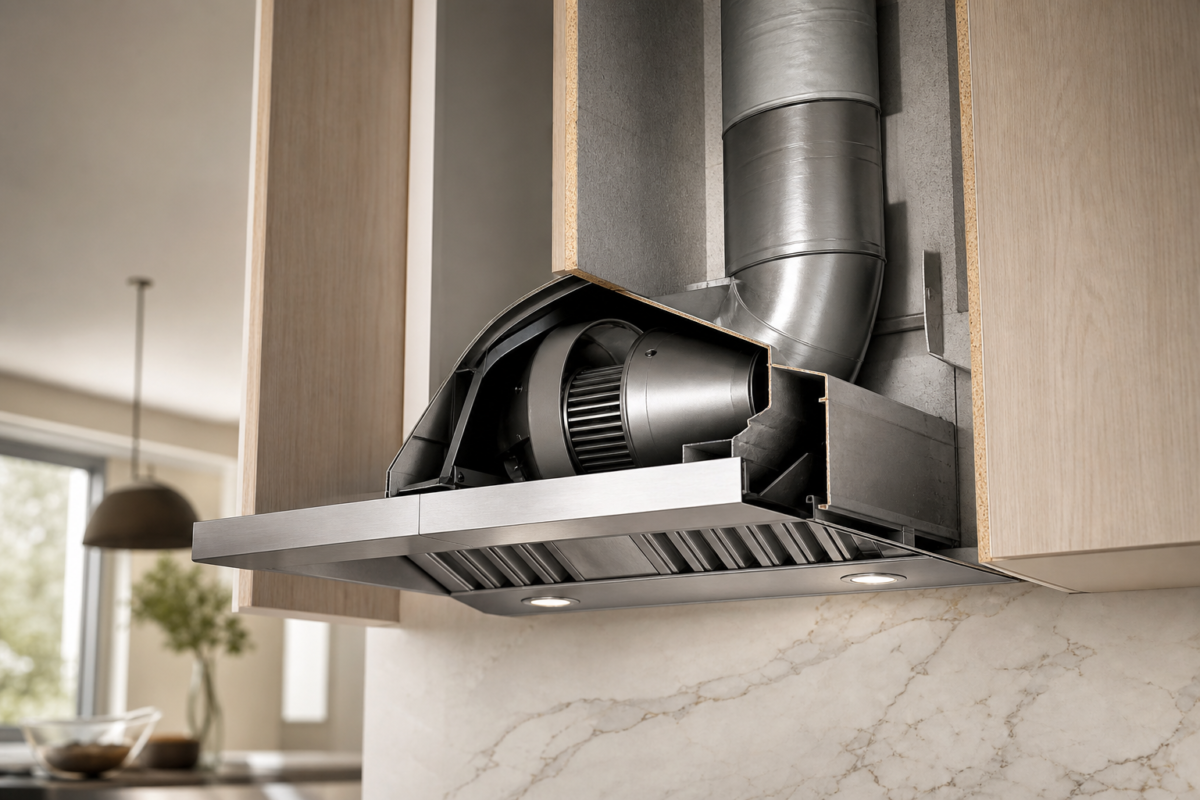
Every hood does three jobs: capture the rising plume, filter grease out of the airstream, and move the air through a blower to an exhaust point. The capture area is the underside of the hood; a wider, deeper canopy catches more of the plume, which is why chimney and island hoods outperform a shallow microwave vent. Air then passes through filters, gets pulled by a blower rated in cubic feet per minute (CFM), and is pushed either through a duct to the outside or, in a ductless setup, back into the kitchen through a charcoal filter.
Blower, filters, and capture explained
The blower is the engine. Its CFM rating tells you how much air it can move, but real-world performance drops as the air fights duct length, elbows, and filter resistance. Baffle filters, made of interlocking stainless steel channels, spin grease out of the air and are dishwasher safe; they outlast the mesh aluminum filters found on cheap hoods. Capture efficiency also depends on how far the hood extends over the front burners, where most cooking happens, so depth matters as much as width.
Range Hood Types and Which One Fits Your Kitchen
The right format depends on where your cooktop sits and how the space is styled. Each type carries a different price, capture performance, and installation demand.
Under-cabinet and over-the-range microwave hoods
An under-cabinet hood mounts beneath a wall cabinet above the range and is the most common choice in the US. It is affordable and effective when ducted. The over-the-range (OTR) microwave combines a microwave and a vent, which saves space but delivers the weakest ventilation of any option; most OTR units top out around 300 to 400 CFM and often vent through a poor duct path or recirculate.
Wall-mount chimney, island, and downdraft
A wall-mount chimney hood is a freestanding canopy with an exposed stack, popular in open-concept kitchens and often the design centerpiece. An island hood hangs from the ceiling over an island cooktop and needs more CFM because it has no walls to help contain the plume. A downdraft rises from behind or beside the cooktop and pulls air down and out; it preserves sightlines but struggles with tall pots and high-BTU burners. If you are planning an island cooktop, coordinate the hood early with your kitchen work triangle so ducting and clearances are settled before cabinets are ordered.
Inserts, liners, and pro-style hoods
A hood insert (also called a liner or power pack) is the blower and filter assembly you build into a custom wood or plaster hood enclosure for a seamless, high-end look. Pro-style or commercial-style hoods pair with high-BTU ranges and move the most air, but they demand serious ducting and almost always trigger makeup air requirements. Match hood power to how you actually cook, and factor it into your broader kitchen appliance plan.
How Much CFM Do You Need? Range Hood Sizing Rules
Sizing is where most buyers go wrong, in both directions: too little air and the hood cannot keep up, too much and you waste money, add noise, and depressurize the house. Use these proven rules of thumb, then round to the nearest available blower size.
Electric and induction cooktop sizing
For an electric or induction cooktop, use roughly 100 CFM per linear foot of cooktop width. A standard 30-inch (2.5-foot) cooktop needs about 250 CFM at minimum, and 300 to 400 CFM is a comfortable target. Induction produces less ambient heat than gas, so you can size at the lower end and still clear steam and grease effectively. If you are weighing burners, our guide to induction vs gas cooktops covers how each affects ventilation load.
Gas cooktop sizing by BTU
Gas needs more air because it produces combustion byproducts and far more heat. The standard formula is 1 CFM for every 100 BTU of total burner output, or 100 CFM per 10,000 BTU. Add up the BTU rating of every burner: a range with burners totaling 60,000 BTU calls for roughly 600 CFM. High-output pro ranges reaching 90,000 to 120,000 BTU push you into the 900 to 1,200 CFM range, which is exactly where makeup air rules kick in.
| Range hood type | Typical CFM | Unit price (2026) | Best for |
|---|---|---|---|
| OTR microwave | 200-400 | $250-$800 | Tight budgets, small kitchens |
| Under-cabinet | 200-600 | $150-$1,200 | Standard wall cooktops |
| Wall-mount chimney | 400-900 | $400-$2,000 | Open-concept focal point |
| Island hood | 600-1,200 | $600-$3,000 | Island cooktops |
| Insert / liner | 500-1,200 | $300-$1,500 | Custom hood enclosures |
| Downdraft | 300-600 | $800-$2,500 | Preserving sightlines |
| Pro-style | 900-1,500 | $1,000-$5,000+ | High-BTU pro ranges |
Ducted vs Ductless Range Hoods
This is the biggest performance decision you will make. A ducted (vented) hood pushes air through a duct to the outdoors, removing heat, moisture, grease, and odors completely. A ductless (recirculating) hood pulls air through a charcoal filter and blows it back into the kitchen; it captures some grease and odor but does nothing for heat or humidity and loses effectiveness as the filter loads up.
When ductless makes sense
Choose ducted whenever it is physically possible; it is the only option that truly ventilates. Ductless is a fallback for apartments, interior cooktops, or high-rise units where running a duct outside is impossible. If you go ductless, plan to replace the charcoal filters every three to six months at $20 to $60 a set, and set your expectations accordingly. A ductless hood cleans some air, it does not clear the room.
Duct Sizing and Routing for Quiet, Effective Airflow
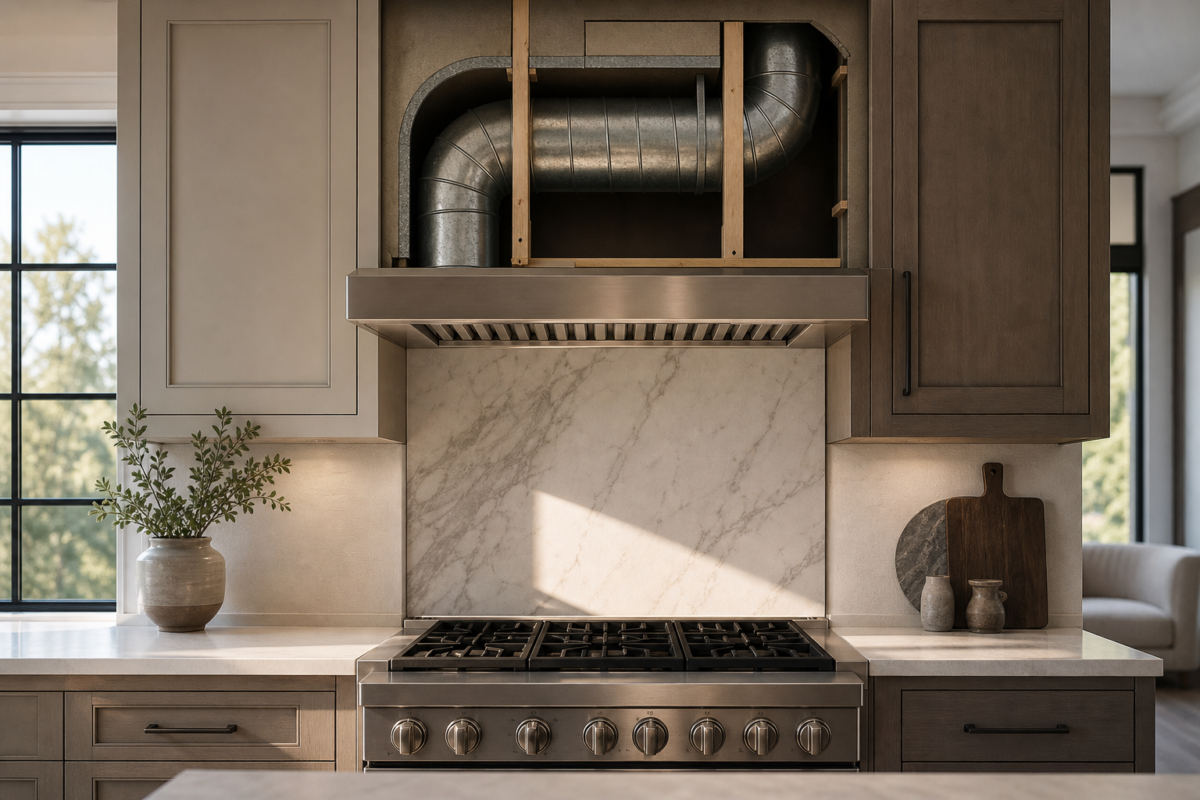
A powerful blower choked by an undersized or twisted duct performs like a weak one. Duct diameter should match the blower: use 6-inch round duct for up to about 600 CFM, 8-inch for 600 to 900 CFM, and 10-inch for 900 CFM and above. Larger ducts move the same air at lower velocity, which cuts noise dramatically.
Keep the run short and smooth
Use rigid smooth-wall metal duct, never flexible foil, which is loud and traps grease. Keep the run as short and straight as possible and minimize elbows; every 90-degree turn adds resistance equivalent to several feet of straight duct. Vent through the roof or an exterior wall with a proper backdraft damper and, in cold climates, an insulated cap. Coordinating the duct path during framing is far cheaper than retrofitting it later, so fold it into your overall kitchen remodeling plan.
Makeup Air and Code Requirements
Powerful hoods create a real building-science problem. When a hood exhausts more air than naturally leaks back in, it depressurizes the house, which can pull dangerous combustion gases back down a furnace or water-heater flue. To prevent this, the International Residential Code (IRC M1503.4) requires a makeup air system for any hood rated over 400 CFM. Some states, including California, apply stricter ventilation standards.
Budgeting for makeup air
A makeup air kit brings tempered outside air back into the home when the hood runs, and it typically adds $500 to $3,000 depending on whether the incoming air is heated. This is a common reason buyers deliberately size a hood at 390 CFM to stay under the threshold, but if you have a high-BTU gas range you need the airflow and the makeup air both. Have your installer confirm local code before you buy.
Contractor’s take
Size the hood at least as wide as the cooktop, and ideally 3 inches wider on each side. I see homeowners buy a 30-inch hood for a 36-inch range to save a little money, then wonder why the front burners still smoke up the room. The hood cannot capture a plume it does not cover. Buy the wider canopy and a slightly larger duct, and you will run the blower on a lower, quieter speed while capturing more.
Sizing Hood Width and Mounting Height
Width and installation height decide capture as much as CFM does. The hood should be at least as wide as the cooktop; a 3-inch overhang per side is the professional standard, and it matters most for island hoods that have no walls to help. Mounting height is set by the manufacturer, but the working ranges are 24 to 30 inches above an electric or induction cooktop and 24 to 36 inches above gas. Island hoods usually mount 28 to 36 inches above the surface. Too high and capture collapses; too low and it becomes a head-knocking hazard.
Noise, Filters, and Features Worth Paying For
Noise is measured in sones, and it is the number that decides whether you actually turn the hood on. A quiet hood runs 1 to 3 sones on low and 4 to 7 sones on high; anything higher gets left off, defeating the purpose. Remote or inline blowers, mounted in the duct run or on the roof, move the motor away from the kitchen and are the quietest solution for high-CFM setups.
Filters, lighting, and controls
Insist on stainless baffle filters over mesh; they capture grease better and clean up in the dishwasher. Good LED task lighting under the hood is a genuine daily benefit, and it pairs well with your backsplash and countertop lighting. Useful extras include variable speed, a delay-off timer that clears lingering steam after you finish, heat sensors that ramp the fan automatically, and dishwasher-safe components. Skip gimmicks like app control unless you truly want them.
- Confirm your cooktop fuel and total BTU to calculate required CFM
- Buy a hood at least as wide as the cooktop, ideally 3 inches wider per side
- Choose ducted over ductless whenever an exterior vent path exists
- Match duct diameter to blower CFM and use rigid smooth metal duct
- Plan makeup air if the hood exceeds 400 CFM
- Check sone rating and mounting height before you order
Range Hood Costs in 2026
The unit itself is only part of the bill. In 2026, a basic under-cabinet or OTR hood runs $150 to $800, a wall-mount chimney hood $400 to $2,000, an island hood $600 to $3,000, and a pro-style hood $1,000 to $5,000 or more. Installation labor typically adds $200 to $600 for a straightforward swap that reuses existing ducting, and $500 to $1,500 when a new duct must be cut through a wall or roof. A makeup air system adds another $500 to $3,000 where required.
Total installed budget
Plan on $400 to $1,500 all-in for a standard ducted under-cabinet or chimney hood, and $2,000 to $6,000 for an island or pro-style setup with new ducting and makeup air. Ventilation is a modest slice of a full renovation but a high-impact one; see how it fits the bigger picture in our kitchen remodel cost breakdown and the detailed kitchen appliance cost guide.
Installation: DIY vs Professional
Swapping a like-for-like hood that reuses existing ductwork and wiring is a confident DIYer weekend job. Anything involving new ducting through a wall or roof, new electrical, gas-range clearances, or makeup air belongs with a pro; mistakes here cause backdrafting, leaks, and grease-fire risk. A straightforward professional install takes a few hours; a new duct run through finished space can take a day or more and may need a permit. Where hood work sits in your overall schedule depends on how the rest of the job is sequenced, so confirm it with your contractor early.
Frequently asked questions
Your next move
You know the number. What are you deciding next?
Everything you need to plan a kitchen remodel in 2026 - budget, layout, cabinets, countertops, appliances, timeline, hiring,…
Continue →A kitchen remodel costs $18,000 to $120,000 in 2026, with a national average near $42,000. Here's the full…
Continue →Kitchen cabinets cost $80-$800 per linear foot installed in 2026. Here's what stock, semi-custom, and custom really cost,…
Continue →Frequently asked
How many CFM do I need for a 30-inch range hood?
For a 30-inch electric or induction cooktop, aim for 250 to 400 CFM using the rule of 100 CFM per linear foot. For a 30-inch gas range, add up the burner BTUs and use 1 CFM per 100 BTU, which usually lands between 400 and 600 CFM.
Are ductless range hoods worth it?
Only when ducting outside is impossible, such as in apartments or interior cooktops. Ductless hoods filter some grease and odor but do not remove heat or moisture, and they need charcoal filter replacements every three to six months. A ducted hood is always the better performer.
Does a range hood need makeup air?
Under the International Residential Code, any hood rated over 400 CFM requires a makeup air system to prevent depressurizing the home. Some states apply stricter rules. Always confirm local code with your installer before buying a high-CFM hood.
How high should a range hood be mounted?
Mount an under-cabinet hood 24 to 30 inches above an electric cooktop and 24 to 36 inches above gas. Island hoods usually sit 28 to 36 inches above the surface. Always follow the manufacturer specification, since too high kills capture and too low is a hazard.
Can I install a range hood myself?
A like-for-like swap that reuses existing ducting and wiring is a reasonable DIY project. Once new ductwork, electrical, gas clearances, or makeup air are involved, hire a professional. Poor installation causes backdrafting and grease-fire risk, so do not cut corners on venting.

CFM and duct guidance follow IRC M1503 and manufacturer specs; prices are 2026 US averages for units, labor, and ducting.